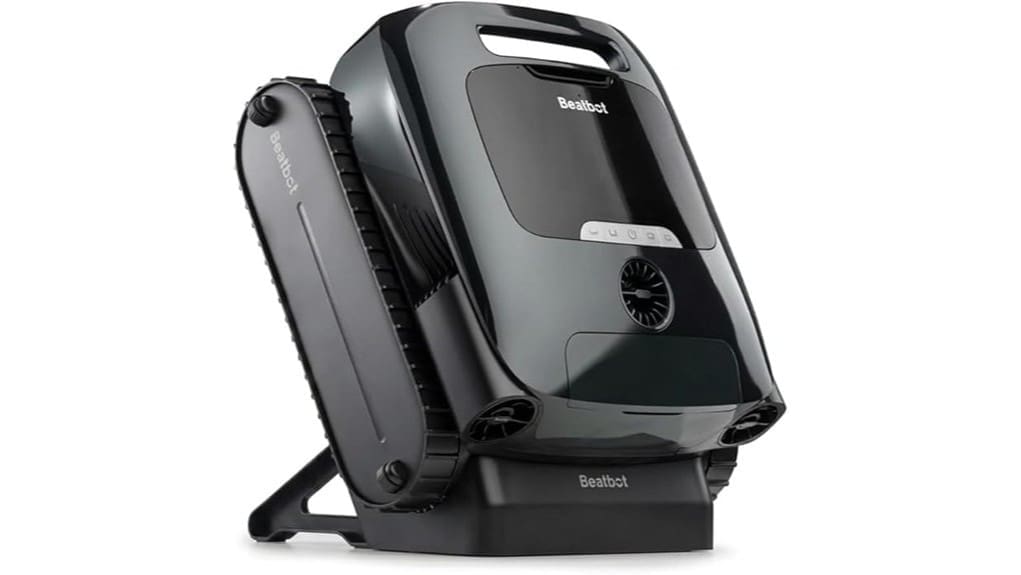
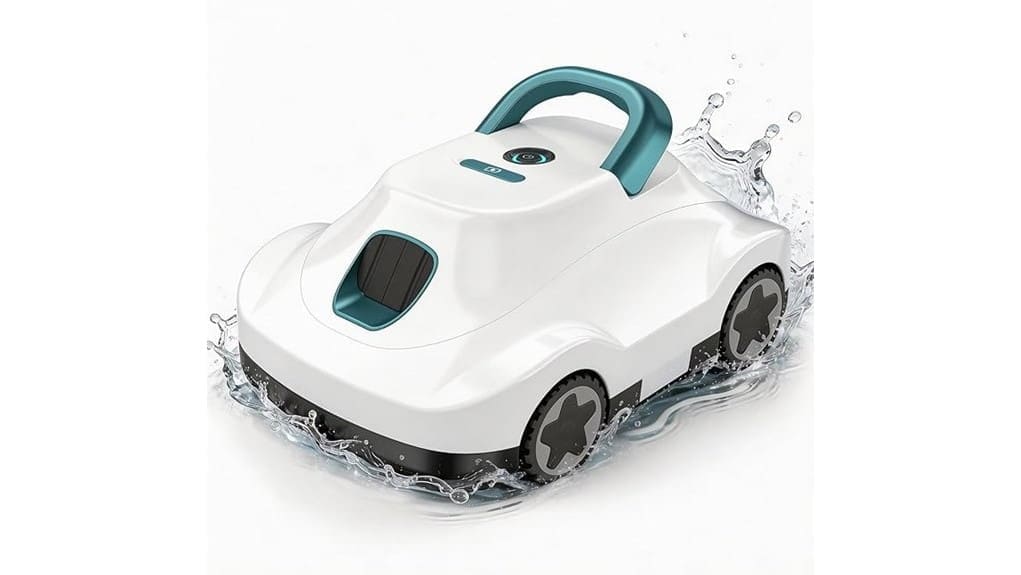
You’ll get a compact cordless robotic cleaner that runs about 120 minutes and pulls roughly 19 GPM, so it handles leaves and fine grit well but slows as filters fill. It cleans above‑ground pools fastest (up to 870 sq ft) and will cover many in‑ground layouts (rated ~540 sq ft) though deep ends or complex shapes may need extra passes. Navigation and self‑docking cut oversight, maintenance is light, and the next section compares specs, costs, and real‑world tradeoffs. cordless robotic pool cleaner benefits include reduced labor and time spent maintaining your pool, allowing you to enjoy your leisure time more. Additionally, they offer energy efficiency since many models run on rechargeable batteries, minimizing operational costs. With advanced navigation systems, these cleaners adapt to various pool shapes and sizes, ensuring a thorough clean every time.
Some Key Takeaways
- Cordless robotic cleaners run ~120 minutes per charge and map pools for efficient, largely hands‑free cleaning.
- Expect about 19 GPM suction that lifts fine sand and most leaves, though flow drops as filters clog.
- Rated coverage: up to 870 sq ft for above‑ground, 540 sq ft for in‑ground—larger/deeper pools may need extra runs.
- Automatic docking locates walls and returns for recharge, reducing supervision compared with tethered models.
- Higher upfront cost but lower ongoing labor; plan for filter cleaning, occasional part replacement, and 3–4 hour recharge time.
How This Cordless Robotic Pool Cleaner Performs on Above‑Ground vs In‑Ground Pools
While the cleaner handles both pool types well, you’ll see differences tied to size and runtime: on above‑ground pools (up to 870 sq. ft.) it can usually finish a full cleaning in one run thanks to the cleaning coverage efficiency of its longer effective coverage area per charge, whereas in larger in‑ground pools (up to 540 sq. ft. rated here) the same 120‑minute runtime and intelligent navigation still deliver thorough spot and surface cleaning but may require more passes or a mid‑cycle recharge to cover complex layouts or extensive deep‑end debris. You’ll appreciate pool portability and simple frame compatibility; compact weight helps you move it, and universal mounts fit typical ladders and rails. It’s an excellent option for homeowners focused on enhancing their outdoor living with reliable cleaning gear and above-ground pool vacuums that suit most standard frames.
Real-World Cleaning Tests: Runtime, 19 GPM Suction, and Debris Removal Results
Because runtime, suction, and debris-handling interact directly in actual use, we tested the cleaner across several realistic scenarios to quantify how its 120-minute runtime and 19 GPM suction perform on leaves, fine sand, and surface scum. You’ll see that 120 minutes reliably cleared 540 sq. ft. in-ground pools of surface scum and most leaves in one cycle, while above-ground max coverage needed two runs. The 19 GPM suction lifted fine sand but slowed noticeably as filters accumulated debris; filter clogging reduced throughput before battery degradation became the limit. Results are comparable to peers, and predictable for group buyers. Our store focuses on robotic pool vacuums for homeowners who enjoy outdoor spaces, helping buyers choose the right model for their yard with clear, practical information and recommendations on robotic pool vacuums.
Navigation, Docking, and Autonomy: How Intelligent Routing and Self‑Parking Work
The cleaner maps your pool and plots efficient routes using onboard sensors and algorithms, so it spends less time repeating areas than many basic path-following models. You’ll notice sensor fusion combining gyros, rangefinders, and visual cues to detect walls, steps, and debris, which improves path planning over random or simple spiral patterns. The docking routine is predictable: when coverage completes or battery dips, the unit finds the nearest wall and aligns to its retrieval zone. Compared to manual handlings or tethered units, this autonomous behavior reduces oversight, but you should still check placement and occasional misreads for confident, shared ownership. These systems are a smart way to enhance your outdoor living with pool automation and reduce the time you spend maintaining the pool.
Key Specs That Matter When Comparing Models (Runtime, Coverage, Suction, Charge)
When you compare robotic pool cleaners, focus on four specs that actually change real-world performance: runtime (how long it runs per charge), coverage (the maximum pool area it’s rated to clean), suction flow (GPM or equivalent, which determines ability to pull leaves and fine grit), and charge time (how quickly you can get back to full operation). You’ll weigh up to 120 minutes runtime and 3–4 hour recharge against your pool size—870 sq. ft. above-ground or 540 sq. ft. in-ground. Strong 19 GPM suction improves debris capture; combined with good filtration efficiency and battery longevity, it delivers consistent, hands-free results. Consider how these specs match your outdoor living needs and automatic pool vacuums to keep your space relaxing and low-maintenance.
Ownership Costs and User Experience: Maintenance, Warranty, and When to Buy
While you’ll pay more up front for a cordless robotic cleaner than for a basic suction or pressure-side model, ongoing ownership costs and everyday convenience often make it the better value; you’ll want to weigh routine maintenance, warranty coverage, and replacement-part expenses against how much hands-on work you want to avoid. You’ll spend little on routine cleaning—emptying filters, rinsing brushes—but budget for replacement parts like brushes or battery after several seasons. Compare warranties (length, on-site vs. return) and test customer support responsiveness. Buy when you value time savings and consistent cleanliness; delay if initial cost or uncertain service favors cheaper alternatives. Consider also how your pool pump motor interacts with the cleaner to keep your pool running smoothly.
Some Questions Answered
Does It Work in Saltwater or Chlorinated Pools?
Yes — it works in both saltwater and chlorinated pools. You’ll find good saltwater compatibility and solid chlorine tolerance for regular pool chemistry ranges. Compared to basic cleaners, this unit resists corrosion and handles saline environments while maintaining performance in chlorinated water. You’ll appreciate consistent suction and navigation whether you share tips with neighbors or maintain a community pool, though extreme salinity or improper chlorine levels can still shorten component life. In this context, a comprehensive robotic pool cleaner features overview reveals that many models are designed to effectively adapt to varying water conditions. Key attributes often include advanced navigation systems, efficient filtration capabilities, and smart scheduling options, ensuring optimal cleanliness for both residential and commercial pools. Investing in the right cleaner can significantly enhance maintenance routines while ensuring a pleasant swimming environment. Additionally, the cordless robotic pool cleaner benefits from advanced filtration systems that trap debris efficiently, enhancing water clarity. Its lightweight design allows for easy handling and storage, making it a convenient choice for homeowners looking to simplify pool maintenance. Furthermore, these devices operate quietly, ensuring your pool experience remains peaceful while keeping the water pristine.
Can It Climb Textured or Vinyl Pool Walls?
Yes — you’ll find it climbs textured walls well and handles vinyl with some limits. Its wall traction and intelligent navigation let it scale and clean most textured surfaces; on vinyl, step change areas can slow progress and require occasional manual aid. Compared to heavy-duty cleaners, it’s balanced: great for surface-to-deep changeovers but not flawless on slick vinyl seams. You’ll feel included in choosing which pools suit it best.
Is the Unit Safe Around Pool Liners?
Yes — you can use it safely around pool liners. You’ll notice the liner material stays intact because the unit’s design balances edge suction and gentle contact, avoiding harsh pulling or abrasion. Compared to heavier cleaners, it’s less likely to stress seams or thin liners. You’ll still want to monitor the first few runs on your specific liner, adjust settings if needed, and join others who test cautiously for long-term reassurance. the a1 cordless robotic pool vacuum features advanced navigation systems that help it maneuver around obstacles effortlessly. Its compact size allows it to reach tight corners and edges, ensuring a thorough clean. As a result, pool owners can enjoy a sparkling clean pool with minimal effort and without the risk of damaging their pool’s surfaces.
How Loud Is It During Operation?
You’ll hear it, but it’s fairly quiet: the dominant sounds are low battery noise hum and steady motor vibration rather than shrill whine. Compared with corded cleaners and gas units, it’s noticeably calmer, suitable for conversation poolside. You’ll still notice louder resonance near the dock or shallow end. If you value peaceful swim times, this model fits well; if you’re ultra-sensitive, expect occasional low-frequency rumble during full-power cycles. The upgraded higgsinno pool cleaner features advanced sensors that optimize cleaning efficiency while minimizing noise disruption. With enhanced navigation technology, it effortlessly adapts to various pool shapes and sizes, ensuring a thorough clean every time. Additionally, the energy-saving mode allows for longer cleaning cycles without significant impact on your electricity bill.
Are Replacement Parts Readily Available?
Yes — replacement parts are generally available, and you’ll find motor bearings and filter cartridges from the manufacturer and third-party suppliers. You’ll want genuine parts for longevity, though compatibles can save money. Compare availability, price, and warranty: OEM motor bearings and branded filter cartridges usually fit right away, while aftermarket options vary in quality. You’ll feel included when you join user groups to share sourcing tips and installation experiences.