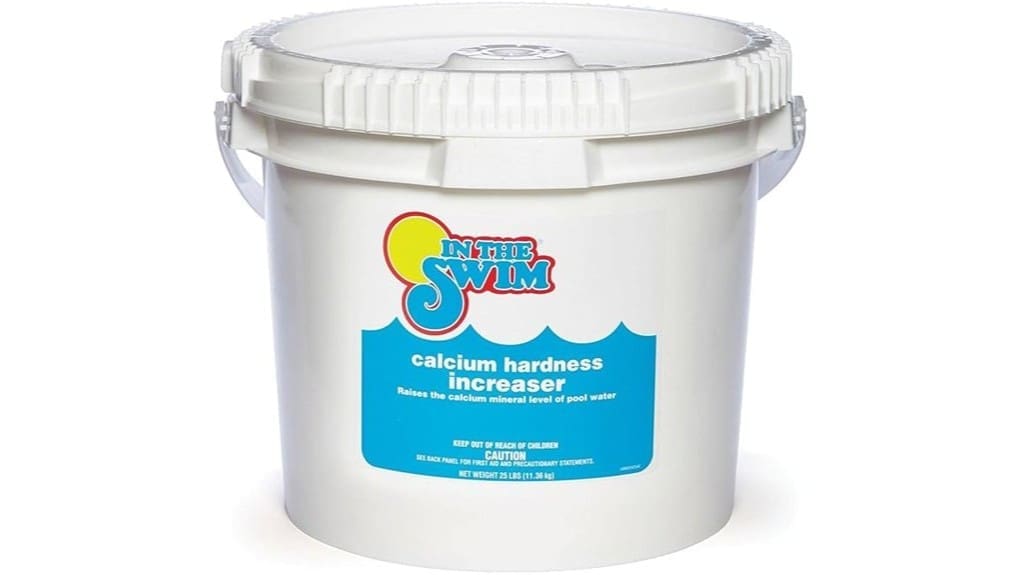
You’ll get a fast, predictable way to raise pool calcium with In The Swim’s 25‑lb calcium chloride, 94% CaCl2 granules that dissolve quickly to release Ca2+. Target 200–400 ppm to avoid corrosion or scaling; expect about 6 lbs per 10,000 gallons to raise hardness ~50 ppm. Add slowly, circulate 2–4 hours between increments, then retest to avoid localized supersaturation and deposits. It’s effective for rapid correction; keep pH/alkalinity balanced and continue for full guidance.
Some Key Takeaways
- In The Swim Calcium Hardness Increaser is primarily calcium chloride granules (~94%) that rapidly raise pool calcium hardness.
- Dosage guideline: about 6 lbs per 10,000 gallons increases hardness roughly 50 ppm; one 25-lb bag treats ~40,000 gallons in increments.
- Add slowly and circulate 2–4 hours between incremental additions to avoid localized supersaturation and scaling.
- Benefits: fast, predictable correction to prevent corrosion and cloudy water; risks include increased TDS and potential scaling if overused.
- Suitable for rapid residential or commercial corrections; consider slower alternatives (tablets/liquid) if gentler increases are needed.
What Calcium Hardness Should Your Pool Have and Why It Matters
Balance matters: you should keep pool calcium hardness between about 200–400 ppm to protect surfaces and equipment. You monitor hardness because ideal levels minimize both scaling and corrosive conditions. If hardness falls below the lower bound, you risk corrosion prevention failure: metal fittings, heaters, and plaster can etch and pit. If hardness exceeds the upper bound, scale deposits form on liners and heat exchangers, reducing efficiency. You test regularly, log results, and adjust measured chemistry to maintain the target range. Precise control supports water clarity, equipment longevity, and predictable chemical interactions without compromising swimmer safety. Regular testing and adjustments are essential for maintaining pool alkalinity and overall water balance.
How In The Swim Calcium Hardness Increaser Works and What’s in the 25‑lb Bag
Understand how the product works: the 25-lb bag contains about 94% calcium chloride granules that rapidly dissolve to release Ca2+ ions, which raise calcium hardness in pool water; at the recommended rate (6 lbs per 10,000 gallons) you’ll increase hardness roughly 50 ppm, and circulating the water after addition guarantees even distribution and prevents localized supersaturation that could cause scaling. You’ll handle a single-ingredient chemical composition dominated by CaCl2 with minor inerts. The granules’ dissolution rate is fast, so you’ll add slowly to avoid transient hotspots. Follow circulation and mixing protocols to maintain uniform hardness and protect surfaces. For homeowners, using a calcium hardness increaser helps preserve plaster and tile by preventing corrosive low-hardness conditions.
Real-World Dosing: How Much to Add and How Fast It Acts (ppm per 10,000 Gallons)
Now that you know the composition and mixing behavior of the 25-lb bag, let’s look at dosing and response times in real-world pools. You’ll dose based on volume: 6 lbs raises calcium hardness ~50 ppm per 10,000 gallons. For a 25-lb bag you can treat roughly four 10,000-gallon increments sequentially. Granular behavior is predictable—fast-dissolving granules give a high dissolution rate, so ppm impact occurs within hours under active circulation. Space additions to manage dose timing: add portions, allow 2–4 hours circulation between increments, then retest. Avoid large single additions to guarantee even distribution and accurate ppm control. Proper filtration with the right filter cartridges helps maintain water clarity and supports balanced chemical levels.
Performance Checklist: Benefits, Risks, and Secondary Uses (Pool Care, Ice Melt)
Although primarily formulated to raise pool calcium quickly and predictably, In The Swim Calcium Hardness Increaser delivers a precise set of performance characteristics you should weigh before use. You get fast-dissolving, high-purity calcium chloride that restores hardness to prevent cloudy water and enable scale prevention on heaters and surfaces. Benefits include corrosion mitigation and predictable dosing (50 ppm per 6 lbs/10,000 gal). Risks: over-application raises total dissolved solids and can accelerate deposit formation if not balanced with alkalinity/pH control. Secondary uses: effective industrial ice melt and routine pool care supplementation. Consider Environmental impact from runoff and disposal; handle per label. Maintaining balanced pool pH is essential for clearer, safer water and proper product performance, especially for homeowners who enjoy their outdoor spaces pool pH.
Who Should Buy It and 3 Alternative Options to Consider
If you manage a residential or commercial pool and need a fast, predictable way to raise calcium hardness, this 25 lb, 94% calcium chloride product is a strong fit—especially where quick dosing and rapid dissolution matter. You should buy it if you need rapid correction to prevent corrosion, prefer measured dosing (6 lbs raises 50 ppm per 10,000 gallons), or value competitive pricing for bulk treatment. Consider availability during peak seasons; seasonal availability can affect planning. Alternatives: 1) Calcium chloride tablets (slower dissolve, controlled feed). 2) Liquid calcium chloride solutions (easy dose). 3) Calcium carbonate supplements (gentler, slower increase). Pools require balanced chemistry to protect equipment and surfaces, so maintain stabilizer levels along with calcium hardness.
Some Questions Answered
Is This Product Safe to Store Indoors Near Other Pool Chemicals?
Yes. You can store it indoors near other pool chemicals if you follow Store compatibility and Chemical separation guidelines. Keep the calcium chloride dry, in its original sealed container, off concrete, and away from incompatible substances like concentrated acids, cyanuric acid, or alkalinity adjusters. Maintain good ventilation, cool temperatures, and secondary containment for spills. Label clearly, inspect regularly, and separate by aisle or shelf to minimize cross-contamination and reaction risk.
Can It Damage Vinyl or Fiberglass Liners With Repeated Use?
No — when used as directed, it won’t directly cause vinyl discoloration or liner brittleness. You’ll raise calcium hardness to prevent corrosive low-Ca effects that can harm surfaces. Excessive, repeated over-dosing or poor dissolution could create localized high concentrations that might stress liners, so you should measure accurately, dissolve or broadcast evenly, and maintain recommended levels. Regular monitoring prevents conditions that could indirectly promote discoloration or brittleness.
How Long After Adding Can Swimmers Re-Enter the Pool?
You can re-enter once the product is fully dissolved and the pump has circulated for at least 30 minutes; longer circulation (1–2 hours) is recommended for larger doses to guarantee uniform distribution. Observe water clarity and smell; if you notice any cloudiness or strong odor, wait and recheck. This wait time minimizes skin irritation risk by preventing concentrated pockets of calcium chloride contacting swimmers. Follow label instructions for precise dosing and circulation.
Will It Affect My Pool’s Chlorine or pH Levels?
No — it won’t markedly alter chlorine interaction or pH stability. You’ll add calcium chloride, which raises hardness without consuming free chlorine or changing pH appreciably. Expect minimal transient effects from dilution and circulation; maintain normal testing to confirm. Follow dosage guidelines and guarantee full dissolution and circulation to avoid local concentration hotspots that could temporarily affect sanitizer readings or equipment. Routine monitoring keeps levels ideal.
Is This Safe to Use on Potable Water or in Drinking Systems?
No — you shouldn’t use this product for potable water or in drinking systems. It isn’t formulated or certified for potable suitability and may introduce high chloride concentrations that harm plumbing compatibility and corrosion-resistant components. If you need to adjust drinking water hardness, use NSF/ANSI‑certified products or consult a water treatment professional. Always follow regulatory standards and material compatibility guidance to protect health and piping integrity.