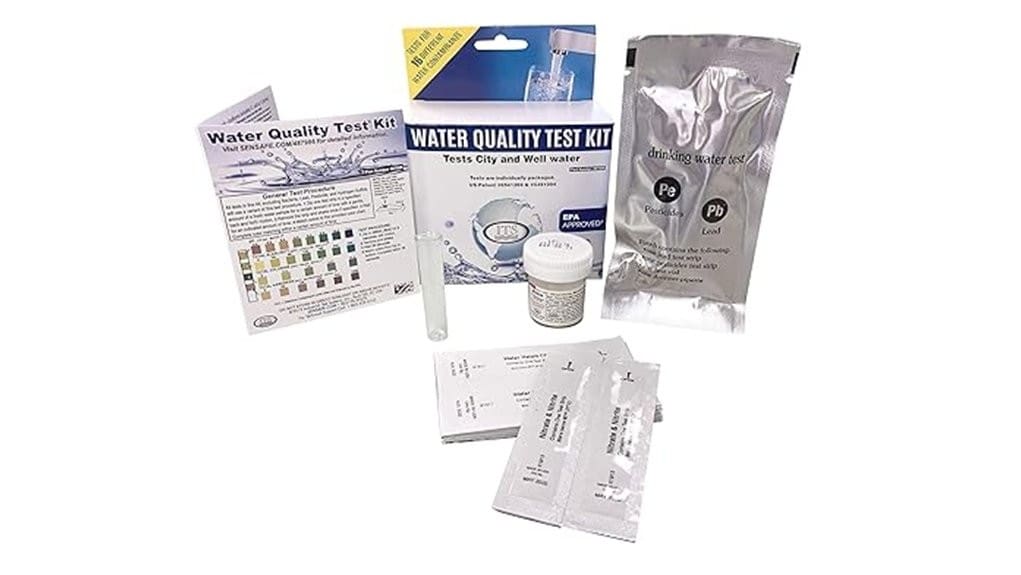
You’ll get a portable, reagent‑based 16‑parameter kit that uses calibrated color comparators for field‑traceable decisions. It includes sealed reagents, standards, vials, comparators, and simple protocols for chlorine (to 0.05 ppm), pH, hardness, nutrients, metals and bacterial screening. The molded case and labeled layout support quick deployment; documentation lists detection limits and uncertainties. It trades lab‑level low‑ppb precision for breadth and convenience, making it ideal for routine onsite screening — more details follow below.
Some Key Takeaways
- ITS 487986 is a compact field kit performing 16 EPA-relevant colorimetric water-quality tests with calibrated standards.
- Kit includes reagents, comparator blocks, sample vials, sterile swabs, and documentation for on-site decisions.
- Measures chlorine, pH, alkalinity, hardness, nutrients, metals, bacteria, and heavy-metal screening across practical regulatory ranges.
- Trade-off: broad, portable screening with certified reagents but less sensitive and precise than lab instruments for low-ppb analysis.
- Well-built, organized case with clear instructions, troubleshooting tips, and reusable inserts for rapid field deployment.
How the ITS 487986 Kit Works: What’s Included and What It Tests
Because it combines colorimetric reagents, calibrated standards, and simple field tools, the ITS 487986 kit lets you perform 16 EPA-relevant water-quality tests on site with minimal training. You’ll find an organized kit contents list: reagent vials, comparator blocks, color charts, sample tubes, sterile swabs, standards, and documentation. You use colorimetric reactions and comparators to quantify parameters across defined ranges. The testing scope covers chlorine (free/total), pH, alkalinity, hardness, chloride, sulfate, nitrates, nitrites, hydrogen sulfide, copper, iron, lead, pesticides, bacteria, and broad heavy-metal screening. Results are traceable to calibrated standards for field decisions. It’s a useful tool for homeowners caring for outdoor water features and pools who want to maintain clear pool water.
First Impressions and Unboxing: Build Quality, Instructions, and Ease of Use
Having seen what the kit measures and how the reagents and comparators work, you’ll next assess how it arrives on site and how straightforward it is to operate. You’ll notice robust molded cases, clearly labeled vials, and sealed reagent bottles that resist leakage. Instructions are compact, stepwise, and reference limit values; you won’t hunt for protocol details. Controls and color comparators are organized for rapid access. Packaging sustainability is addressed with recyclable inserts and minimal void fill. User accessibility is strong: tactile vials, readable type, and logical layout let you deploy tests quickly with minimal training. Homeowners will appreciate how this setup supports maintaining clear pool water and enjoying their outdoor spaces.
Accuracy and Range Breakdown: pH, Chlorine, Hardness, Nutrients, Metals, and More
When you test with the ITS 487986 kit, expect discrete, EPA-aligned ranges and colorimetric steps that balance field practicality with laboratory-grade traceability. You’ll read pH across eight fixed points (2.0–12.0), chlorine as free/total with low-step sensitivity to 0.05 ppm, hardness to 1000 ppm, nutrients (nitrate/nitrite) across regulatory thresholds, and metals from sub-ppb to ppm tiers. The kit documents detection limits and provides stated measurement uncertainty for each parameter, so you can assess compliance margins. Color charts and calibrated standards support repeatability; interpret results knowing step resolution limits precision but preserves robust field decision-making.
Real-World Testing: Step‑by‑Step Use Cases, Results, and Troubleshooting
Although field conditions vary, you’ll follow a consistent procedure for each parameter: collect a representative sample, rinse and fill the test vial to the specified mark, add the reagent(s) in the order and volumes listed, invert or shake as instructed, allow the prescribed reaction time, then compare the resulting color to the kit’s calibrated chart or use the included comparator. For field sampling include blanks and duplicates, note temperature and turbidity. Use sequential tests for chlorine, pH, hardness, nutrients, metals. Record results for immediate corrective action and longterm monitoring trends. Troubleshoot by checking reagent expiry, light conditions, vial cleanliness, and retesting suspicious readings. For homeowners maintaining outdoor pools, consider simple test kits for routine monitoring of pool water.
Who Should Buy It and How It Compares to Alternatives
If you need a single, field‑portable kit that covers a broad range of regulatory and operational water tests, the ITS 487986 is worth considering because it combines 16 validated parameters, traceable QC, and US‑manufactured reagents. You’ll benefit if you’re a commercial user needing reliable onsite screening for chlorine, hardness, nutrients, metals, sulfides, bacteria, and pesticides without lab turnaround. Compared with electronic meters or single‑analyte strips, the ITS kit trades some analytical precision for breadth, portability, and certified reagents. In a budget comparison, it’s cost‑effective versus multiple specialized instruments but less suited when low‑ppb quantitation or automated logging is required. Many homeowners using outdoor water features also prefer convenient digital testing options like digital pool testers for regular maintenance.
Some Questions Answered
What Is the Kit’s Shelf Life and Optimal Storage Conditions?
You get about a 2–3 year shelf longevity if you store the kit at recommended storage temperature. Keep reagents sealed, dry, and between 15–25°C (59–77°F); avoid freeze–thaw cycles, direct sunlight, and high humidity. Use lot-specific expiration dates on vials; discard any reagents that show color change or precipitation. For longest accuracy, rotate stock, maintain original packaging, and record storage temperature and opening dates for traceability.
Are Replacement Reagents and Components Available Separately?
Yes — you can obtain replacement reagents and spare components separately. Contact the manufacturer or authorized distributors to order reagent packs, indicator tablets, vials, reagents, and accessory parts. They maintain lot-controlled supplies produced under GMP, with quality-checked standards and traceability. When ordering, specify part numbers or test parameters (e.g., chlorine, nitrate, hardness) to guarantee compatibility and expiration dating for reproducible, accurate results.
Does the Kit Require Any Special Disposal Procedures After Use?
Yes — you’ll need to treat some used reagents as hazardous waste and follow local regulations for disposal. Check the kit’s MSDS and instructions to identify which chemicals require special handling (e.g., metal, oxidizer or preservative residues). Don’t pour concentrated reagents down drains; neutralize or collect per guidance. Contact local waste authorities or your institutional EH&S for approved disposal routes, labeling, and transport to licensed disposal facilities.
Can Test Results Be Logged Digitally or Integrated With Software?
No — the kit doesn’t include built‑in digital logging or native software integration. You can, however, record measurements manually and import them into your preferred data system. For semi‑automated workflows, scan or photograph color charts and use third‑party color‑analysis or spreadsheet software to translate results into digital logs. Make certain consistent lighting and calibration samples for reliable software integration and traceable digital logging.
Is Customer Support or Warranty Included With Purchase?
Yes — you get warranty details and support channels with purchase. You’ll receive a manufacturer’s warranty covering defects and QC failures; specific term and claim process are in the included documentation. For technical issues or replacements, you can contact ITS via phone, email, or their website support portal. Keep serial/lot numbers and purchase proof; they’ll expedite service. Follow stated return/claim timelines and troubleshooting steps for faster resolution.