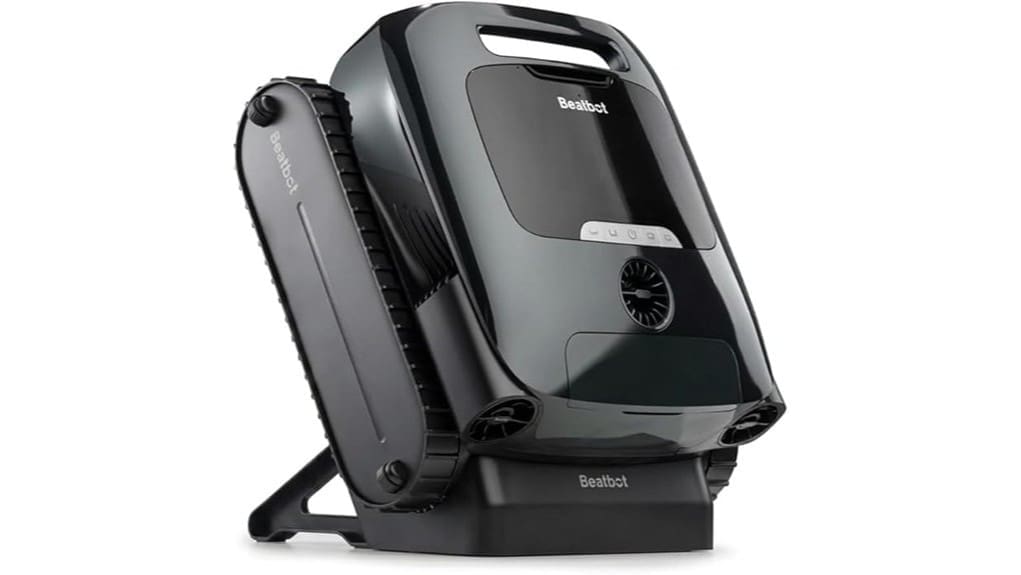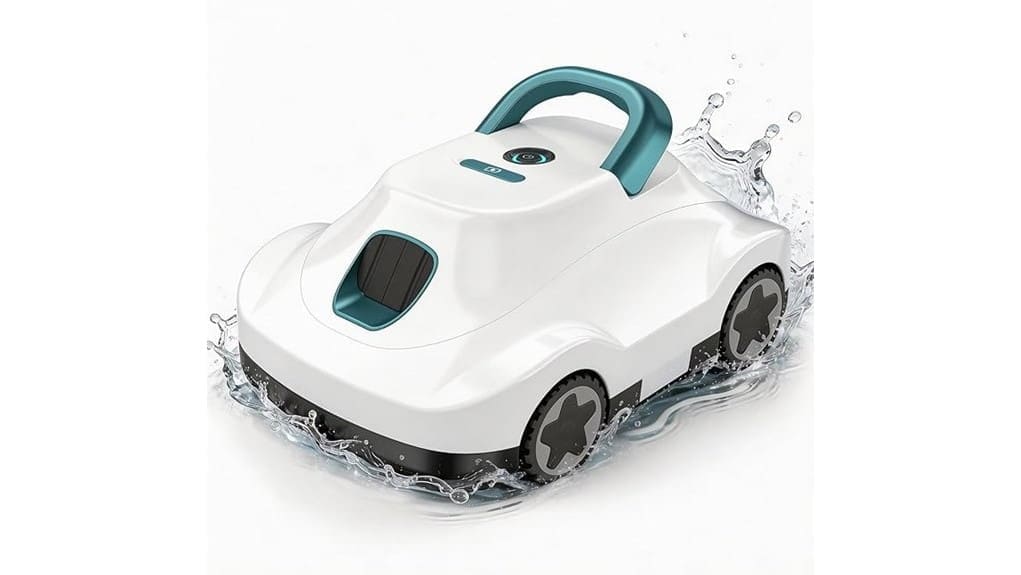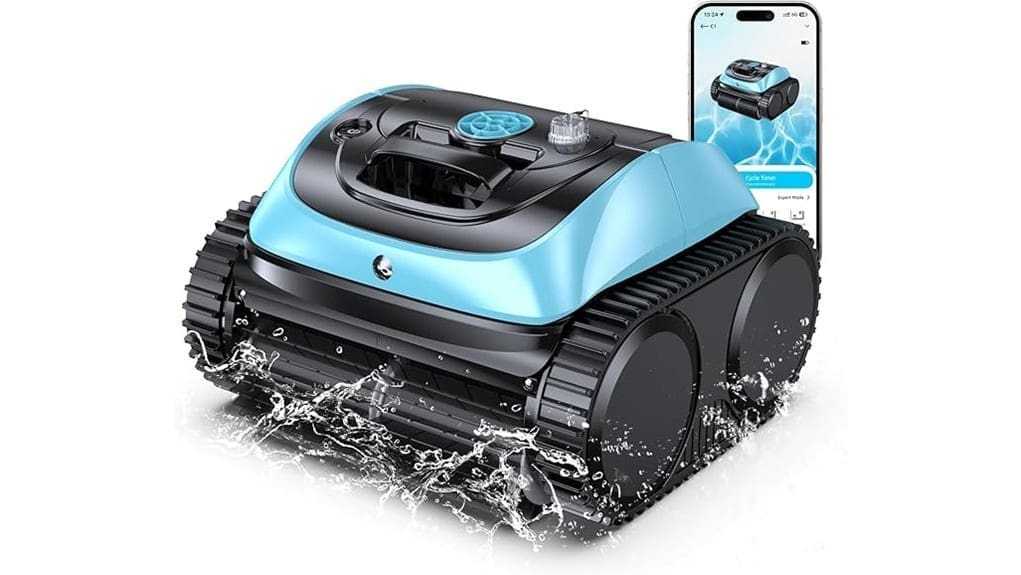
You’ll get a high‑flow robotic suited for medium to large inground pools that handles concrete, plaster, tile, aggregate, and fiberglass. It uses a 3,038 GPH pump, dual‑PVC brushes to dislodge sand and embedded sediment, and deterministic navigation with slope‑capable traction to climb 45° walls and avoid drains or ladders. Materials resist salt and chlorine, and a 4,600 mAh battery runs up to 150 minutes with smart charging. Continue for detailed specs and tradeoffs.
Some Key Takeaways
- Choose cleaners compatible with inground surfaces like concrete, plaster, tile, aggregate, and fiberglass to avoid damage and ensure effective cleaning.
- Look for strong suction (up to ~3,000 GPH) and adequate filtration to pick up sand, leaves, and fine sediments without frequent clogs.
- Dual-PVC or soft-brush systems improve agitation and reduce localized abrasion, important for vinyl liners and delicate finishes.
- Prioritize advanced navigation, climb-capable traction, and obstacle detection for predictable coverage and slope-to-wall transitions.
- Compare runtime (up to ~150 minutes), charging convenience, and app features versus pool size to match cleaning needs and maintenance schedule.
Which Inground Pool Types and Problems This Vacuum Solves
When you need reliable, automated cleaning for various inground pool constructions, this vacuum fits concrete, plaster, tile, aggregate, and fiberglass surfaces by combining strong suction (up to 3,038 GPH) with a dual-PVC brush system that dislodges sand, leaves, and embedded sediments. You’ll deploy it in salt pools and chlorine systems; materials and sealing guarantee heater compatibility and resist corrosion. It tolerates vinyl liners when users select appropriate cycle and soft-brush settings to avoid abrasion. Deep ends receive targeted suction and climb-capable traction for complete coverage. The unit solves sediment buildup, line scum, and debris accumulation across varied pool geometries. Many homeowners prefer manual vacuums for their cost-effectiveness and ease of maintenance.
How Suction, Filtration, and Brush Systems Affect Cleaning Performance
Because suction, filtration, and brushes work together, their specifications directly determine cleaning speed, debris capture, and surface safety. You’ll rely on the upgraded pump delivering up to 3,038 GPH to generate consistent suction power; higher flow increases pick-up rate but can accelerate brush wear on abrasive surfaces. Dual-PVC brush design improves agitation for sand, leaves, and stains while distributing mechanical load to reduce localized abrasion. Filtration capacity and mesh size control particle retention; small pores trap fine sediment but raise risk of filter clogging, requiring more frequent maintenance. Balance pump flow, brush aggressiveness, and filter rating for peak performance. For homeowners, choosing equipment that matches pool size and typical debris load helps maintain efficiency and prolong component life, especially when considering pump flow rates.
Mobility, Navigation, and Obstacle Handling You Can Expect
Although compact, the vacuum’s triple-motor drive and patented navigation system give it the torque and path-planning needed to traverse complex inground pools, climb slopes up to 45 degrees, and maintain stable traction on wet surfaces. You’ll rely on deterministic mapping and real-time sensor fusion for predictable coverage, with corner detection reducing missed debris along joins. Obstacle handling combines proximity sensors and reactive maneuvers to identify drains, ladders, and toys, then replan paths to avoid entanglement. Slope climbing performance is sustained by independent motor torque control and traction-optimized treads, ensuring consistent speed and adherence during vertical shifts and wall-to-floor reversals. These features make it ideal for homeowners who want to keep their pool pristine with minimal manual maintenance.
Battery Life, Runtime, Charging, and Real-World Convenience
Expect reliable, long-duration operation: the unit houses a 4600 mAh battery that delivers up to 150 minutes of runtime after a roughly 4-hour charge, balancing cleaning power and run time for most inground pool sizes. You’ll observe consistent real world runtime across mixed cycles; heavy wall work reduces continuous run time compared with floor-only modes. Charging ergonomics are solid: a simple dock and clear indicator minimize user error and speed turnover. Monitor battery degradation via the app and schedule maintenance to preserve capacity. Overall, charging, storage, and self-parking combine for high maintenance convenience and predictable daily availability. The website also offers a curated selection of compatible tools and accessories for pool maintenance, making it easy to outfit your outdoor space with pool maintenance essentials.
Who Should Buy This Model and Alternatives by Budget and Pool Size
If you need a high-coverage, low-maintenance robotic cleaner for a medium to large inground pool, this model delivers the best balance of suction power, navigation, and runtime for most users. You should buy it if you want autonomous 4-in-1 cleaning, robust filtration (up to 3,038 GPH), slope climbing, and app-based scheduling that reduces seasonal maintenance workload. Alternatives by budget tiers: entry-level—basic suction or suction-side cleaners for small pools and tight budgets; mid-tier—corded robots with good coverage but limited mobility; premium—commercial-grade units for large or heavily used pools needing continuous heavy-duty performance. Our selection emphasizes options tailored to homeowners who enjoy and maintain their outdoor living spaces, including models specifically designed for above-ground pool vacuums.
Some Questions Answered
Does It Support Saltwater or Chlorinated Pools Without Corrosion Issues?
Yes — it supports saltwater compatibility and chlorinated pools with corrosion resistance features. You’ll get reinforced, corrosion-resistant housings and stainless or coated fasteners that prevent electrochemical degradation in saline environments. Regular rinsing after use and following maintenance schedules preserves seals and motors. The pump and motors are designed for neutral pH ranges typical of pools, but prolonged exposure to extreme salinity or improper chemical balance can still accelerate wear.
Can I Use It on Pools With Solar Covers or Automatic Covers?
Yes — you can use it with solar blankets and many automatic covers, but you’ll need to manage cover sensors and clearance. The robot’s navigation adapts to pool shapes and obstacle detection, yet solar blankets may snag brushes; secure edges before operation. If your automatic cover has exposed sensor signals or restricts entry, disable cover movement and make certain cover sensors won’t trigger during runs. Follow manufacturer guidance for safe clearance and sensor integration.
Is a Separate Transformer or Power Station Required for the Charger?
No, you won’t need an external transformer or separate battery station for the charger. The unit includes an integrated charger compatible with standard household outlets and charges the 4600 mAh battery directly. If you prefer centralized charging, an optional battery station can be used but isn’t required. The included charger supports safe charging protocols, OTA power management, and meets the robot’s runtime and self-parking requirements without extra power supplies.
How Noisy Is the Unit While Operating Above and Below Water?
You’ll hear a low motor hum above water and a muted suction noise when it’s submerged. Above water, the triple-motor system emits a measurable hum at startup and during operation, noticeable but not harsh. Below water, the pool dampens airborne sound; you’ll mainly perceive a subdued suction noise and faint mechanical vibration. Overall acoustic signature is moderate, with peak levels during climbs or heavy debris intake, remaining within typical robotic-cleaner ranges.
Are Replacement Parts and Filters Readily Available Locally?
Yes — replacement parts and filters have good local availability in many regions. You’ll find manufacturer OEM spares through authorized dealers and common consumables at pool supply stores; aftermarket compatibility is strong for filters, brushes, and wheels, lowering costs and lead times. Check serial/model numbers before buying to verify fit. You’ll also want to confirm local stock levels and warranty implications when choosing aftermarket components.