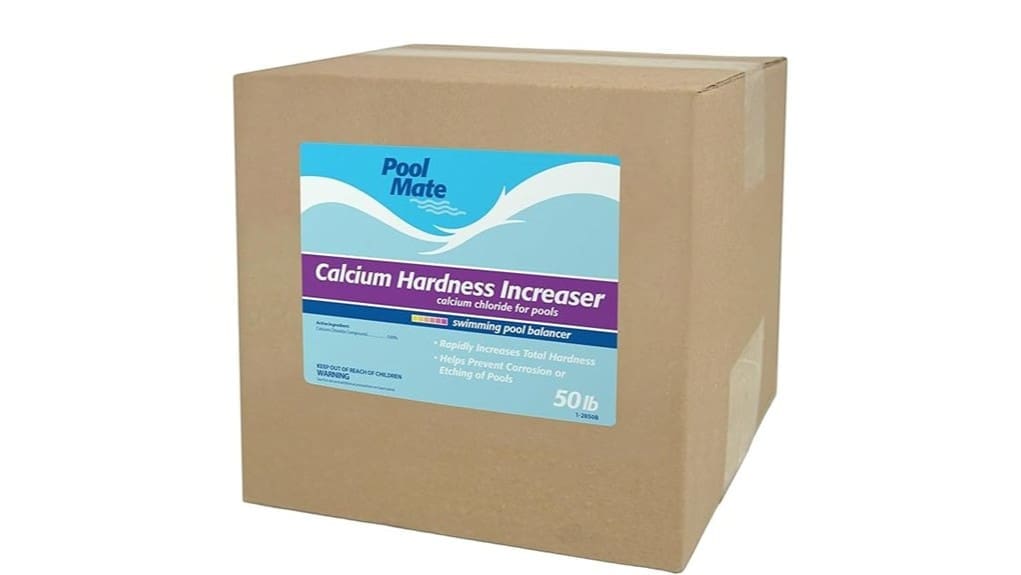
You’ll get a 100% calcium chloride, 50‑lb bag that reliably raises hardness with predictable dosing—8 oz adds ~10 ppm per 5,000 gallons—so you can calculate exact additions for any pool. Pre‑dissolve measured amounts (≤2 lb per ~5‑gal bucket), wear gloves/eye protection, and pour slowly with circulation on; retest after two hours and stage large doses. It’s cost‑effective for homeowners and pros, but raises conductivity and needs careful handling; keep reading for full dosing examples and safety steps.
Some Key Takeaways
- 100% calcium chloride granular formula effectively raises pool calcium hardness with predictable dosing rules.
- Dosage: 8 oz raises calcium hardness 10 ppm per 5,000 gallons; calculate exact mass for your pool volume.
- Pre‑dissolve up to 2 lb per ~5‑gallon bucket, wear gloves/eye protection, and pour slowly with circulation running.
- 50‑lb bag lowers per‑pound cost and reduces handling frequency, but requires careful lifting and storage.
- Re‑test hardness after two hours, stage larger doses (e.g., max 10 lb per 2 hours), and monitor pH/alkalinity.
Quick Verdict : Is Pool Mate 50‑lb Calcium Increaser Worth Buying?
Wondering if the Pool Mate 50‑lb Calcium Increaser is worth buying? You get a 100% calcium chloride, granular product that reliably raises hardness for large pools; dosage is explicit and application is straightforward. From a cost comparison standpoint, the 50‑lb unit lowers per‑pound price versus smaller packages, reducing supply trips and handling frequency. You’ll also weigh environmental impact: calcium chloride is effective but adds ions to discharge; follow local disposal and dilution guidance. Overall, if you maintain larger pools and follow dosing limits, you’ll find this economical, predictable, and operationally efficient for hardness control. Many homeowners use calcium hardness increasers to keep pool water balanced and protect surfaces and equipment, so consider calcium hardness maintenance as part of your regular pool care routine.
How Well It Works : Performance, Dosing, and Test Results
Evaluate performance by measuring hardness before and after treatment with a reliable test kit and following the stated dosing: 8 ounces of Pool Mate raises calcium hardness by 10 ppm per 5,000 gallons, so calculate required mass precisely and pre-dissolve at up to 2 lb per ~5‑gallon bucket of water. You’ll track dissolution rate during mixing; granules dissolve rapidly in warm water, forming a clear solution. Dose increments produce predictable ppm increases when you respect per‑volume guidance. Post‑treatment tests should confirm targets. Long term stability is driven by baseline chemistry and maintenance; maintain recommended ranges to prevent drift and protect surfaces. Keep your pool pH balanced for clearer, safer water by monitoring and adjusting alkalinity and pH alongside hardness using a quality test kit.
Step‑by‑Step Application and Safety Tips for Best Results
Before you add anything, test the pool’s calcium hardness and calculate the exact dose using the rule that 8 ounces raises 10 ppm per 5,000 gallons; then pre-dissolve the measured amount (never exceeding 2 lb per ~5‑gallon bucket) in a plastic bucket of pool water so you can introduce a clear solution while the circulation runs. Wear personal protective equipment — gloves and eye protection — when handling granular calcium chloride. With circulation on, pour the bucket slowly around the perimeter. Re-test hardness after two hours. If further dosing is required, wait the recommended interval (per volume limits) and repeat pre dissolving techniques and safety checks to avoid oversaturation. Keeping total alkalinity balanced helps maintain proper calcium levels, so monitor and adjust total alkalinity as part of routine maintenance.
Pros, Cons, and Real Customer Feedback Highlights
Because this product uses 100% calcium chloride, you’ll see rapid, predictable increases in calcium hardness when you dose per the stated rule (8 oz → +10 ppm per 5,000 gallons), which makes it straightforward to correct low-hardness conditions and prevent etching or corrosion of pool surfaces. You’ll appreciate pros: precise dosing, fast dissolution when pre-mixed, and clear application limits that reduce oversaturation risk. Cons: increases conductivity, may raise stabilizer concerns, and handling 50-lb bags requires care. Customer testimonials cite reliable performance and measurable results; reports on long term durability of finishes are positive when dosing guidelines are followed. Homeowners who maintain their outdoor spaces often pair hardness increasers with proper filter cartridge maintenance to keep water clear and equipment protected, since filter cartridges play a key role in overall pool water quality.
Who Should Buy It and Dosing Examples by Pool Size
If you need dependable, fast correction of low calcium hardness—especially for vinyl, tile/exposed-aggregate, marcite, fiberglass, or painted surfaces—this 100% calcium chloride product is a solid choice. You should buy it if you’re a homeowner managing varied surfaces, a pool service professional needing rapid adjustments, or beginner owners who want straightforward dosing. For dosing: 8 oz raises 10 ppm per 5,000 gallons. Example: 10,000 gal pool — add 16 oz to raise 20 ppm; limit 10 lb per 2 hours. For 20,000 gal — double doses, staged over hours. Use seasonal treatments to stabilize levels. Test before and after. Homeowners who use chlorine tablets to maintain sanitization will also benefit from maintaining proper calcium hardness to protect surfaces and equipment, especially when balancing pool chemistry with routine maintenance.
Some Questions Answered
Is This Product Safe for Pools With Saltwater Chlorine Generators?
Yes — it’s compatible. You can use Pool Mate calcium chloride with Saltwater compatibility if you monitor levels and avoid rapid dosing. You’ll raise calcium hardness without harming the generator’s function, but you shouldn’t let hardness stay too low or fluctuate wildly because that can accelerate Equipment corrosion. Pre-dissolve per instructions, test regularly, and dose incrementally (follow the 2-hour/10 lb guidance for 10,000 gallons) to protect surfaces and equipment.
Can It Be Used in Small Above-Ground Inflatable Pools?
Yes — you can use it in small above-ground inflatable pools if you test first and dose carefully. You’ll raise calcium hardness precisely: pre-dissolve per instructions, calculate ppm change for your gallonage, and never exceed recommended additions per time. Maintain proper circulation during application and monitor levels after treatment. Prioritize inflatable safety by avoiding undissolved granules contact with liners and using plastic buckets to prevent localized etching or damage.
What Is the Shelf Life Once the Bag Is Opened?
You can expect usable life of opened calcium chloride for 1–2 years if you maintain proper storage conditions and moisture control. Keep the bag sealed in a dry, cool area, off concrete, ideally in an airtight container with desiccant. Avoid humidity, freezing, and contact with metals. If granules cake or dissolve, efficacy may be reduced—discard if markedly clumped or contaminated. Label with open date for inventory control.
Does It Affect Pool Water pH or Alkalinity?
No — adding calcium chloride won’t directly change pH much, but it can indirectly influence alkalinity and pH through calcium solubility and buffer interaction. You’ll raise calcium hardness without a strong acidic or basic shift, though concentrated dissolving may locally lower pH briefly. Because buffer interaction can be subtle, test and adjust total alkalinity and pH after treatment; follow dosing limits and pre-dissolve properly to minimize transient effects.
Is This Calcium Chloride Safe to Ship to All States?
Generally you can ship calcium chloride to most states, but you’ll need to check shipping restrictions and any hazardous classification with carriers. Calcium chloride is often non-flammable and not regulated as a hazardous material for ground transport in small consumer quantities, yet some carriers or states may impose limits or require labeling. Confirm carrier policies, state regulations, and required documentation before shipping 50-pound packages to make certain compliance and avoid penalties.