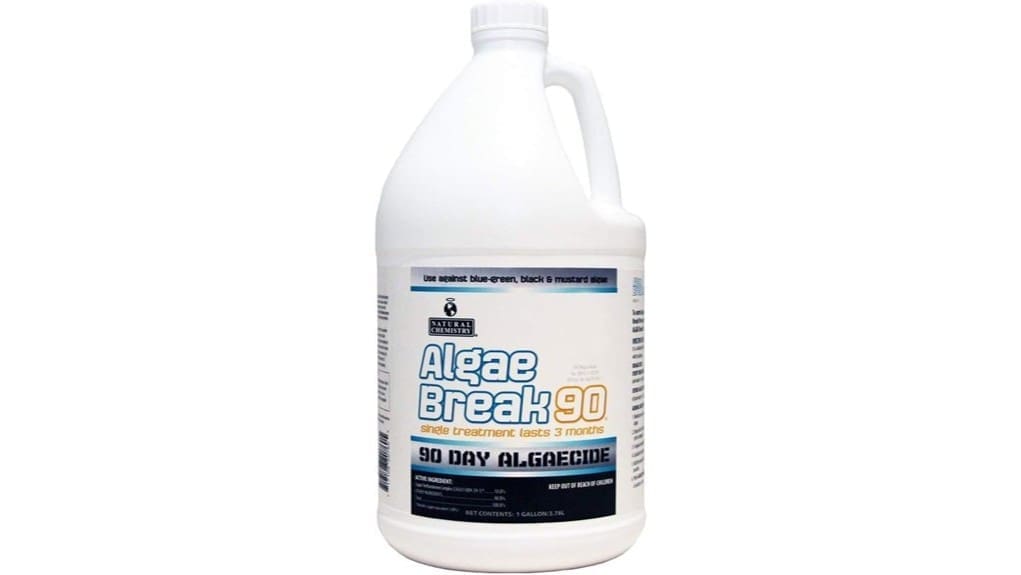
You’ll find Natural Chemistry Pro Series Algae Break 90 is a professional‑grade, quaternary ammonium algaecide that you’ll use quarterly to prevent and treat blue‑green, green, yellow, and black algae. It adsorbs to cell walls, disrupts membranes, and causes rapid lysis when dosed and circulated correctly. Real‑world duration varies with load, sunlight, and chemistry, so you’ll test and correct pH/chlorine before applying and maintain circulation for 8–12 hours; more details follow.
Some Key Takeaways
- Professional-grade, quaternary ammonium algaecide claiming up to 90 days’ prevention per dose for routine quarterly use.
- Best as a preventative in stable, low-contaminant pools; larger/heavily used pools need proportional dosing.
- Requires correct water balance, chlorine levels, debris removal, and 8–12 hours circulation for reliable efficacy.
- Real-world performance varies; persistent outbreaks may need supplemental shock, manual cleaning, or additional treatments.
- Store securely, follow PPE and label instructions, and document dosing for safety and regulatory compliance.
What Natural Chemistry Pro Series Algae Break 90 Is and Who It’s For
Designed as a professional-grade liquid algaecide, Natural Chemistry Pro Series Algae Break 90 provides up to 90 days of algae prevention and treatment per dose, targeting blue-green, green, yellow, and black algae. You’ll find a one-gallon, non-foaming, non-staining formulation engineered for routine dosing every three months. You’ll use it to reduce treatment frequency and control outbreaks in commercial and residential systems. Pool owners will appreciate simplified scheduling and measurable coverage; maintenance professionals will value consistent performance and compatibility with standard water-care protocols. Application is straightforward: measure per volume, distribute evenly, and record dosing for regulatory compliance. Designed for homeowners who enjoy their outdoor spaces, it helps keep your pool clear with reduced maintenance intervals.
How the Formula Works and Which Algae Types It Targets
When you add Algae Break 90 to pool water, its concentrated quaternary ammonium-based formulation rapidly adsorbs to algal cell walls and disrupts membrane integrity, causing cellular lysis and stopping growth. You observe a cation mechanism: positively charged quats bind negatively charged surfaces, collapsing electrochemical gradients and denaturing membrane proteins. The liquid disperses uniformly, so contact-dependent inactivation occurs across suspended and surface-colonizing populations. Targeted strains include blue-green (cyanobacteria), green chlorophytes, yellow microalgae, and filamentous black algae; efficacy depends on dose, contact time, and water chemistry. You’ll note rapid cell death with prevention of immediate recolonization when applied correctly. This product is designed for homeowners maintaining pools and other outdoor water features, helping them keep surfaces clear with pool shock treatments.
Real-World Performance: Coverage, Duration, and User Experience
Although you’ll see manufacturer claims of a single dose lasting up to 90 days, real-world coverage depends on pool volume, bather load, sunlight, and nutrient inputs, so Algae Break 90 performs as a preventative best under stable, low-contaminant conditions and as a treatment where dosing and water balance are promptly corrected. You’ll note consistent coverage consistency in small-to-medium residential pools with routine maintenance; larger or heavily used pools require proportional dosing and monitoring. Swimmer feedback is generally positive when clarity improves within days, but persistent outbreaks need supplemental shock and manual cleaning. Expect predictable, measurable performance when protocols are followed. Homeowners can pair clarifiers with routine maintenance to help sustain clear pool water.
How to Use It Safely and Get a Full 90-Day Treatment
Because achieving a full 90-day treatment depends on correct dosing and stable pool conditions, you should start by testing and correcting water chemistry (pH 7.2–7.6, chlorine at recommended levels) and removing visible debris; then apply the labeled dose of Natural Chemistry Pro Series Algae Break 90 evenly around the pool with the pump running, ensuring circulation for at least 8–12 hours so the non-foaming, non-staining liquid disperses uniformly and begins continuous algae inhibition. Maintain scheduled checks every 30 days, monitor residuals, and reapply at three-month intervals. Follow label PPE, store securely, and document application timing for pool safety and compliance. This product is ideal for homeowners who want to keep their outdoor spaces clear with natural enzyme treatments.
Buying Considerations: Size, Cost, Compatibility, and Final Verdict
If you’re choosing Natural Chemistry Pro Series Algae Break 90, weigh size and dosing against your pool’s volume and treatment cadence: a single 1‑gallon (128 fl oz) unit delivers a concentrated, non‑foaming liquid intended for quarterly application, so it’s suited to medium‑to‑large pools or multi‑season maintenance where you’ll administer the labeled dose every three months. You’ll assess cost-per-treatment versus alternatives; the upfront price spreads over three applications annually. Check compatibility with your sanitizer regime and surface materials. Review packaging options for storage safety and spill control. Finally, factor environmental impact from runoff and disposal when deciding to buy. Remember to keep your pool balanced with appropriate stabilizer levels and routine testing to maintain water quality and protect equipment, especially when using concentrated treatments like this one and considering stabilizer tips.
Some Questions Answered
Does It Affect Pool Heater or Solar Systems?
No, it won’t damage heaters or solar systems when used as directed; you’ll find good heater compatibility and minimal solar interaction. The liquid algaecide is non-staining and formulated to avoid deposits that foul heat exchangers or solar panels. Still, you should follow dosing and circulation guidelines, run the pump during treatment, and consult manufacturer specs for sensitive systems to guarantee peak thermal transfer and prevent residue buildup.
Is It Safe for Vinyl and Fiberglass Liners?
Yes — you can use it with vinyl and fiberglass liners; it’s formulated for vinyl compatibility and minimizes liner discoloration when used per directions. You’ll monitor concentration and avoid overdosage, since prolonged high levels can risk cosmetic changes. Apply at recommended dosages, maintain balanced water chemistry, and rinse any splashes on exposed surfaces. If you notice unusual fading or staining, stop treatment and consult the manufacturer for guidance.
Can It Be Used With Phosphate Removers?
Yes — you can use it with phosphate removers if you test phosphate levels first and follow label instructions. You’ll perform phosphate testing, add the remover per directions, then apply the algaecide once chemistry stabilizes. This sequencing prevents interactions and maintains algae resistance efficacy. Monitor phosphate and sanitizer levels during treatment, and avoid simultaneous heavy dosing to guarantee the algaecide retains its intended long-duration performance against resistant strains.
Does It Change Pool Water pH or Alkalinity?
No, it won’t appreciably alter your pool’s pH or alkalinity; the formulation maintains pH stability and shows minimal alkalinity interactions when dosed per instructions. You’ll observe no measurable drop or spike in routine tests, though extreme overdosing or incompatible chemicals can produce shifts. Monitor pH and total alkalinity after treatment as a precaution, and adjust using standard buffering agents only if you detect deviations beyond recommended ranges.
Is It Safe for Swimmers Immediately After Dosing?
You shouldn’t let swimmers enter immediately after dosing; wait until product fully disperses and filtration runs. You’ll avoid potential skin irritation and reduce risk for respiratory sensitivity from concentrated vapors or splashes. Follow label directions for circulation time and recommended wait period (often until levels normalize). Rinse any splashed skin and ventilate pool area if needed. When in doubt, contact the manufacturer or your pool professional for precise clearance times.