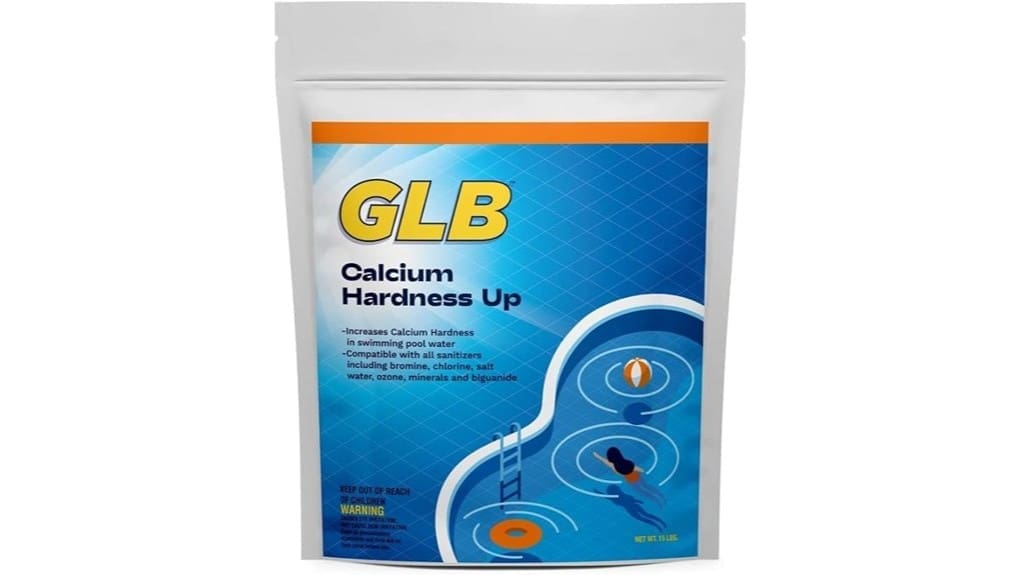
You’ll get a technician-grade 15 lb granular formula that reliably raises pool calcium hardness to prevent corrosion and stabilize water chemistry. You’ll measure current hardness, calculate dose from the chart, dissolve the granules if recommended, and add to the deep end with circulation running. The sealed liner and tamper-evident lid keep supply vans and maintenance closets secure. It’s predictable and midrange in value; keep pH/alkalinity monitored and continue for application specifics.
Some Key Takeaways
- GLB (Sigura) GL71251A is a 15 lb granular calcium hardness increaser formulated for predictable, rapid ppm increases per label dosing.
- Ideal for technicians and diligent owners who monitor pH and total alkalinity while adjusting hardness.
- Packaged with sealed polyethylene liner, tamper-evident lid, and stackable moisture-resistant container for safe storage.
- Best practice: measure hardness, dissolve granules if recommended, add to deep end with pump running, retest after 24–48 hours.
- Pros: precise formulation and corrosion prevention; cons: granular dissolution required and may need frequent repurchase for large pools.
What the Sigura GL71251A Calcium Hardness Up Does and Who Needs It
Although calcium imbalance often goes unnoticed, the Sigura GL71251A Calcium Hardness Up precisely raises calcium hardness in pool water to prevent corrosive conditions and scale inconsistencies. You’ll use this granular balancer to adjust ppm calcium, stabilizing water chemistry and reducing metal leaching and surface etching. In routine swimming maintenance and professional water treatment, you’ll calculate dose based on volume and current hardness, then disperse evenly with recommended circulation. Technicians and diligent pool owners who monitor total alkalinity and pH will need this product to maintain target hardness ranges, protect equipment, and make certain consistent, predictable water behavior across systems. Proper filtration and the right filter powder improve overall water clarity and complement hardness balancing.
Key Specs and Packaging: 15 Lbs Granular Formula, UPC, and Handling Details
When you handle the Sigura GL71251A, you’ll note it’s a 15 lb granular formula designed for measured dosing and easy storage: the granules disperse quickly in circulation systems, and the package lists capacity as 15 lbs (240 fl oz equivalent) with UPC 785336712512 and ASIN B09HR15KMG for inventory tracking. You’ll appreciate the technical labeling—manufacturer part GL71251A, brand GLB—supporting traceability. Packaging aesthetics are functional: clear product ID, sealed polyethylene liner, and a tamper-evident lid. For storage optimization, stackable dimensions and moisture-resistant construction minimize degradation and simplify logistics in maintenance closets or supply vans. This product helps homeowners maintain balanced pool water chemistry by increasing calcium hardness to protect surfaces and equipment, making it a useful pool maintenance tool.
How to Use It: Dosages, Application Steps, and Safety Tips for Pool Owners
Because maintaining proper calcium hardness keeps plaster and equipment from deteriorating, you’ll want to measure current hardness and dose the Sigura GL71251A precisely: test your pool with a reliable calcium hardness kit, calculate the pounds needed based on pool volume and the product’s dosing chart, then dissolve the measured granular product in a bucket of pool water (if recommended) and add it to the deep end with the circulation pump running to guarantee even distribution. Follow dosage charts and plan application timing during low bather load. Wear gloves, eye protection, avoid inhalation, store sealed, retest hardness 24–48 hours, adjust incrementally. Also remember to maintain proper pH balance for clearer, safer water and overall pool health with regular testing and adjustments Keep Your Pool pH Balanced.
Performance Review: Effectiveness, Corrosion Prevention, and Real-World Results
After you’ve established baseline calcium hardness and followed the dosing protocol, evaluate the Sigura GL71251A’s performance by measuring post-treatment hardness, observing equipment and plaster behavior over weeks, and tracking pH and total alkalinity to confirm chemical stability. You’ll see rapid hardness increases consistent with label dosing; repeat applications produce predictable incremental gains. Corrosion prevention is evidenced by reduced metal staining and stable heater surfaces when hardness reaches target range. Monitor maintenance trends for drift and adjust dosing seasonally. Verify equipment compatibility with non-metal feeders and PVC systems. For long term evaluation, document quantitative readings and visual inspections to validate efficacy. Homeowners who enjoy outdoor spaces should consider safe handling and storage practices for pool chemicals, including keeping tablets in a cool, dry area away from direct sunlight.
Buying Verdict: Pros, Cons, Price/Value, and Who Should Buy This 15 Lb Balancer
Balancing calcium hardness precisely, the Sigura GL71251A gives you predictable dosing and measurable results for most residential pools. You’ll appreciate precise formulation, granular delivery, and clear dosing guidance that integrate with your maintenance schedule. Pros: accurate hardness increase, corrosion prevention, durable packaging, easy storage. Cons: single 15 lb unit may require frequent repurchase for larger pools; granular form needs careful dissolution to avoid localized deposits. Price/value: midrange—you’re paying for quality materials and reliability rather than low cost. Who should buy: homeowners focused on water chemistry control, extending equipment life, and preserving pool aesthetics. Regular shock treatments and proper chemical balance help keep outdoor pools safe and sparkling, especially when combined with routine maintenance.
Some Questions Answered
Is This Product Safe for Vinyl and Fiberglass Pool Surfaces?
Yes — you can use it; it’s safe for vinyl when dosed correctly and formulated to raise calcium hardness without aggressive acids. You’ll find it’s gentle on fiberglass if you avoid overdosing and maintain proper pH and total alkalinity. Monitor hardness increments and disperse granules per label directions to prevent local concentration. Treat it as a technical adjustment: measure, calculate required mass, dissolve or broadcast uniformly, then retest to confirm safe levels.
Can It Be Used With Saltwater Chlorinators?
Yes—you can use it with saltwater chlorinators, but monitor levels closely. Saltwater compatibility is generally acceptable because calcium increasers don’t deactivate chlorine generation, yet high calcium can scale electrodes and plumbing. Check chlorinator interactions by measuring calcium hardness, total alkalinity, and stabilizer frequently after dosing. Maintain recommended ranges, clean cell per manufacturer, and dose gradually to avoid localized scaling on the cell and heat exchangers.
Does It Affect Pool pH or Alkalinity Significantly?
It won’t markedly affect pH when dosed correctly; you’ll see minimal immediate affects pH changes. Calcium hardness additions primarily raise dissolved calcium, but there’s an alkalinity interaction you must monitor: adding granular calcium can slightly raise total alkalinity over time. You should test pH and alkalinity after treatment and adjust with acid or alkalinity increaser as needed. Follow dosing guidelines to minimize pool chemistry shifts and corrosion risk.
Is Reapplication Needed After Heavy Rainfall or Water Backwashing?
Yes — you should reapply when levels drop. After heavy rainfall or filter backwash timing events, perform post rainfall testing for calcium hardness and total alkalinity. If hardness falls below your target, dose according to product instructions to restore recommended ppm. Track residuals after each corrective dose and repeat testing after 24–48 hours. Maintain records of rainfall and backwash volumes to refine future dosing frequency and prevent corrosion risk.
Are There Bulk or Refill Options for Commercial Pools?
Yes — you can source bulk refills and commercial packaging for calcium hardness increasers. You’ll evaluate supplier catalogs for 15 lb units, larger drums, or palletized granular loads to match turnover and dosing requirements. Calculate required mass from pool volume, target ppm increase, and solubility limits, then specify industrial-grade packaging, safety data sheets, and delivery logistics. Make certain compatibility with your dosing equipment and confirm warranty and return policies.