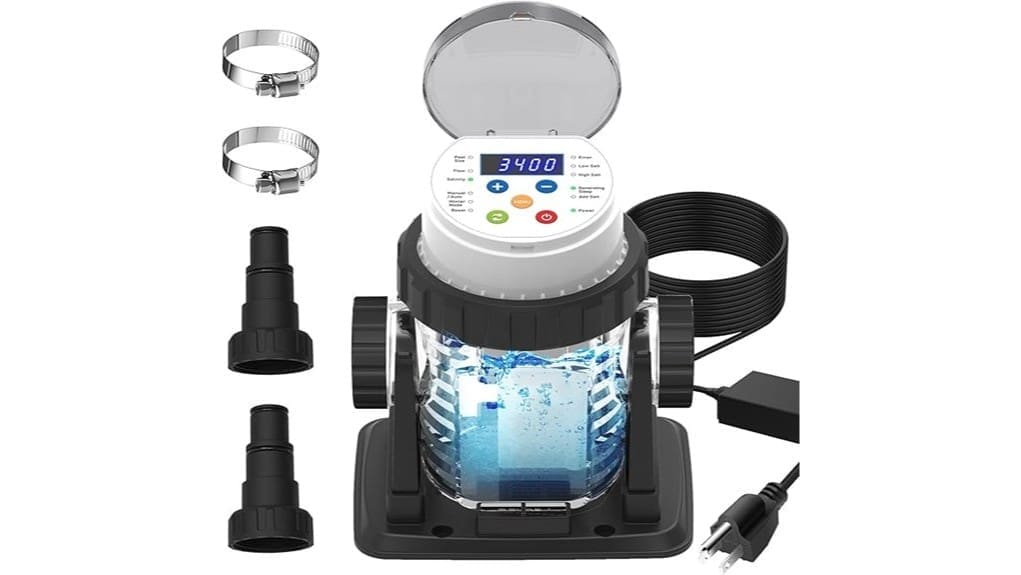
You’ll get a compact plug‑in saltwater chlorinator that’s built for above‑ground pools up to about 10,000 gallons, automating chlorine generation with self‑cleaning reverse polarity cycles and real‑time salt, current, voltage, and temperature readouts. Installation is simple: plug into an outdoor outlet, place inline with the return, set pool size, and adjust output via the control panel. Expect minimal noise, routine salinity checks, and a cell life of 3–5 years — continue for setup, maintenance, and buy-vs‑alternative guidance.
Some Key Takeaways
- Plug-in salt chlorinator electrolyzes dissolved salt to automatically generate chlorine, simplifying pool sanitation for above-ground pools up to 10,000 gallons.
- Real-time display shows salt, current, voltage, and temperature, enabling easy monitoring and prompt troubleshooting of cell performance.
- Self-cleaning reverse-polarity cycles reduce scaling, extending cell life to about 3–5 years with proper chemistry and maintenance.
- Simple plug-in installation and intuitive controls require minimal wiring, daily upkeep, and seasonal draining/storage procedures.
- Best for low-maintenance users; consider larger systems for inground pools or UV pairing to further reduce chemical use.
Quick Verdict: Is This Plug-In Salt Water Chlorinator Right for Above‑Ground Pools?
If you want a no-fuss, plug-in chlorinator for an above-ground pool, this unit delivers: a compact, all-in-one system sized for up to 10,000 gallons with simple pool-size selection and calculated salt recommendations. You’ll get automated chlorine generation and self-cleaning to reduce manual dosing and scale buildup. Real-time monitoring helps you manage pool chemistry precisely while protecting the salt cell. Installation’s straightforward—no complex wiring. Noise levels remain low during operation, so it won’t disturb nearby areas. For practicality and minimal maintenance, it’s a solid choice if your pool matches the capacity and you want reliable, hands-off sanitation. It’s especially well-suited for homeowners who prefer maintaining saltwater above-ground pools and enjoy using their outdoor spaces with minimal fuss.
How the Unit Works and What the Control Panel Displays (Salt, Current, Voltage, Temp)
The unit electrolyzes dissolved salt to produce free chlorine, routing pool water through the transparent salt cell where electrically charged plates convert chloride ions into hypochlorous acid. You monitor salt concentration via the built-in salinity sensor; salt calibration guarantees readings match your pool chemistry. The control panel shows real-time salt, current, voltage and temperature so you can confirm proper operating ranges and troubleshoot performance. Display alerts warn for low salt, over/under current, voltage irregularities, or high temperature, prompting corrective action. You’ll use these precise metrics to protect the cell, optimize output, and maintain stable, automated chlorination. For best long-term results, follow recommended maintenance and tablet-handling practices to keep your pool water clear and safe, including proper storage and dosing of chlorine tablets.
Installation and Daily Operation: Plug‑In Setup, Pool-Size Selection, and User Controls
Typically, you’ll plug the all‑in‑one unit into a standard outdoor outlet and place the compact chlorinator inline with your pump return so setup requires no wall mounting or complex wiring. You select pool size on the control panel; the unit calculates required salt and displays salt level, current, voltage, and temperature. Route the power cord through a cord cover and secure connections to prevent moisture ingress. Daily operation is largely monitoring and occasional adjustment of output via simple buttons. For off‑season, follow manufacturer instructions for seasonal storage: drain the cell, disconnect power, and stow indoors. Many homeowners pair these systems with pool thermometers to help monitor water temperature alongside salt and chlorine levels.
Maintenance, Self‑Cleaning Performance, and Long‑Term Reliability of the Salt Cell
When you follow the unit’s self‑cleaning schedule and keep salinity within the recommended range, the salt cell needs minimal hands‑on maintenance and delivers consistent chlorine output over time. You’ll rely on automatic reverse polarity cycles to shed mineral scaling, reducing manual acid washes. Monitor real-time salt and current readouts; deviations signal reduced efficiency or early scaling so you can act before damage. Expect typical cell lifespan of 3–5 years depending on usage, water chemistry, and maintenance habits. Replace proactively when output drops despite clean cycles. Keep records of cycles and readings to maximize reliability and budget for eventual replacement. For homeowners looking to protect their outdoor pools, pairing a salt chlorinator with a UV sanitizer can further reduce chemical use and improve overall water safety.
Who Should Buy It, Alternatives to Consider, and Final Buying Recommendations
If you want a straightforward, low‑maintenance chlorination solution for an above‑ground pool up to 10,000 gallons, this plug‑in all‑in-one unit is a strong fit because it combines easy installation, real‑time monitoring, and automatic self‑cleaning to cut routine tasks and stabilize chlorine output. You should buy it if you value minimal upkeep, clear diagnostics, and predictable operating expenses; expect lower maintenance costs versus manual dosing. Consider alternatives—larger-capacity salt systems for inground pools or basic floating chlorinators—if you need higher output or lower upfront cost. Check warranty terms and service availability before final purchase to limit long-term risk. Many homeowners pair salt chlorinator systems with heat pump pool heaters to extend their outdoor season and maximize pool use.
Some Questions Answered
Is This Unit Compatible With Heated or Solar-Covered Pools?
Yes — you can use it with heated or solar-covered pools. You’ll get solar compatibility and heater integration benefits because the unit monitors temperature and salinity, helping it adjust output for warmer, sun-exposed water. You’ll still follow the pool-size and salt recommendations, and the self-cleaning cell handles scale from higher temps. Keep sensors unobstructed by covers and maintain recommended salt levels so heater integration stays accurate and reliable.
Can It Operate on a GFCI or Dedicated Circuit Safely?
Yes — you can install it on a GFCI-protected, dedicated circuit. Use proper GFCI installation to meet code and protect against ground faults, and size the circuit per the unit’s nameplate current and startup draw. Avoid sharing the circuit with other heavy loads. Mount the GFCI where it stays dry, follow local electrical codes, and consult a licensed electrician to confirm Circuit sizing, breaker type, and wire gauge for safe, reliable operation.
What Warranty and Customer Support Options Are Available?
You get a limited warranty—typically a one- to three-year warranty length depending on component (cell vs. electronics). You’ll register the unit to activate coverage and retain proof of purchase for claims. Support responsiveness is quick via phone and email during business hours; extended troubleshooting resources and replacement-part options are available. If a failure’s covered, they’ll guide repair or replacement. Keep maintenance logs to speed any warranty service.
Does Saltwater Affect Pool Liners or Nearby Metal Fixtures?
Yes — saltwater can affect liners and metal. You’ll risk vinyl discoloration if salt concentration or free chlorine gets too high, so monitor salinity and pH. Metals near the pool face galvanic corrosion from electrochemical cells and stray currents; use sacrificial anodes, isolated fittings, and corrosion-resistant hardware. Maintain the chlorinator’s grounding, follow recommended salt levels, and run diagnostics to minimize electrochemical damage and preserve liner appearance.
How Loud Is the Unit During Operation or Self-Cleaning Cycles?
You’ll notice only minimal motor noise and light cell vibration during normal operation; it’s quiet enough not to disturb nearby conversations. During self-cleaning cycles the motor noise rises slightly and cell vibration becomes more pronounced, but it stays within expected tolerances for compact chlorinators. You can place it near seating without major annoyance, though mounting it on a solid surface and using rubber pads will further dampen vibration and reduce perceived noise.