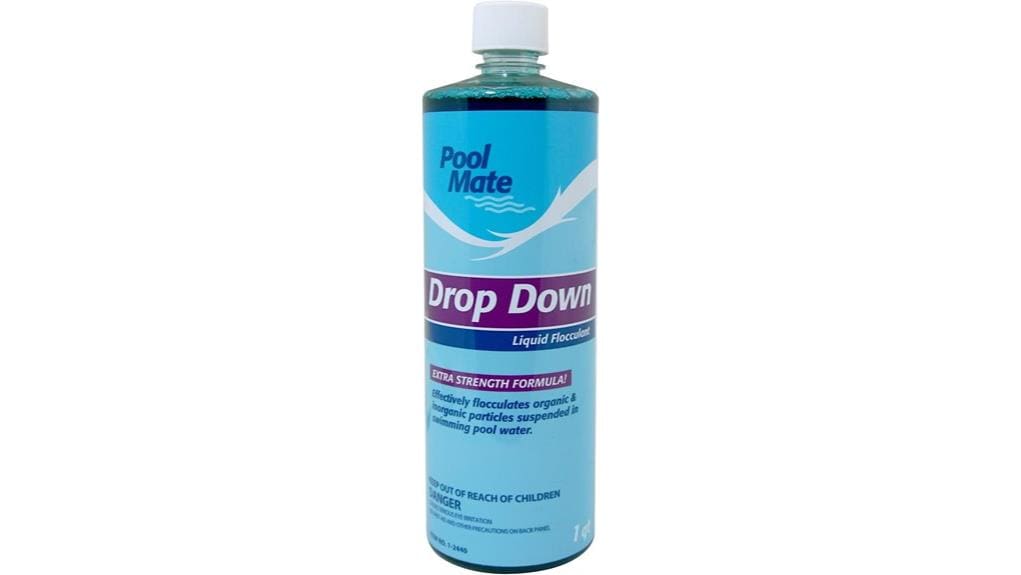
You’ll find Pool Mate’s 1-quart Premium Drop Down Liquid Flocculant is a reliable, easy-to-dose option that makes cloudy pools clear by coagulating fine particles into sinkable flocs; it’s typically dosed at 1 oz per 5,000 gallons for routine cloudiness with 24–48 hours to settle, and heavier turbidity needs larger doses and patience. It works with cartridge, sand, or D.E. systems when you follow vacuum-to-waste or backwash steps, and further details follow below.
Some Key Takeaways
- Effective 1-quart liquid flocculant that reliably clears cloudy pools by aggregating fine particles into sinkable flocs.
- Standard dosing is 1 oz per 5,000 gallons; heavy turbidity may need about 4 oz per 5,000 gallons.
- Expect settling and vacuum-to-waste removal over 24–48 hours, sometimes up to 72 hours for severe cloudiness.
- Compatible with cartridge, sand, and D.E. filters when following pump-off or vacuum-to-waste procedures.
- Good value for small pools and occasional use; consider concentrates or multi-packs for larger or frequent treatments.
Quick Verdict: Is Pool Mate 1-Qt Flocculant Worth Buying?
Although it’s compact, Pool Mate’s 1-quart liquid flocculant delivers a reliable, cost-effective way to clear cloudy pools by binding fine particles so they settle for vacuuming. You’ll find it worth buying if you want an affordable, straightforward adjunct to regular maintenance: dosing is simple, and applications for cartridge, sand, or D.E. filters are documented. Consider cost effectiveness alongside your pool size and turbidity frequency; heavy cases need larger doses. User reviews generally note effectiveness and ease of use, with occasional mentions of required patience for settling. If you value predictable results and community-tested performance, this fits. Homeowners who enjoy their outdoor spaces often prioritize clearer pool water as part of yard and patio upkeep.
How Pool Mate Works and What It Treats (Cloudiness, Suspended Particles)
If you decide Pool Mate 1-Qt is the right clarifier for your maintenance routine, it’s helpful to understand exactly how it clears cloudy water and what kinds of particles it treats. You’ll apply a liquid that promotes particle aggregation: tiny organic and inorganic particulates collide and bind into larger flocs. Those flocs sink via sediment settling to the pool floor, where you vacuum to waste or remove them per your filter type. It targets suspended algae, silt, fine debris, and other colloidal matter that normal filtration misses. Used responsibly, it complements routine chemistry and circulation to restore clarity for everyone who shares your pool. Many homeowners use clarifiers alongside pool clarifiers and other products sold for outdoor pool maintenance to keep their water clear.
Real-World Performance and Dosing: Results for Normal vs. Heavy Turbidity
When you dose Pool Mate according to the label, you’ll typically see quick clarification for routine cloudiness: the standard 1 oz per 5,000 gallons helps bind fine, suspended particles into flocs that settle within 24–48 hours, making them easy to vacuum to waste or remove per your filter type. For normal turbidity, you’ll notice improved transparency within a day; dosage tolerance is forgiving around the recommended dose. For heavy turbidity follow the higher ~4 oz/5,000 gal approach, expect longer settling time (24–72 hours), and be prepared for more intensive removal. Results are predictable when you follow procedure. Many homeowners also use pool test strips to monitor water chemistry before and after flocculation to ensure balanced conditions.
Filter-Type Workflow and Step-by-Step Use (Cartridge, Sand, D.E.)
Because each filter type handles settled floc and backwash differently, you should follow a specific workflow for cartridge, sand, or D.E. systems to avoid clogging and guarantee efficient removal. For cartridges, perform cartridge maintenance: turn pump off for heavy doses, remove the element, reassemble for vacuum-to-waste, then vacuum slowly using careful vacuum techniques until sediment clears; reinstall and monitor pressure. For sand and D.E., prepare for vacuum-to-waste, vacuum slowly, then use proper backwash timing if pressure rises. Always confirm filter compatibility before use, follow pressure cues, and resume normal filtering once water clears for consistent pool care. Many homeowners find that combining automatic pool vacuums with regular maintenance makes outdoor living more relaxing and effortless.
Value, Packaging, and Buying Considerations (Price, Size, Warranty, Alternatives)
Although the 1-quart size keeps storage and dosing simple, you’ll want to weigh cost-per-gallon treated and warranty support when judging value. You’ll compare price comparisons across brands to see if the unit dose fits your pool size; at 1 ounce per 5,000 gallons, a quart treats many small pools but may not suit large or frequent treatments. Check packaging durability—tight cap, sturdy plastic, clear labeling—to avoid leaks and accidental misuse. Warranty is available through Robelle customer service; confirm terms before buying. Also consider concentrated alternatives or multi-packs if you need greater economy or convenience. Homeowners who enjoy their outdoor spaces should also consider how routine shock treatments fit into an overall pool maintenance plan that keeps water safe and sparkling.
Some Questions Answered
Is Pool Mate Safe for Vinyl or Plaster Pool Surfaces?
Yes — you can use Pool Mate on vinyl and plaster surfaces if you follow directions and avoid prolonged contact during heavy treatments. You’ll preserve vinyl compatibility by applying around the perimeter or into the skimmer and by vacuuming to waste promptly; for plaster, stick to recommended doses and brush as instructed to support surface restoration. You’ll want to monitor chemistry and rinse equipment to keep all surfaces safe and restored.
Can It Be Used With Saltwater Chlorinators?
Yes — you can use it with salt chlorinators, but you should be careful. You’ll apply the liquid flocculant per directions while the system’s running or off for heavy doses, and it won’t harm sanitization. However, repeated heavy use can increase debris that contacts the cell and may contribute to electrode wear over time. You’ll belong to a careful maintenance group if you rinse cells, monitor build-up, and follow manufacturer care to minimize wear.
Does the Flocculant Affect Pool pH or Chlorine Levels?
No, it won’t markedly alter pH impact or chlorine interaction when used per directions. You’ll find flocculants bind particles without changing water chemistry much, though very large doses or organic load can slightly consume free chlorine as particles settle. You should test pH and chlorine after treatment and adjust if needed. By monitoring levels you’ll keep your pool balanced and feel confident maintaining clear, safe water with others who care about proper pool care.
Is This Product Safe for Pets and Wildlife if Pool Drains to Yard?
It’s unlikely to be safe for pets or wildlife; you should assume some risk. Pet toxicity and wildlife impact depend on concentration and drainage amount. Don’t drain treated water onto lawns or areas animals access. Follow label directions for disposal, neutralize or dilute water if required, and contact manufacturer or local authorities for guidance. You’ll protect animals best by vacuuming to waste away from habitats and keeping pets off treated areas until cleared.
Can Leftover Product Be Stored Long-Term After Opening?
Yes — you can store leftover product long-term after opening if you follow proper reseal methods and storage lifespan guidance. Keep the bottle tightly capped, upright, in a cool, dry, shaded area away from children and pets. Label with opening date; expect effectiveness for at least one season (12 months) under ideal conditions. If color, clarity, or performance changes, dispose per local hazardous-waste rules and don’t use it.