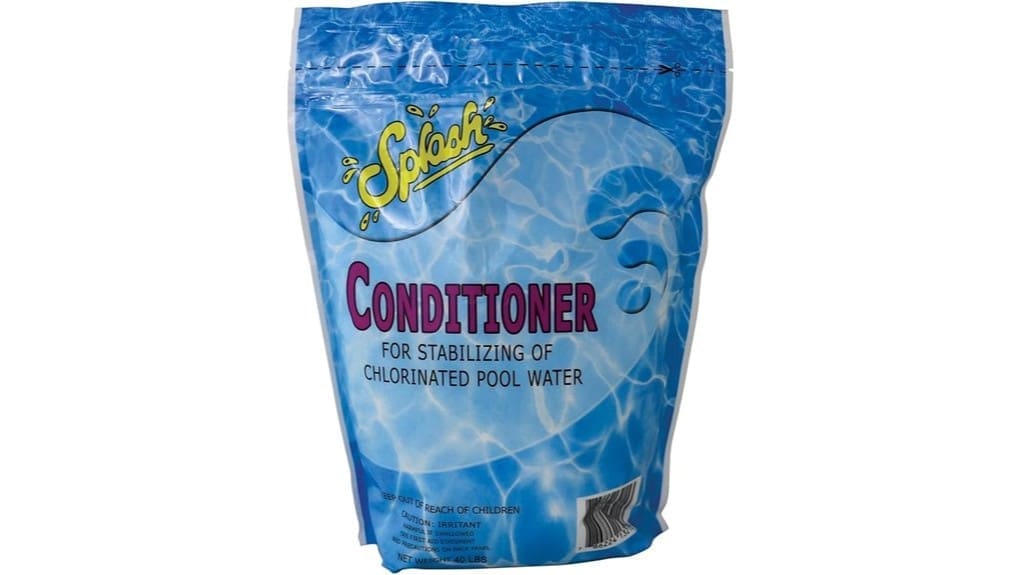
You’ll find Robelle’s 40-pound granular stabilizer a cost-effective way to raise cyanuric acid and cut sunlight-driven chlorine loss for medium to large pools. It dissolves fairly fast if pre-mixed or added slowly to the skimmer, and 6 oz per 5,000 gallons raises CYA about 10 ppm so dosing is predictable. The bag’s heavy and you must avoid over-stabilizing, but it’s great for seasonal upkeep; scroll on for detailed dosing, testing, and storage tips.
Some Key Takeaways
- 40-pound bag of cyanuric acid provides economical bulk stabilizer for pools, raising CYA predictably when dosed correctly.
- Use 6 oz per 5,000 gallons to increase CYA ~10 ppm; pre-dissolve or add slowly to the skimmer.
- Run the pump 24 hours after dosing, then test and adjust cyanuric acid and free chlorine levels.
- Pros: cost-effective for medium/large pools and improves chlorine retention; cons: heavy bag and over‑stabilization risk.
- Store sealed in a cool, dry place, verify UPC/ASIN before buying, and use Robelle support or 30-day returns if issues arise.
Quick Verdict and Key Specs for Robelle 40-Pounds Chlorine Stabilizer
While you want reliable chlorine protection, Robelle’s 40-pound Chlorine Stabilizer delivers concentrated cyanuric acid in a granular form that’s made to cut sunlight-driven chlorine loss and extend sanitizer life. You’ll appreciate clear specs: 40 lb granular, made in USA, model 3-2605B-08BX, 640 oz. Its stabilizer chemistry is straightforward—cyanuric acid—to reduce UV degradation and boost chlorine longevity. It disperses rapidly, fits pools needing 40–100 ppm, and comes with a 30-day return window plus manufacturer support. For practical buyers, it’s effective, economical, and focused on sun protection without unnecessary additives or complicated instructions. Homeowners who enjoy their outdoor spaces will find it especially useful for maintaining clear pool water.
How to Dose and Add Cyanuric Acid for 5,000–20,000-Gallon Pools
Now that you know the product’s basics, here’s how to actually dose it for pools between 5,000 and 20,000 gallons. For pool sizing, use the chart: 6 ounces raises cyanuric acid 10 ppm per 5,000 gallons; scale accordingly (e.g., 12 oz for 10 ppm in 10,000 gal). For new fills, add 4 oz per 1,000 gallons to reach target 40–100 ppm. Pre-dissolve granules in warm water or add slowly into the skimmer. Mind application timing: run the pump and recirculate 24 hours to dissolve fully, then test and adjust stabilizer and free chlorine. Clearer pool water often requires routine balancing and occasional use of flocculants to remove fine particles and improve clarity, which is why homeowners should understand proper dosing and maintenance practices for their outdoor pools, including using pool flocculants.
Performance in Use: Stabilizer Levels, Chlorine Retention, and Dissolving Time
When you add Robelle’s cyanuric acid correctly, you’ll see stabilizer levels climb predictably—about 6 oz per 5,000 gallons raises CYA by roughly 10 ppm—helping your chlorine last longer under sunlight and reducing daily chlorine burnoff. You’ll monitor CYA with a reliable test kit and hit the recommended 40–100 ppm window to limit sunlight degradation without over-stabilizing. Dissolution rate is reasonable if you pre-dissolve or feed slowly through the skimmer; expect full recirculation for 24 hours. In practice, chlorine retention improves noticeably once target CYA is reached, cutting weekly chlorine demand and stabilizing residuals for routine maintenance. Homeowners who enjoy their outdoor spaces often pair shock treatments with stabilizers to keep pools sparkling and low-maintenance, especially when using pool shock treatments from specialized suppliers.
Pros, Cons, and Ideal Buyer for a 40-Pound Granular Stabilizer
Because it’s concentrated and sold in a 40-pound bag, Robelle’s granular cyanuric acid gives you long-lasting value and predictable results for maintaining CYA in medium to large pools. You’ll get strong algae prevention by keeping stabilizer in the recommended 40–100 ppm range, which helps chlorine last through sunny days. Pros: economical bulk, fast dispersal, simple dosing for large volumes. Cons: heavy bag to handle, over‑stabilizing risk if you don’t test, not ideal for very small pools. Ideal buyer: owners of medium/large pools, seasonal swimmers, and those preparing or winterizing pools who want reliable, cost‑effective stabilization. Regular phosphate testing and removal can further improve algae control by reducing available nutrients for growth and enhancing sanitizer effectiveness phosphate removers.
Where to Buy, Store, Test Levels, and Warranty/Return Tips
If you want reliable supply and good value, buy the 40‑pound Robelle bag from reputable pool-supply retailers or major online marketplaces where the UPC/ASIN (034261223113 / B0F7BQL6PM) and model number match—this helps avoid counterfeit or mislabeled product. Check retail availability before season start; bulk bags sell quickly. Store the granular cyanuric acid in a cool, dry spot, sealed and off concrete to preserve packaging and meet storage conditions. Test cyanuric acid with a reliable kit after dosing; target 40–100 ppm. For issues, contact Robelle customer service and use the platform’s 30‑day return guarantee if needed. Proper calcium hardness management is also important to keep pool surfaces and equipment in good condition, so monitor total alkalinity and calcium levels along with cyanuric acid and use calcium boosters when necessary.
Some Questions Answered
Will Cyanuric Acid Affect Saltwater Chlorine Generators?
Yes — cyanuric acid affects saltwater chlorine generators. You’ll see reduced chlorine output and slightly lower generator efficiency at high CYA levels because stabilized chlorine persists longer, so the cell runs differently. Excessive CYA can promote sensor fouling and increase maintenance needs, while salt corrosion risk to the cell isn’t directly caused by CYA but poor maintenance and imbalanced water chemistry can accelerate corrosion. Monitor CYA and follow manufacturer guidelines.
Is This Product Safe for Vinyl Pool Liners?
Yes — it’s generally safe for vinyl pool liners when used correctly. You should still perform liner testing after adding cyanuric acid to make certain no reaction with additives or high concentrations. Add slowly, follow dosage and dissolution instructions, keep pH and chlorine in recommended ranges, and recirculate 24 hours. If discoloration or softening appears during liner testing, stop use and contact the manufacturer or a pool professional for guidance.
Can I Use It in Hot Tubs or Spas?
No — you shouldn’t use it in hot tubs or spas. Hot tubcompatibility is poor because cyanuric acid concentrates in small volumes, impairing sanitizer performance and making spamaintenance harder. You’d over-stabilize quickly, raising CYA above recommended levels and forcing higher chlorine levels or draining. For spas, stick to products formulated for small, high-temperature systems and test frequently to keep sanitizer and pH balanced.
Does It Contain Any Anticaking Agents or Additives?
No, the product info doesn’t specify any anticaking presence or additive disclosure; you’ll want to assume it’s primarily concentrated cyanuric acid. If you need certainty, contact Robelle customer service for full additive disclosure and warranty details. Test a small batch first if you’re concerned about residues or clumping. Keep storage dry and sealed to prevent caking and preserve effectiveness.
Is It Suitable for Commercial/Public Swimming Pools?
Yes — you can use it in commercial/public pools, but you’ll need careful dosing and monitoring. It stabilizes chlorine effectively, yet high cyanuric acid can reduce disinfection, so align with public liability standards and local regulations. Stick to maintenance scheduling, continuous recirculation after application, and frequent testing to keep 40–100 ppm CYA and 2.0–4.0 ppm chlorine. If unsure, consult pool health authorities or a pro for recordable compliance.