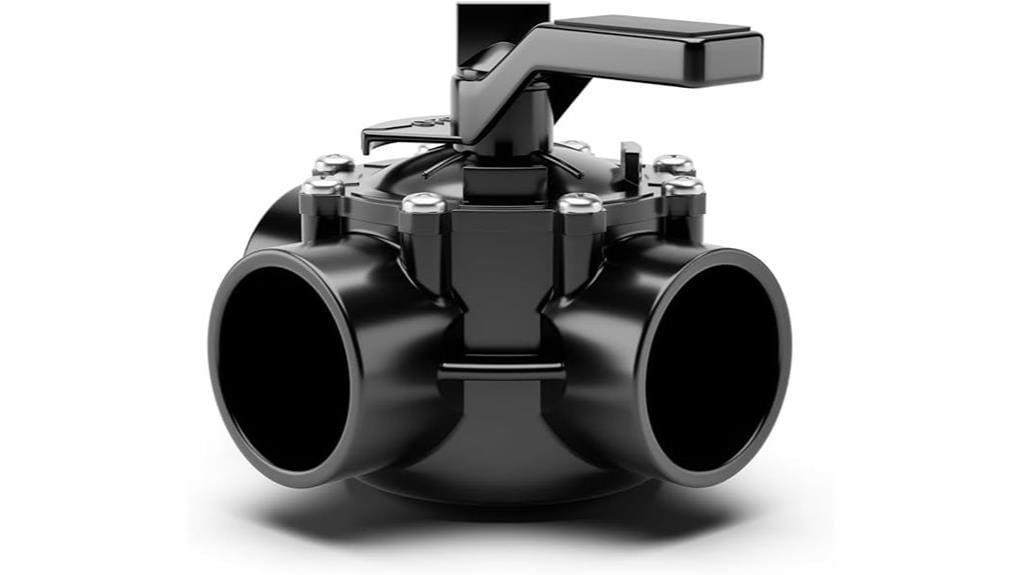
You’ll find the FibroPool 1½” 3‑way diverter is a compact, serviceable CPVC valve with PTFE seats that lets you isolate, blend, or partially regulate flows for heater bypasses, salt cells, and chemical lines. It seals tightly across temperature swings, resists chlorinated and saline environments, and is repairable with common tools—no greasing needed. Plan for slip‑glue connections and check heater/salt‑cell compatibility. Keep going to get installation tips, pros/cons, and maintenance steps.
Some Key Takeaways
- Compact 1½” CPVC 3‑way diverter offers positive‑seal routing, blending, and partial flow regulation for pool systems.
- PTFE seats provide lubeless, low‑friction sealing with predictable flow and minimal leakage across temperature swings.
- Serviceable design allows quick internal part access and PTFE seat replacement using basic tools to minimize downtime.
- Slip‑port (1½”) connections require planning for glue fittings or adapters and may limit compatibility with threaded equipment.
- Best for heater bypasses, chemical feeders, and salt generators; consider larger or brass alternatives for different pipe sizes or higher durability.
What the FibroPool 1½ 3‑Way Diverter Valve Is and Who It’s For
Think of the FibroPool 1½ 3‑way diverter as a compact, serviceable valve that lets you route or blend 1½‑inch flows without greasing or frequent maintenance. You’ll find it aimed at a clear target audience: pool technicians, DIY owners, and service teams who value reliable, low-maintenance components. In installation scenarios like heater bypasses, chemical dispenser lines, or salt generator routing, you’ll use its positive-seal 3‑way action to isolate, blend, or partially regulate flow. You’ll appreciate the slip‑port connections and serviceable design that keep downtime minimal, and you’ll feel part of a community focused on practical, durable pool plumbing solutions. It’s a smart upgrade for homeowners looking to upgrade their pool pump setup and enjoy better outdoor living.
How the Valve Is Built: CPVC Body, PTFE Seats, and Serviceable Design
Built from CPVC with PTFE seating, the FibroPool 1½ 3‑way diverter combines temperature and impact resistance with low‑friction, lubeless operation. You’ll note CPVC longevity in the molded body, resisting heat and physical stress common in heater and chemical setups. PTFE seats deliver consistent sealing without grease; PTFE maintenance is minimal—inspect and replace seats rather than lubricate. The Serviceable mechanism lets you access internal parts with basic tools, so your team can swap seats or check the rotor quickly. Design choices prioritize straightforward upkeep, shared standards, and predictable service life, keeping installations unified and dependable. Homeowners will appreciate that proper box selection and installation contribute to safe, code‑compliant pool electrical setups, especially when paired with pool electrical boxes.
Performance in Real Use: Flow Control, Sealing, and Thermal/Chemical Resistance
When you put the FibroPool 1½ 3‑way diverter into service, you’ll find its CPVC body and PTFE seats deliver predictable flow modulation, tight sealing, and strong resistance to heat and pool chemicals. You’ll adjust the handle to proportionally restrict any port, and the valve responds with stable flow control at common pool pump pressures. PTFE seats mean lubeless operation and contribute to seal longevity under chlorinated, saline, and heated conditions. You’ll notice minimal creep or leakage during seasonal temperature swings. Serviceable design lets your crew replace wear parts quickly, keeping systems reliable and everyone on your team confident. Homeowners can integrate these valves into their outdoor pool plumbing systems to simplify maintenance and control.
Installation Tips and Compatibility: Slip vs. Socket, Heater, Salt Generator, and Chemical Feeder Hookups
Because the FibroPool 1½ 3‑way comes with 1½” slip ports designed for 1½” pipe-glue connections, you’ll want to plan fittings and clearances before you cut pipe. Use short slip couplers or adapter fittings when connecting to threaded equipment; avoid forcing socket adapters that stress CPVC. Consult a compatibility guide for heater, salt generator, and chemical feeder hookups—confirm materials, max temp, and flow direction. For heaters, keep straight pipe runs and a union nearby. For salt generators and feeders, install isolation valves and check electrical grounding. You’re part of a community that values tidy, serviceable plumbing and safe hookups. Keep your outdoor pool warm all season long with proper heater selection and installation practices, and review heater compatibility before purchasing.
Pros, Cons, and Value: When to Choose This Diverter Valve and Alternatives
After planning fittings and clearances for the slip ports, weigh whether the FibroPool 1½” 3‑way is the right choice for your system: it gives a compact, serviceable way to route flow to heaters, chemical feeders, or salt generators without lubricants, and its CPVC/PTFE build resists heat and impact better than generic PVC valves. You’ll like its serviceable design and partial‑closure control when you need precise flow. Consider cons: limited to 1½” piping and slip/glue connections, replacement parts availability, and slightly higher purchase price. Run a simple maintenance schedule and perform a cost comparison versus larger multiport or brass alternatives. For homeowners focused on improving return fitting performance, investing in quality components helps upgrade poolflow.
Some Questions Answered
What Is the Valve’s Warranty Period and Coverage?
The valve typically carries a limited one-year warranty covering defects in materials and workmanship; it won’t cover improper installation, chemical misuse, or damage from freezing. You should check the manufacturer’s paperwork for exact terms. For material compatibility, confirm CPVC and PTFE suit your chemicals before installing. Installation tips: follow torque specs, use proper glue for 1 1/2 pipe, test for leaks, and verify warranty eligibility.
Are Replacement PTFE Seats Sold Separately?
Yes — you can buy replacement PTFE seats separately. You’ll get parts that maintain PTFE longevity when you service the valve, letting you restore lubeless operation and reliable sealing. Check seat tolerances carefully to make certain a snug fit and smooth actuation; mismatched tolerances can leak or bind. Order OEM seats or verified equivalents, and follow serviceable-design instructions so your group’s heater, chemical dispenser, or salt system stays dependable.
Can the Handle Be Locked in Place or Padlocked?
No, you can’t padlock the handle as supplied; it lacks a built-in lock mechanism. You can, however, add security options: install an external clamp-style lock or a small hasp on the valve mounting bracket, or fit a tamper-resistant cover plate around the handle. You’ll want to make certain any modification maintains CPVC clearance and doesn’t stress the PTFE seats. These practical steps keep your pool system secure and let you join others using similar solutions.
Is the Valve Uv-Resistant for Outdoor Pool Installations?
Yes — you’ll get UV resistant materials in this valve, designed for outdoor pool use. The CPVC body resists sunlight degradation and FibroPool reports sunlight testing for long-term exposure. You won’t need extra shielding; the PTFE seats also tolerate UV indirectly by avoiding lubricant breakdown. You’ll feel confident installing it poolside, knowing the serviceable, robust construction is made to withstand sun, heat, and routine outdoor conditions.
What Is the Maximum Working Pressure Rating?
The maximum pressure is 75 psi — the valve is rated 75 psi for typical pool plumbing. You’ll rely on CPVC construction and PTFE seats to handle that rated psi while resisting heat and impact. You can service it without grease, and you’ll appreciate its positive-seal, 3-way control for heaters, chemical feeders, or salt systems. Use standard 1½” slip and pipe-glue connections and keep within the 75 psi limit for safety.