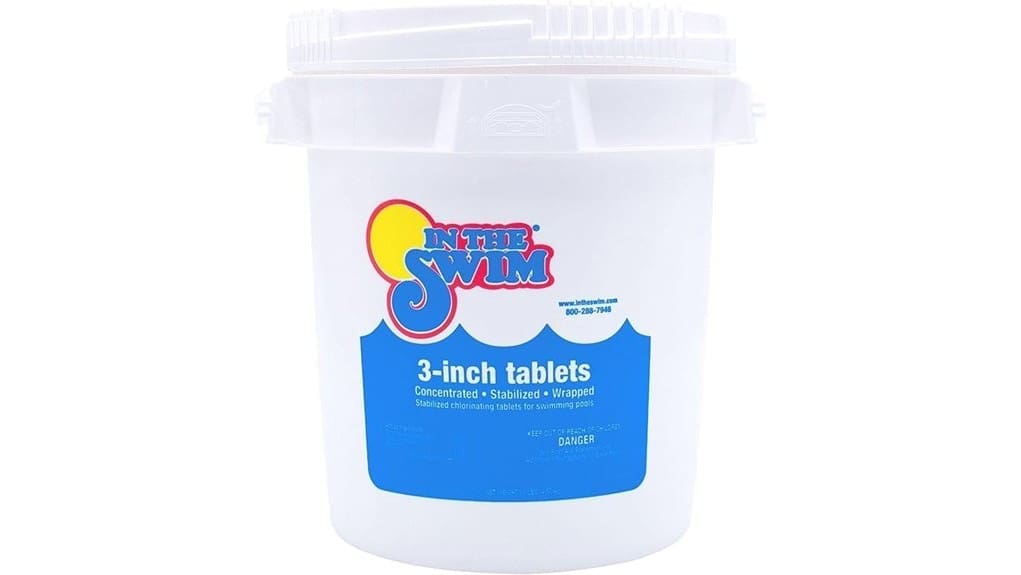
You’ll get 3‑inch trichlor tablets (≈99% trichloro‑s‑triazinetrione) made for floaters and automatic feeders that deliver slow, predictable dissolution and about 90% available stabilized chlorine per tablet. They’re sun‑stabilized to curb UV loss, packaged in 10‑lb bags, and best used within two years while stored dry and separate from acids. Expect steady 1–3 ppm maintenance residuals, CYA buildup over time, and routine safety handling; continue for guidance on dosing, monitoring, and alternatives.
Some Key Takeaways
- 3-inch Tri‑Chlor tablets deliver stabilized, slow‑dissolving chlorine suited for floaters and automatic feeders.
- Approximately 90% available chlorine and UV stabilizer provide consistent weekly free‑chlorine of 1–3 ppm.
- Tablets erode concentrically with low variability, offering predictable residuals and long shelf life (best within two years).
- Main drawbacks: CYA buildup over time, less dose flexibility, and potential feeder/equipment corrosion if misused.
- Recommended for routine maintenance of moderate outdoor pools; use alternatives for shock dosing or low‑CYA needs.
What the In The Swim 3-Inch Stabilized Chlorine Tablets Are and Who They’re For
While you maintain pool water, the In The Swim 3-inch stabilized chlorine tablets deliver a concentrated, slow-dissolving Tri‑Chlor sanitizer (99% trichloro‑s‑triazinetrione) in a 3‑inch tablet form designed for floaters and automatic feeders. You’ll use them to provide consistent, stabilized chlorine residuals that control bacteria, algae, and organic load. They suit operators who prioritize routine sanitization: residential owners, pool service technicians, and facility managers. Consider pool chemistry when dosing—adjust pH and alkalinity to optimize efficacy. User profiles dictate deployment frequency and feeder settings; match tablet placement to circulation patterns and occupancy to maintain target free chlorine levels efficiently. They are a popular choice for homeowners who enjoy caring for their outdoor spaces and keeping pools sparkling, especially when used with proper chlorine tablet tips.
Key Specs: Formulation, Tablet Size, Chlorine Strength, Packaging, and Shelf Guidance
Think of these tablets as a compact, high‑strength sanitizer: each 3‑inch In The Swim tablet is a slow‑dissolving Tri‑Chlor pellet (99% trichloro‑s‑triazinetrione) delivering about 90% available stabilized chlorine, packaged individually in a 10‑lb bag for use in floaters or automatic feeders; they’re sun‑stabilized to resist UV loss, non‑perishable in storage but best used within two years of manufacture for peak effectiveness. You’ll handle 3‑inch diameter, uniform-mass tablets formulated for predictable release. Packaging sustainability is limited by polymer wraps; consider recycling outer bags where accepted. Store dry at ambient storage temperature, away from heat, moisture, and combustible materials. These tablets are especially suited for homeowners who want low-maintenance sanitizer options for their outdoor pool floaters and feeders.
How They Perform in Pools: Dissolution Rate, Stabilization (UV Protection), and Sanitation Results
Because these 3-inch Tri‑Chlor tablets dissolve slowly and predictably, you can maintain a steady free chlorine residual with floaters or automatic feeders calibrated for their release rate. You’ll observe low dissolution variability under stable temperature and flow; tablets erode concentrically, producing consistent hypochlorous acid generation. The formulation includes UV stabilizer, providing measurable stabilizer longevity that reduces photolytic loss versus unstabilized products. Sanitation results show reliable bacteria and algae control with maintained free chlorine; residual bromine is negligible unless brominating agents are added. Overall performance supports swimmer safety when residuals are monitored and kept within recommended ppm ranges. For best results, also monitor and adjust pool pH regularly to keep water balanced and ensure clearer, safer swimming conditions.
How to Use Them Safely and Effectively in Floaters or Automatic Feeders
Having confirmed consistent dissolution and UV protection, you’ll set up floaters or automatic feeders to deliver steady chlorination without overconcentration. Position floaters away from skimmers and returns to guarantee uniform dispersion; adjust feeder output to target free chlorine 1–3 ppm. Handle tablets with gloves and eye protection in a well-ventilated area; store sealed, dry, and separate from incompatible acids to maintain proper ventilation and chemical compatibility. Do not mix with other sanitizers or shock. Inspect feeders and seals for corrosion regularly. Monitor chlorine and cyanuric acid levels weekly, and remove tablets immediately if equipment degradation or unexpected concentration spikes occur. For long-term pool protection, maintain appropriate cyanuric acid levels by monitoring stabilization and protecting against UV degradation to extend tablet effectiveness and pool water balance.
Pros, Cons, and Buying Recommendation: When to Choose These Tablets vs Alternatives
While stabilized Tri-Chlor tablets offer reliable, slow-release sanitization and UV protection that make them ideal for routine maintenance with floaters or feeders, you should weigh their pros and cons against alternatives based on pool size, cyanuric acid (CYA) tolerances, and dosing flexibility. Pros: consistent chlorine residual, long shelf life, compact 3-inch form for feeders, cost-effective per pound. Cons: raises CYA, less flexible dose control, contains cyanuric-stabilizer residues, potential environmental impact from cyanuric accumulation. Choose Tri‑Chlor for weekly maintenance in moderate-sized pools; choose unstabilized liquid or granular chlorine if you need rapid shock dosing or lower CYA. Consider pairing tablets with proper algaecide care for overall pool health and outdoor spaces.
Some Questions Answered
Do These Tablets Affect Pool pH Levels Long-Term?
Yes — you’ll see gradual pH drift if you rely solely on these trichlor tablets. They’re acidic and add cyanuric-stabilized chlorine while lowering pH over time. You’ll need consistent alkalinity buffering to resist that acidifying trend; maintain total alkalinity within recommended range and monitor pH regularly. Use sodium bicarbonate to raise alkalinity, and adjust pH with alkali as needed to prevent long-term corrosion or scale formation.
Can They Be Used in Saltwater or Mineral Pools?
Yes — you can use them, but monitor chemistry. These 3-inch tri‑chloro tablets offer saltwater compatibility and provide stabilized chlorine with mineral stability, so they’ll sanitize salt or mineral pools effectively. They’re slow‑dissolving and suited for floaters/feeders, but tri‑chloro lowers pH over time; you’ll need regular pH and cyanuric acid checks and occasional alkalinity adjustments to maintain balanced water and protect pool equipment.
Are They Safe for Vinyl Liners and Pool Covers?
Yes — you can use them with vinyl liners and pool covers. Their stabilized, slow‑dissolving Tri‑Chlor formula provides consistent chlorine levels that won’t abruptly degrade vinyl. Maintain proper dilution and avoid direct tablet contact with liner or cover to prevent localized bleaching or chemical damage. Monitor chlorine and pH regularly; that preserves vinyl compatibility and maximizes cover longevity through balanced, controlled sanitization and reduced chemical stress.
Do They Have Any Strong Odor During Use or Storage?
You won’t notice a strong odor from the tablets in normal pool use; their stabilized Tri‑Chlor formula releases chlorine odor only during dissolution and high concentrations. For storage, keep packages sealed and guarantee storage ventilation to avoid accumulated fumes; store in a cool, dry, well‑ventilated area away from organics. If you detect persistent odor, remove sources, increase ventilation, and inspect for damaged packaging or spills to prevent off‑gassing.
Can They Be Combined With Other Chlorine Products Safely?
No — you shouldn’t combine these tablets with other chlorine products directly. Tri-chlor tablets can cause hazardous chemical interactions if mixed with unstabilized chlorine, shock, or acidic additives. Practice sanitizer layering by keeping only one active chlorine source in feeders or floaters and add other treatments separately after full dispersion and testing. Always wait, measure free chlorine and pH, and follow label safety to avoid over-chlorination or reactive byproducts.