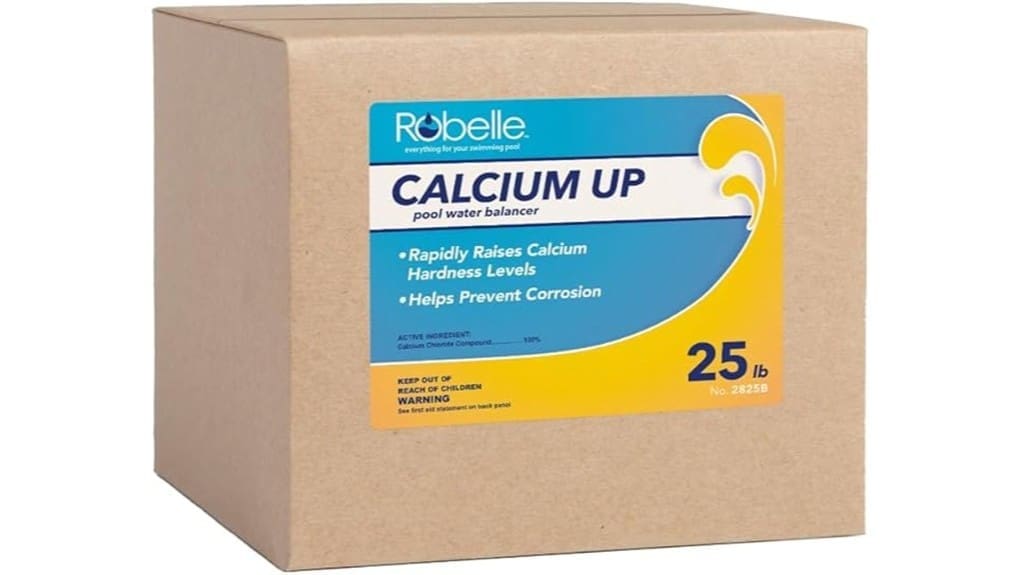
You’ll find Robelle’s 25‑lb Calcium Up is a cost‑effective, reliable granular calcium chloride for raising pool hardness. You’ll mix measured portions in a plastic bucket, add slowly with circulation, and expect 8 oz to raise 10 ppm per 5,000 gallons. It prevents plaster etching, staining, and corrosion when used incrementally and tested between doses. Take precautions—gloves, eye protection, avoid dust—and follow dissolution limits; continue for full dosing examples and safety details.
Some Key Takeaways
- Reliable 25 lb granular calcium chloride effectively raises pool calcium hardness with predictable dissolution when mixed per instructions.
- Dosing: 8 oz increases hardness 10 ppm per 5,000 gallons, enabling accurate calculations for any pool size.
- Economical: competitive cost per ppm compared with similar 25 lb products, good for large or repeat treatments.
- Safety: dissolve in plastic bucket (≤2 lb/5 gal), add slowly with pump running, wear gloves and eye protection.
- Caveats: avoid overcorrection to prevent scaling; reseal bags and store dry to maintain long-term potency.
Quick Verdict: Is Robelle 25‑Pound Calcium Up Worth Buying?
Bottom line: buy it if you need a reliable, economical way to raise pool calcium hardness. You’ll get 25 lb of dry granular increaser that dissolves predictably when mixed per instructions; dosing metrics let you calculate ppm change precisely (8 oz → 10 ppm per 5,000 gal). In a price comparison against comparable 25 lb products, Robelle is competitive on cost per ppm increase. You can store unopened bags for long term storage in a cool, dry area to preserve efficacy; once opened, reseal and avoid moisture. Use testing and controlled additions to meet target hardness without overshooting. Many homeowners use calcium increasers to protect plaster and reduce corrosive scale and corrosion in pool surfaces and equipment.
How Robelle Calcium Up Works and What It Prevents
Having decided Robelle’s 25‑lb Calcium Up is a practical choice, you should understand how it works and what problems it prevents. You dissolve measured granular calcium chloride, introduce the solution with circulation running, and raise total calcium hardness to target ppm. Increasing calcium hardness shifts equilibrium toward higher calcium saturation, reducing aggressive water that leaches plaster, grout, and metal. At correct levels you prevent surface etching, staining, and corrosion. Conversely, avoiding overcorrection minimizes scale formation on heaters and plumbing. You test before and after dosing, follow recommended mixing ratios, and dose incrementally to balance hardness without inducing scale prevention conflicts. Properly maintained calcium levels also help protect pool surfaces and equipment by reducing corrosion and staining.
Real‑World Dosing Guide : How Much to Add for Common Pool Sizes?
For practical dosing, start by testing your pool’s current calcium hardness, then calculate the required increase and translate that into Robelle 25‑lb increments using the product’s conversion (8 oz raises 10 ppm per 5,000 gallons); for example, to raise a 15,000‑gallon pool by 30 ppm you’d add 3 × 8 oz × 3 = 72 oz (4.5 lb) dissolved per recommended mixing ratios, applied in staged doses with circulation running and retesting between additions. Use pool calculators to scale for common sizes: 5,000, 10,000, 15,000 gallons. Factor seasonal adjustments for temperature and evaporation; add gradually, observe, retest. Homeowners who enjoy their outdoor spaces should pair dosing with regular testing and maintenance using pool test strips to keep water clear and balanced.
Mixing, Application, and Safety Tips to Avoid Problems
When you mix and apply Robelle Calcium Up, dissolve the measured granules in a plastic bucket of pool water following the up-to-2-lb-per-5-gallon guideline, stir until fully dissolved, then add the solution slowly around the pool perimeter with the circulation pump running to guarantee even dispersion. Measure pool volume and target ppm; use the product chart to calculate additions. Observe dilution ratios and never exceed recommended per-period doses. Wear protective gear—gloves and eye protection—and avoid inhaling dust. Pre-dissolution prevents localized high concentrations. Re-test hardness after each adjustment and wait recommended equilibration time before swimming or adding other chemicals. Keeping pH balanced helps maintain clearer, safer water and optimize how hardness adjustments affect overall water quality.
Pros, Cons, and Who Should Choose This 25‑Pound Bag
If you want a reliable, concentrated solution for raising calcium hardness across multiple treatment cycles, Robelle’s 25-pound bag delivers predictable dosing: 8 ounces raises hardness 10 ppm per 5,000 gallons, and you can safely dissolve up to 2 lb in ~5 gallons of water for each addition. Pros: high potency reduces frequency, clear dosing metrics, suitable for large pools and repeat treatments; cost analysis favors bulk purchase versus single-use packets. Cons: dry granular handling requires care; limited reseal on bag raises durability concerns during storage. Choose this if you manage medium-to-large pools and prefer economical, controlled dosing. Proper filtration and maintenance of pool filters and filter powder selection help maintain water clarity and overall pool health.
Some Questions Answered
Is This Product Safe for Saltwater Pools?
Yes — you can use it in saltwater pools, but monitor carefully for saltwater compatibility and potential electrode corrosion. You’ll dissolve recommended doses in a plastic bucket, add with circulation, and retest hardness. Keep calcium within the specified ranges to reduce corrosive water chemistry. High calcium helps prevent etching, yet chlorinated salt systems and electrodes still need regular inspection; adjust additions slowly to avoid localized oversaturation.
Can I Use It With Algaecide or Chlorine Immediately?
Yes — you can use it with algaecide or chlorine, but stagger dosing timing. Test hardness first, dissolve calcium up per mixing ratio, then add with circulation. Wait 30–60 minutes after adding calcium before dosing algaecide; wait 2 hours (or until stabilised reading) before adding high chlorine shock. That prevents precipitation and guarantees pool compatibility. Adjust timing per pool size and manufacturer instructions to avoid chemical interaction.
How Long Until Calcium Hardness Stabilizes After Dosing?
You’ll see calcium hardness begin stabilizing within 2–4 hours after dosing with circulation running, though full uniformity can take 24 hours. Perform pool testing after 4 hours, then again at 24 hours to confirm levels and adjust dosing frequency. If levels remain low, wait 2 hours between additional safe additions per dosing guidelines. Always dissolve granules, add slowly, and retest before repeating any dose.
Does It Affect Pool pH or Alkalinity?
No, adding calcium hardness won’t directly change pH much, but it influences calcium interaction with carbonate chemistry and pH buffering. You’ll mainly raise dissolved Ca2+; pH and total alkalinity remain largely unchanged if you dilute and dissolve properly. However, shifts in carbonate equilibrium can alter buffering capacity slightly, so you should test pH and alkalinity after dosing and adjust as needed to maintain target ranges and water stability.
Where Is Robelle Manufactured?
Robelle is manufactured in Canada and imported to the USA. You’ll see “Made Canada” on packaging while distribution channels note “Imported USA.” For compliance, labels and shipping documentation reflect Canadian production with U.S. import handling. If you need specific factory details or lot origin, contact Robelle customer service with the model number (2825B-A) and UPC (034261217068); they’ll provide manufacturing site and batch traceability.