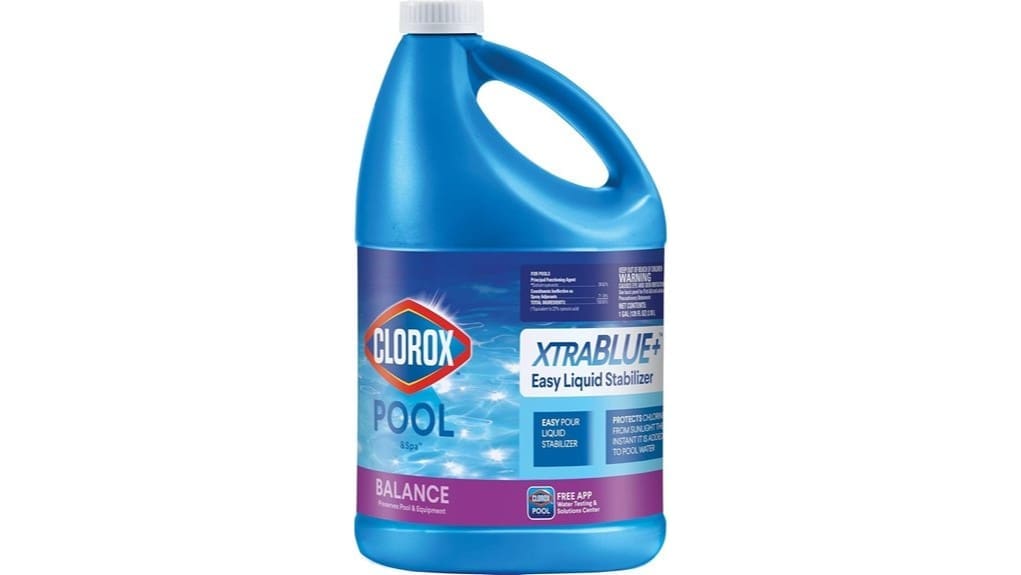
You’ll get a fast‑acting liquid cyanuric acid stabilizer that reliably protects free chlorine from UV loss when dosed per label. It disperses quickly, raises CYA predictably, and reduces how often you add chlorine without changing disinfection chemistry if properly balanced. Wear gloves and eye protection, add incrementally with circulation, monitor free chlorine and pH, and store sealed out of heat. Continue for detailed dosing, spill response, and cost comparisons.
Some Key Takeaways
- Effectively raises cyanuric acid to protect free chlorine from UV degradation when dosed per label.
- Liquid formula disperses rapidly, enabling quick measurable chlorine preservation within hours.
- Predictable stabilization reduces frequency of chlorine additions and maintains sanitizer efficacy.
- Requires PPE for handling, upright cool storage, and careful spill cleanup per label instructions.
- Compare cost per ppm·gallon with granular alternatives to assess value and dosing convenience.
Quick Verdict: Is Clorox XtraBlue Plus Worth Buying?
Cutting straight to it: Clorox XtraBlue Plus is worth buying if you need a fast, reliable way to protect pool chlorine from UV degradation and maintain residual levels. You’ll appreciate straightforward dosing, rapid dissolution, and predictable stabilization that reduces repeat chlorine additions. From a safety standpoint, follow label PPE and storage guidance to minimize exposure and contamination. Expect measurable cost savings through lower chlorine consumption when used per instructions; verify with periodic residual tests. Review aggregate user reviews for real-world consistency and application notes, but rely on objective monitoring — free chlorine readings — to confirm product performance in your pool. Homeowners who enjoy their outdoor spaces should also consider proper chlorine tablet care to keep their pools sparkling.
How XtraBlue Plus Works and What’s in the Bottle
XtraBlue Plus works by delivering a concentrated liquid stabilizer—primarily cyanuric acid (CYA) in a water-soluble carrier—that binds to free chlorine molecules and selectively shields them from ultraviolet-driven photodegradation; you’ll see a more persistent free chlorine residual because fewer hypochlorous agents are destroyed by sunlight. You’ll handle a formulated chemical composition optimized for rapid dispersion: CYA concentration, solvent carrier, and inert additives to maintain stability. Apply per label; avoid skin/eye contact and inhalation. The product’s uv protection mechanisms are predictable: reversible CYA–chlorine complexing reduces photolytic loss without altering chlorine’s disinfection chemistry when dosed correctly. Maintaining proper total alkalinity helps keep pool water balanced and supports effective sanitizer performance, so check and adjust alkalinity as needed using alkalinity increasers.
Real-World Performance: Effectiveness, Speed, and Stability
When you dose Clorox Pool & Spa XtraBlue Plus according to the label, you’ll see a rapid and measurable preservation of free chlorine levels because the liquid stabilizer disperses quickly and raises cyanuric acid (CYA) concentration to buffer against UV-driven chlorine loss; this delivers predictable effectiveness without needing prolonged dilution or agitation. You’ll observe consistent chlorine retention in routine testing within hours. Application speed minimizes exposure windows where pathogens could proliferate. Stability of CYA and residual chlorine remains steady over standard sunlight cycles, provided you maintain recommended levels. Monitor regularly; follow safety precautions to avoid over-stabilization and maintain sanitizer efficacy. Using a solar cover can further help retain heat and reduce chemical loss.
How to Use 128 Fl Oz Xtrablue Plus Safely and Effectively
Having confirmed that the stabilizer quickly raises cyanuric acid and preserves free chlorine under sunlight, you’ll next apply the 128 fl oz XtraBlue Plus with strict attention to dosing, handling, and monitoring to keep levels safe and effective. Calculate dose from pool volume and add incrementally to skimmer or deep end while pump circulates. Wear protective gear—chemical-resistant gloves and eye protection—avoid inhalation and skin contact. Store upright in cool shaded area, sealed, for proper storage away from heat and children. For spills, isolate area, absorb with inert material, follow spill cleanup procedures, then dispose per local regulations and label instructions. Maintain proper pH to ensure clearer, safer water and balanced pool chemistry by monitoring regularly and adjusting as needed for balanced pH.
Price, Value Comparison, and Best Alternatives
For most pool owners, price and value hinge on how efficiently a stabilizer raises and maintains cyanuric acid relative to cost per treatment, so you’ll want clear metrics before buying. Compare XtraBlue Plus unit cost (128 fl oz) to granular stabilizers on price comparison per ppm·gallon. Calculate treatment dose, CYA increase per ounce, and cost per ppm increase to assess value. Factor handling safety: liquid reduces dust inhalation but requires spill control. For alternative brands, consider both liquid and granular ChemTech or SwimRight offerings with published dosing charts. Choose based on measured efficacy, storage safety, and total treatment cost. Many homeowners also consider how well a product improves overall pool water clarity when paired with an appropriate filter powder, since effective filtration complements stabilizer performance and keeps water sparkling; see filter powder options for best results.
Some Questions Answered
Is Xtrablue Plus Safe for Vinyl or Fiberglass Pools?
Yes — you can use XtraBlue Plus in vinyl and fiberglass pools if you follow directions. You’ll preserve vinyl compatibility by avoiding over-dosing and by adding product to circulation with pump running. For fiberglass durability, monitor cyanuric acid levels and total alkalinity to prevent surface stress. Wear protective gloves and eyewear, add measured doses slowly, and test water regularly to maintain safe, balanced chemistry and protect finishes.
Can I Use It With Saltwater Chlorine Generators?
Yes — you can use it with saltwater chlorine generators, but you’ll monitor salt cell compatibility and adjust generator calibration. The liquid stabilizer won’t harm cells, yet it raises cyanuric acid, which can alter free chlorine levels. You should measure CYA and chlorine, then recalibrate your generator output to maintain target residuals. Follow manufacturer specs for salt cells and retest weekly to guarantee safe, effective disinfection and prevent scaling or sensor errors.
Does It Stain Pool Liners or Decking Surfaces?
No, it shouldn’t stain pool liners or decking when used as directed. You’ll avoid color fading and surface etching by measuring dosage, adding it to circulating water, and not pouring concentrated product onto vinyl or porous decking. Wear gloves and eye protection, rinse any spills immediately, and follow manufacturer instructions. If you’re concerned, test a small inconspicuous area first and monitor materials for changes over 24–72 hours.
How Long Does One 128 Fl Oz Bottle Last on Average?
You’ll get an average lifespan of roughly one to three pool treatments per 128 fl oz bottle depending on pool size and chlorine demand. Use dosage calculation: typical dose is about 1–2 fl oz per 1,000 gallons to reach recommended stabilizer levels; for a 20,000-gallon pool that’s 20–40 fl oz per treatment. You’ll monitor cyanuric acid and reapply as needed, following safety handling and storage instructions.
Is It Safe for Pets if They Swim After Treatment?
Yes — it’s generally safe for pets once chlorine and stabilizer levels return to normal; you shouldn’t let them swim immediately after heavy dosing. You should wait until water tests show balanced free chlorine and cyanuric acid within recommended ranges. Follow a rinse protocol: hose off pets with fresh water after swimming to remove residual chemicals. Monitor for skin or eye irritation and consult a vet if you notice abnormal behavior or distress.