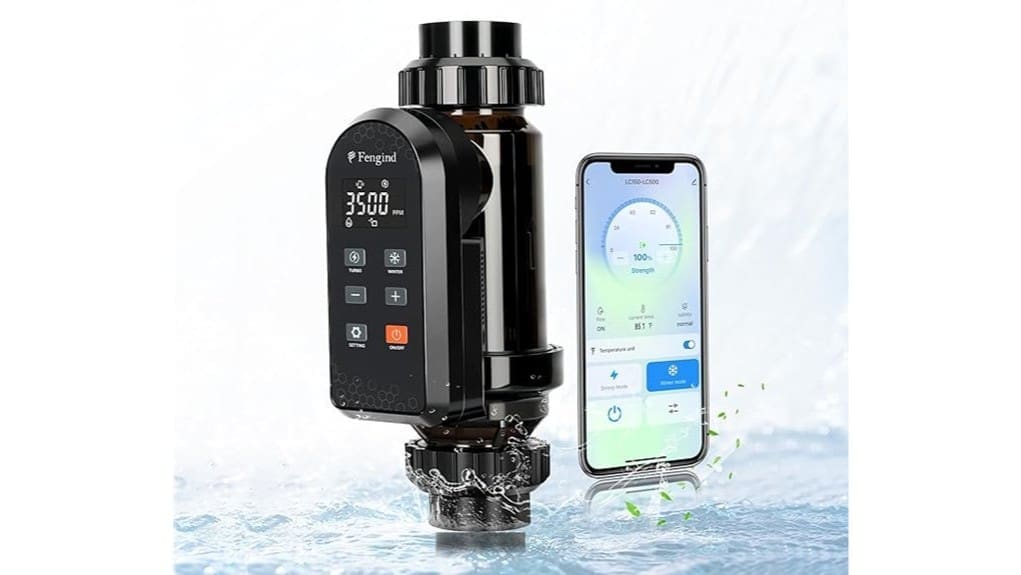
You’ll get a Wi‑Fi enabled saltwater chlorinator that automates chlorine production and periodic polarity reversal to cut scale for pools up to 22,000 gallons, reducing manual chemical handling and irritation. It fits 1.5″ or 2″ PVC, weighs 2.93 kg, and is IPX5‑rated so mount under cover. The app shows salt, chlorine and faults, and lets you schedule runs and cleaning. Warranty runs three years; keep pipe sizes and outdoor exposure in mind if you want full details.
Some Key Takeaways
- Produces free chlorine via titanium electrolysis for pools up to 22,000 gallons with automated polarity reversal to reduce scaling.
- Built‑in Wi‑Fi and companion app provide real‑time chlorine, salt readings, remote control, and maintenance alerts.
- IPX5 splash‑resistant housing requires mounting under cover; not submersible or fully weatherproof for exposed installations.
- Routine upkeep limited to salt balancing, periodic cell rinses, sensor calibration, and 500‑hour cleaning reminders.
- Three‑year warranty, low‑salt alarm, and compatibility with 1.5″/2″ PVC; confirm adapter size and electrical grounding before purchase.
What the Fengind LC500A Does and Who It’s Best For
The Fengind LC500A converts dissolved salt into free chlorine via saltwater electrolysis to maintain sanitization for pools up to 22,000 gallons; you’ll control chlorine output, run times, and cleaning schedules through built‑in Wi‑Fi and the companion app. You’ll monitor real‑time water quality, receive low‑salt alerts, and adjust output remotely to sustain target residuals. Self‑cleaning titanium plates reverse polarity every eight hours to limit scale. The unit suits homeowners associations enforcing consistent sanitation and busy families wanting low‑touch upkeep. It reduces added chemical handling, lowers irritants, and provides automated reminders—designed for operational predictability rather than aesthetic enhancement. It’s an attractive option for owners of above-ground pools who want to integrate automated sanitation into their outdoor spaces.
Key Specs and Installation Checklist (Pipe Sizes, Weight, Power, IPX5)
Having covered what the LC500A does and who it’s for, let’s focus on the measurable specs and installation checklist you’ll need to fit and operate it properly. The unit weighs 2.93 kg, fits pools to 22,000 gallons, and accepts 2″ (60.3 mm OD) or 1.5″ (48.3 mm OD) PVC with supplied adapters. IPX5 rating means splash resistance only—mount under cover, avoid submersion. Verify electrical supply and specified power draw in manual, observe grounding requirements and secure earth connection. Use recommended installation torque on fittings to prevent leaks. Confirm app Wi‑Fi range before final placement. Consider pairing the chlorinator with an appropriate pool pump kit to ensure optimal circulation and compatibility.
Real-World Performance: Chlorine Generation, Self-Cleaning, and Maintenance
While you monitor output settings and salt levels, expect the LC500A to deliver steady chlorine production through its titanium electrolysis cell, with automatic polarity reversal every 8 hours to minimize scale buildup and maintain consistent output. You’ll perform periodic salt balancing and sensor calibration to guarantee accurate generation rates; the unit’s low-salt alarm helps prompt adjustments. Self-cleaning cycles and polarity reversal contribute to scale prevention and prolong electrode lifespan, but occasional manual inspection after the 500-hour cleaning reminder is prudent. Maintenance tasks are limited to salt adjustments, occasional cell rinses, and verifying sensor accuracy to sustain reliable performance. Keeping your pool pH balanced is essential for clearer, safer water and optimal chlorinator efficiency, so monitor and adjust pH as needed with pH decreasers when required.
App Features and Remote Monitoring: Wi‑Fi Control, Alerts, and Automation
How will you monitor and adjust pool chemistry from wherever you are? The LC500A’s app uses built‑in Wi‑Fi to display real‑time chlorine readings, salt level, and runtime. You’ll set target chlorine and salt thresholds, receive mobile alerts for low salt or faults, and view maintenance reminders. Remote commands let you change chlorinator output, start cleaning cycles, and toggle self‑cleaning polarity intervals. Schedule automation creates recurring run times tied to measured conditions, reducing manual intervention. Data logs show recent measurements and actions for diagnostics. Security and connection status are visible; firmware updates deploy through the app to maintain protocol compatibility. The system is ideal for homeowners managing pool sanitation with chlorine tablets as part of their seasonal maintenance routine.
Pros, Cons, and Buying Decision: Warranty, Pool Size Limits, and Final Verdict
Because the LC500A pairs robust features with clear limits, you can weigh its suitability for your pool quickly: it’s designed for pools up to 22,000 gallons, offers a 3‑year service warranty and timely support, and includes automated self‑cleaning and low‑salt alarms that reduce hands‑on maintenance. You’ll appreciate the Wi‑Fi monitoring and automatic polarity reversal for reduced scaling. Downsides: IPX5 limits outdoor exposure, and verify pipe adapter size before purchase. For warranty comparisons, the 3‑year service is competitive but check coverage specifics. Purchase considerations: match capacity to pool size, confirm installation compatibility, and evaluate vendor support response times. If you want to keep your backyard pool refreshingly cool this summer, consider pairing the unit with a pool chiller to extend comfort and efficiency.
Some Questions Answered
Can the LC500A Integrate With Third‑Party Pool Automation Systems?
Yes — you can integrate it with third‑party integration efforts if the system’s built‑in Wi‑Fi and app support open APIs or bridge protocols; otherwise direct protocol compatibility may be limited. You’ll need to verify whether Fengind exposes REST/JSON endpoints, MQTT, or supports common pool automation hubs. If not, you can use an intermediary gateway or custom script to translate between the LC500A app and your automation controller.
How Noisy Is the Unit During Electrolysis or Polarity Reversal?
You’ll hear minimal operational noise during electrolysis and polarity reversal; it’s typically low and unobtrusive. Measured audible frequency components are dominated by low-level electronic hums and occasional mechanical clicks during polarity swaps. You won’t experience sustained high-frequency tones or loud vibrations; any sound level is comparable to common pool equipment background noise. If you’re sensitive, place the unit in a ventilated, shaded enclosure to further attenuate audible frequency and vibration transmission.
Are Replacement Titanium Plates Sold Separately and at What Cost?
Yes — replacement plates are sold separately; you’ll need to order the titanium electrolytic cell when the original degrades. Costs vary by vendor and region, typically ranging from about $120 to $280. Check that replacement parts don’t void warranty coverage; the unit includes a 3-year service warranty, so confirm whether plate replacement is covered or requires authorized service. Keep receipts and contact support for authorization and pricing confirmation.
Does the Unit Support Multiple User Accounts in the App?
Yes — the app supports multiple profiles and family access. You can create separate user accounts with role-based permissions, share device control with household members, and monitor real-time settings concurrently. The system logs actions per profile for auditability and issues alerts to designated users. Setup requires account invitations via email; admin can revoke or adjust access. Connectivity and permission changes apply immediately across linked devices.
What Is the Expected Lifespan Beyond the 3‑Year Service Period?
You can expect gradual expected degradation of the electrolytic cell after the 3‑year service period; typical titanium plate life often ranges 3–8 years depending on usage, salt levels, and maintenance. You should plan for reduced efficiency and eventual replacement. Check if warranty extensions are offered by the manufacturer or retailer; purchasing an extension or service plan can cover parts/labor and delay out‑of‑warranty costs through additional coverage.