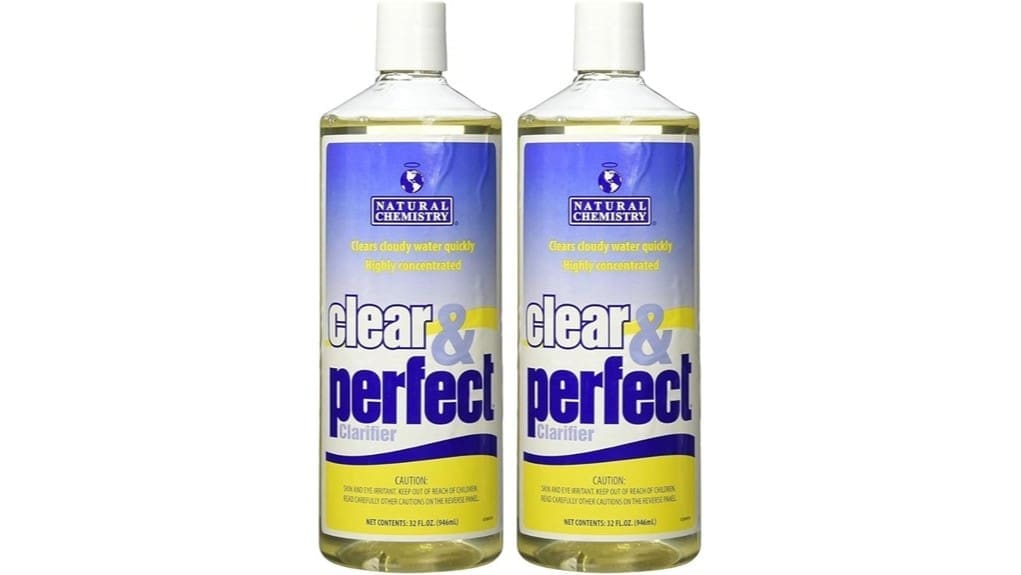
You’ll find Natural Chemistry Clear and Perfect is a concentrated, pH‑neutral clarifier that agglomerates submicron particles so your filter removes what it can’t catch alone. Its synthetic polymer performs coagulation, flocculation, adhesion, compaction and charge neutralization to form filterable flocs. Use after sanitizer balancing; typical dose is 1–2 oz per 5,000 gallons with pump running and 8–12 hours filtration before cleaning. It’s fast for routine cloudiness and repeatable for heavy loads—keep going for application tips and troubleshooting.
Some Key Takeaways
- Concentrated synthetic polymer clarifier agglomerates submicron particles into filterable flocs, improving clarity within hours for most cloudy pools.
- pH-insensitive formula won’t alter pool chemistry during treatment, useful without adjusting pH.
- Typical dose: 1–2 oz per 5,000 gallons; double for heavy turbidity, apply with pump running.
- Run filtration 8–12 hours post-dose and backwash or clean cartridges to remove consolidated debris.
- Not a sanitizer replacement; best paired with balanced sanitizer, occasional shock, or algaecide for persistent organic or algae issues.
Natural Chemistry Clear and Perfect : What It Is and Who It’s For
When your pool turns cloudy despite regular filtration, Natural Chemistry Clear and Perfect steps in as a highly concentrated clarifier that targets microscopic suspended particles standard filters miss. You’ll deploy a synthetic polymer formula that agglomerates and guides contaminants to your filter without altering pH. It’s engineered for quick restoration of clarity, aiding algae prevention and staining control by reducing nutrient and particle load. Ideal if you manage medium to large pools, have recurring cloudiness, or want to boost filter efficiency. Dosage is precise and treatment fast; you’ll see measurable turbidity reduction while maintaining normal chemical balance and routine maintenance. Many homeowners pair clarifiers with routine filtration maintenance to keep outdoor pools consistently clear.
How the Clarifier Works: 6-in-1 Technology and What That Means for Your Pool
Now that you know when to use Clear and Perfect, let’s examine how its 6-in-1 technology actually clears your water. You’ll rely on targeted agglomeration, coagulation and flocculation to convert submicron contaminants into filterable material. Synthetic polymer bridges link suspended solids, promoting particle aggregation and rapid growth of flocs. Adhesion and compaction consolidate those flocs, improving filter capture efficiency and reducing backwash frequency. Neutralization balances surface charges so once-separated particles won’t re-disperse. The formula’s concentration and pH-insensitive behavior mean you don’t adjust chemistry to activate mechanisms. You’ll use existing filtration to remove the resulting aggregated material reliably. Many homeowners pair clarifiers with algaecides to maintain clear, algae-free pools.
Real-World Performance: Clarity Results, Application Rate, and Speed of Action
Although results vary with load and filtration quality, you’ll see measurable clarity improvements within hours for most cloudy pools. In practice, the concentrated polymer rapidly agglomerates fine particulates, directing them to your filter so turbidity drops noticeably after treatment. You’ll judge effectiveness by visual transparency and reduced filter load cycles; clarity retention depends on continued filtration and source control. Speed of action is high for routine cloudiness, moderate for organic or algae-laden water. Seasonal performance shifts: spring openings and fall leaf loads may need repeat dosing. Overall, expect reliable, expedited clearing when used as part of standard maintenance. This is especially helpful for homeowners who enjoy their outdoor spaces and want clearer pool water with minimal fuss.
When to Use It and How to Apply for Best Results (Dosage, Timing, and Filter Tips)
If your pool shows persistent cloudiness or fine particulate buildup that your filter can’t clear alone, dose the clarifier after balancing sanitizer and alkalinity so the polymers can work efficiently. Use 1–2 ounces per 5,000 gallons for routine clarification; double dose for heavy turbidity. Apply with pump running, broadcasting along pool perimeter; run filtration 8–12 hours, then backwash or clean cartridge. For cartridge systems, inspect and clean after treatment; for sand/DE, backwash and regenerate as recommended. Integrate clarifier into regular pool maintenance and post-storm protocols to aid algae prevention and reduce recurring particulate load. For best long-term results consider pairing clarifier use with periodic shock treatment as part of your pool care routine.
Pros, Cons, and Who Should Buy Natural Chemistry Clear and Perfect
Because it targets microscopic particles with concentrated synthetic polymers, Natural Chemistry Clear and Perfect delivers fast, measurable clarity gains for pools that struggle with fine suspended debris. You’ll appreciate rapid clearing, pH neutrality, and a concentrated 6-in-1 mechanism that aids algae prevention while improving filter capture efficiency. It’s ideal if you need targeted corrective treatment without altering chemistry. Cons: it’s not a sanitizer replacement, requires correct dosing, and heavy loads may need repeated treatments and backwashing. Buy it if you manage persistent cloudiness, want reduced filter maintenance frequency, and need a technical clarifier to complement routine sanitization and filtration. Many pool owners who enjoy their outdoor spaces use enzyme and clarifier combos to reduce maintenance and keep water clear with minimal effort, especially when maintaining outdoor pool health.
Some Questions Answered
Is This Clarifier Safe for Vinyl and Fiberglass Pools?
Yes — you can use it in vinyl and fiberglass pools. The vinyl safe formulation won’t harm liners, and the product’s fiberglass compatibility testing supports safe use on gelcoat surfaces. You’ll apply the concentrated clarifier per label directions, avoid overdosing, and run the filter to remove flocculated particles. You’ll still monitor water balance and follow manufacturer guidance to guarantee peak, damage-free clearing performance.
Can It Be Used With Saltwater or Chlorine-Free Pools?
Yes — you can use it with saltwater systems and chlorine free pools. The clarifier’s synthetic polymers and 6-in-1 action aren’t pH sensitive and don’t rely on chlorine, so saltwater compatibility and chlorine free operation are supported. You’ll still follow dosage for water volume and run filtration to remove aggregated particles. Monitor clarity and adjust treatments; it complements, but doesn’t replace, regular sanitizer or balanced water maintenance.
Will It Cloud Water Temporarily After Application?
Yes — you’ll see a temporary haze as the clarifier works. The synthetic polymers induce flocculation timing that draws microscopic particles into larger flocs, causing short-lived cloudiness before they settle or get trapped in the filter. Expect clearer water within hours once filtration runs; backwashing or vacuuming settled floc speeds recovery. Follow dosage and run filtration continuously to minimize downtime and optimize particle removal.
Is It Safe for Pets and Wildlife if Pool Water Is Drained?
You shouldn’t drain treated pool water where pets or wildlife will contact it; pet exposure and wildlife impact can occur from concentrated clarifier residues and bound contaminants. Neutralize and dilute before discharge: test and adjust chemistry to meet local environmental limits, allow filtration and dechlorination, and route effluent to sanitary sewers or approved storm systems. Follow manufacturer and local regulations to minimize ecological harm and protect animals.
How Long Should Filters Run After Treatment?
Run your filter continuously for 24–48 hours after treatment, then maintain normal pump cycles of 8–12 hours daily until clarity stabilizes. The initial filter duration maximizes particle capture as polymers agglomerate contaminants; extended pump cycles prevent re-suspension. Backwash or clean cartridges as turbidity indicators rise. If cloudiness persists after 48 hours of continuous filtration plus maintenance cycles, repeat treatment or inspect circulation and filtration efficiency.