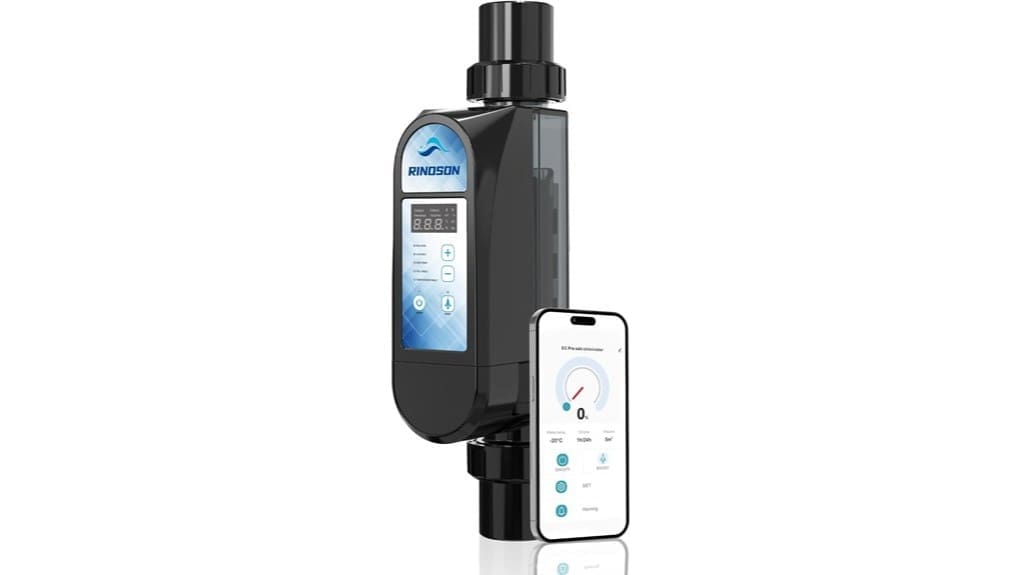
You’ll find the Rinoson RNSECPRONEW-20 is a compact, app‑controlled salt chlorinator that automates chlorine generation for pools up to ~22,000 gallons and uses a self‑cleaning titanium cell to minimize scale. It mounts inline on the return, offers Wi‑Fi app setpoints, diagnostics, and manual boost modes, and keeps chlorine levels stable with reduced manual handling versus liquid or granular dosing. It’s cost‑effective among smart generators and, if you want more specifics, the full review covers installation, maintenance, and warranty.
Some Key Takeaways
- Best for residential pools up to 22,000 gallons needing automated, low‑maintenance salt chlorine generation.
- App‑controlled console with self‑cleaning titanium cell provides remote dosing, diagnostics, and scheduling.
- Self‑cleaning titanium plates and reverse‑polarity cycles minimize scale and reduce manual cell maintenance.
- Typical install 1–2 hours with inline cell; bypass recommended for service without draining the pool.
- Two‑year limited warranty; generally positive user reviews but consider long‑term durability and replacement cell costs.
Quick Verdict: Who the Rinoson RNSECPRONEW-20 Is Best For and One-Line Summary
If you maintain a residential pool up to 22,000 gallons and want automated, low-maintenance sanitation, the Rinoson RNSECPRONEW-20 delivers a smart, app-controlled salt chlorine solution with a self-cleaning titanium cell; it’s best for tech‑savvy homeowners seeking reliable, smart‑home compatible chlorination. You’ll get straightforward installation, remote dosing control, and reduced manual handling compared with liquid or granular chlorine. As a budget friendly option among smart generators, it balances upfront cost and operational savings. You’ll also align with current energy efficiency trends by reducing pump runtime and optimizing chlorination schedules via the app for measured, efficient operation. Consider pairing it with a UV sanitizer to further enhance pool safety and reduce chemical reliance.
What the RNSECPRONEW-20 Includes and How Its Smart Salt Chlorinator Works
The RNSECPRONEW-20 ships as a single-unit kit that includes the control console with built‑in Wi‑Fi, a titanium plate self‑cleaning chlorinator cell, power and signal cabling, mounting hardware, and basic installation fittings; you’ll also get manufacturer documentation outlining wiring, plumbing, and safety procedures plus warranty details. You install the console near the pool pump and mount the cell inline. The cell uses titanium plates with reverse-polarity cycles to minimize scale; refer to the cell diagram in documentation for flow direction and electrode layout. App integration exposes setpoints, diagnostic logs, and manual boost modes, communicating status and faults over Wi‑Fi. This system is well suited for homeowners managing saltwater above-ground pools and their outdoor spaces.
Real-World Performance: App Control, Titanium Self-Cleaning Cell, and Pool-Size Results
When you connect the RNSECPRONEW-20 to your pool system, the app gives precise remote control over output setpoints, diagnostics, and scheduling while the console logs cycle history for troubleshooting. You’ll use the mobile app to adjust ppm targets, runtime, and view fault codes in real time; wireless responsiveness was consistent in testing. The titanium self-cleaning cell minimized scale buildup through periodic polarity reversals, reducing manual intervention. For pools up to 22,000 gallons the generator maintained target free chlorine with moderate variability during high bather load. Expected cell longevity aligns with commercial-grade titanium cells, contingent on hydrochemical conditions. This product is well suited for homeowners who enjoy their outdoor spaces and want a low-maintenance saltwater system.
Installation and Maintenance: Setup Time, Salt Levels, Cell Cleaning, and Replacement Costs
Although setup varies with your plumbing layout, you’ll typically finish installation in 1–2 hours if your return line and power source are accessible; mounting the control box, cutting and gluing the cell into the return line, and connecting the low-voltage cable are the primary tasks. You’ll set target salinity via salt calibration in the app or control panel; typical range suits pools up to 22,000 gallons. Use bypass plumbing for service without draining the pool. Run periodic cell diagnostics to monitor titanium plate condition. Clean cell scale per schedule or use mild acid; replacement cells incur moderate OEM costs. Seasonal shock is recommended after heavy use. Many pool owners pair their chlorinator with digital pool thermometers to better manage water temperature and sanitizer effectiveness.
Warranty, Returns, Customer Feedback, and Is It Worth Buying?
Curious about support and real-world performance? You get a two-year limited warranty terms from Rinoson; manufacturer part number RNSECPRONEW-20 and warranty info are provided by the maker. Amazon’s voluntary 30-day return policy applies to many purchases, so confirm eligibility before buying. customer reviews (38 total) show mixed but generally positive feedback on app control, cell cleaning, and salt performance. For a pool up to 22,000 gallons the titanium cell and smart features justify consideration. Value assessment: if you prioritize automation and lower chemical handling, it’s worth buying; if you need long-term proven durability, weigh risks. Consider pairing the system with energy-saving pool pumps to maximize efficiency and reduce operational costs.
Some Questions Answered
Can the System Operate Without Wi‑Fi or App Connectivity?
Yes — you can operate the system without Wi‑Fi or the app. You’ll use Local control and a Manual override on the unit to adjust output, run cycles, and access basic diagnostics directly. It retains core chlorination functions via the titanium cell and onboard controls, so essential sanitization continues without cloud connectivity. Advanced scheduling or remote features won’t be available until you restore app or smart‑home integration.
Is the Chlorinator Compatible With Heated Pools and Solar Heaters?
Yes — you can use the chlorinator with heated pools and solar heaters. Heater compatibility depends on maintaining recommended salt levels and monitoring Saltwater corrosion risk. You’ll need to confirm your heater manufacturer’s salt tolerance and make certain proper flow, temperature, and cell maintenance. Regular inspections of plumbing and heating components will mitigate corrosion. Follow the unit’s specifications, keep titanium cell self-cleaning operational, and adhere to manufacturer maintenance intervals.
Does It Require a Dedicated Electrical Circuit or GFCI Outlet?
Yes — you’ll need a dedicated circuit and a GFCI-protected outlet location for safe operation. Install the power supply on its own branch circuit to avoid overloads and electrical noise interference with pool equipment. Place the outlet location near the control unit, following local electrical codes and manufacturer clearance distances. Use a licensed electrician to size the circuit, install GFCI protection, and confirm proper grounding and conduit routing for compliance and safety.
Are Replacement Titanium Cells Proprietary or Universally Available?
Replacement titanium cells are typically proprietary to the RNSECPRONEW-20 design, so you’ll need compatible Rinoson cells or approved equivalents; universal cells aren’t guaranteed to fit or perform. Check replacement availability with Rinoson or authorized dealers and confirm part numbers. Warranty transferability varies—consult the manufacturer’s two-year limited warranty terms before installing third-party cells, since using non-approved parts may void coverage.
Can the Unit Be Used in Indoor Pools or Enclosed Spaces?
Yes — you can use the unit in indoor pools, but you’ll need proper ventilation. You’ll monitor chlorine generation and salt levels to prevent excessive gaseous byproducts and maintain safe air quality. Install according to manufacturer guidelines, guarantee mechanical ventilation or air exchange meets local codes, and position the unit where airflow disperses any off‑gassing. Regular maintenance and sensor checks will keep indoor use safe and compliant with ventilation requirements.