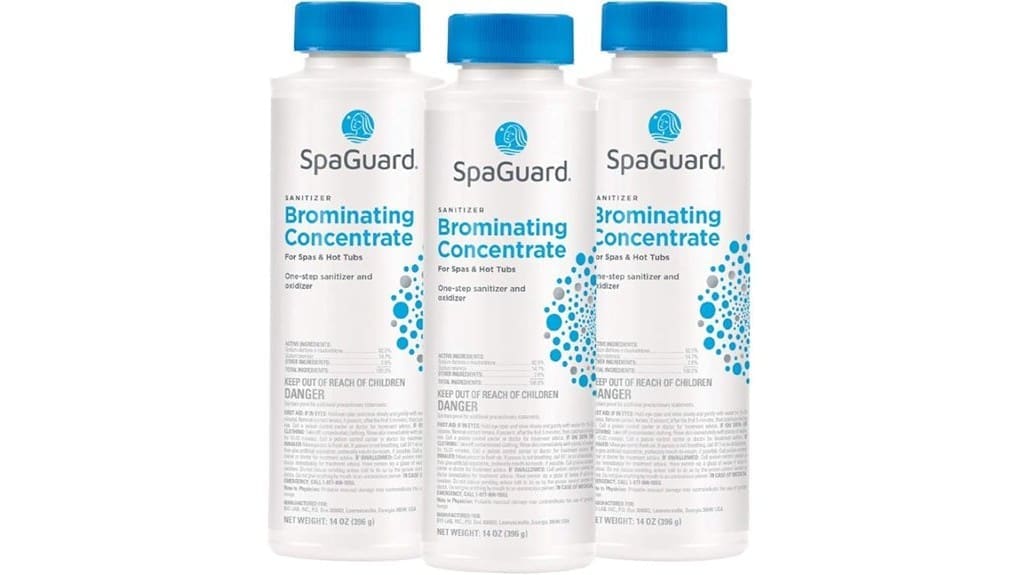
SpaGuard Brominating Concentrate is a one-step, fast-dissolving bromine granule that sanitizes and oxidizes spas without changing pH or alkalinity. You’ll dose about 1 tsp per 200 gallons directly into the spa with the pump running, circulate 15–30 minutes, then retest. It delivers quick bromine residuals and moderate oxidizing capacity, so you’ll re-dose with heavy bather load. It’s convenient for residential and light-commercial use; continue for details on performance, handling, and comparisons.
Some Key Takeaways
- One-step, 14 oz fast-dissolving granules provide combined bromine sanitizer and oxidizer action for quick residuals.
- Standard dosing is 1 teaspoon per 200 gallons; add directly with pump running and circulate 15–30 minutes.
- pH- and alkalinity-neutral formula minimizes adjustments and maintains stable water chemistry.
- Best for residential and light-commercial users who value convenience; not ideal for high-use automated systems.
- Pros: simple dosing and predictable residuals; cons: modest oxidation longevity and potential skin sensitivity for some users.
What SpaGuard Brominating Concentrate Is and Who It’s For
Because it combines rapid-dissolving brominating granules with dual sanitizer/oxidizer action, SpaGuard Brominating Concentrate is a one-step water treatment designed for spa and hot tub owners who need a straightforward maintenance solution. You’ll recognize it as a 14 oz, fast-dissolving granule pack formulated to sanitize and oxidize without affecting pH or alkalinity. Target user profiles include residential spa owners, rental operators, and light-commercial facilities seeking spa essentials that simplify routines. You’ll apply it directly with the pump running; dose planning affects maintenance frequency. Follow standard safety precautions for handling chemicals, storage, and avoiding direct contact or inhalation. Many homeowners also pair spa chemicals with routine equipment care to keep skimmers running and maintain overall system performance.
How to Use SpaGuard Brominating Concentrate (Dose, Timing, and Tips)
Having covered what the product is and who should use it, next focus on practical dosing and timing to maintain safe spa water. You’ll use 1 tsp per 200 gallons; run the pump and add granules directly—no pre-dissolving or activators. For variable volumes, consult a dosing calculator to scale accurately. Follow an application sequence: test water, adjust alkaline/pH if needed, add SpaGuard, circulate 15–30 minutes, retest. Pre treatment timing isn’t required, but allow full circulation before use. Prioritize user safety: wear gloves, avoid inhalation, store sealed. Record doses and readings for consistent maintenance. Consider also using compatible sanitizers and following shock treatment best practices for overall pool and spa care.
Performance Breakdown: Sanitizing, Oxidizing, and Water Chemistry Impact
When you add SpaGuard Brominating Concentrate to your spa, it delivers both sanitizing and oxidizing actions in a single, fast-dissolving granule that works immediately on contact; the bromine species neutralize microbes while concurrent oxidizing activity breaks down organic contaminants and odor-causing compounds. You’ll observe rapid sanitization kinetics with measurable bromine residuals within minutes, supporting microbial control. Oxidizer longevity is moderate; repeat dosing maintains oxidizing capacity against continual bather load. pH neutrality means the product won’t shift pH or alkalinity, simplifying adjustments. Minimal residue formation occurs when dosed per instructions, reducing scale and film compared to heavier oxidizers. It’s an ideal choice for homeowners looking to get their outdoor spa ready quickly with essential pool opening chemicals.
Pros, Cons, and Real-World Results From Regular Use
Although compact in form, SpaGuard Brominating Concentrate delivers clear practical advantages and a few limitations you’ll want to weigh: it combines sanitizer and oxidizer functions in a single, fast-dissolving granule that produces measurable bromine residuals within minutes, requires no activators or pH adjustments, and reduces odors and organic film with routine dosing at 1 tsp per 200 gallons. You’ll appreciate simplified dosing, neutral pH impact, and consistent residuals that promote comfortable water. Monitor for skin sensitivity in sensitive users; irritation is uncommon but possible. Perform a brief cost analysis: per-tank expenditure is low, maintenance predictable, supply frequency depends on bather load. Enhance your outdoor oasis with pool mineral systems to further improve water quality and reduce chemical usage.
How SpaGuard Compares to Other Spa Bromine Options and Buy-or-Skip Verdict
The practical benefits and minor drawbacks noted above set the stage for a direct comparison between SpaGuard Brominating Concentrate and alternative bromine products. You’ll find SpaGuard’s fast-dissolving, one-step sanitizer/oxidizer simplifies dosing versus two-part systems and tablet feeders. In a price comparison, per-treatment cost is competitive for small-volume users buying the 3-pack; bulk tablet systems may be cheaper long term for high-use setups. SpaGuard’s pH-neutral profile reduces chemical juggling, suiting users who prioritize stability. If you value convenience, predictable activation, and minimal adjustments, buy; if you prioritize lowest ongoing cost and automation, skip. Homeowners who want to maintain clear pool and spa water with minimal fuss should also consider simple testing routines using pool test strips to monitor sanitizer and pH levels.
Some Questions Answered
Is Spaguard Safe for Aromatherapy Oils and Additives?
Yes — SpaGuard is generally compatible with aromatherapy oils and additives when you use proper oil dilution and follow aroma compatibility guidelines. You should add oils sparingly, using a compatible carrier or commercial spa oil designed for water to prevent fouling and foaming. Avoid concentrated drops directly into water. Monitor sanitizer levels after adding oils, since organics can increase demand and require additional dosing to maintain effective bromine residuals.
Can It Be Used With Swim Spas and Salt Systems?
Yes — you can use it in swim spas and with salt systems. Its fast-dissolving brominating granules provide one-step sanitizer/oxidizer action without altering pH or alkalinity, supporting swim spa compatibility. For salt compatibility, it functions independently of salt chlorine generators since no activators are required; monitor combined halogen levels and generator settings to avoid duplicate dosing. Follow 1 tsp per 200 gallons and maintain regular water testing for peak control.
How Should I Store the Product Between Uses?
Store it in a cool storage area, away from heat and direct sunlight, in its original upright container with the lid tightly closed. Keep it dry, separate from acids, organics, and incompatible chemicals, and out of reach of children and pets. Maintain ambient temperatures per label, avoid freezing, and minimize humidity exposure. Inspect the container for damage before each use, and follow local regulations for storage and disposal of oxidizing sanitizers.
Is It Pet-Safe if Pets Contact Spa Water?
You shouldn’t allow unsupervised pet exposure to treated spa water. Brominating granules produce active bromine that’s effective as a sanitizer and oxidizer but can cause skin irritation or eye discomfort in pets with prolonged contact. If pets briefly lick or swim, rinse them with fresh water and monitor for redness or irritation. Keep pets away during dosing and until bromine levels return to safe, manufacturer-recommended concentrations.
Are There Shipping Restrictions or Hazard Notices?
Yes — you’ll encounter Transport restrictions and possible Hazmat labeling for brominating granules. You must check carrier and regional regulations; some couriers classify oxidizing solids as hazardous for transport. Package size, concentration and destination determine labeling, documentation and handling rules. You’ll need Safety Data Sheet guidance, proper packaging, and any required marks or placards. Contact the supplier or carrier for specific shipping approvals and compliance instructions before dispatch.