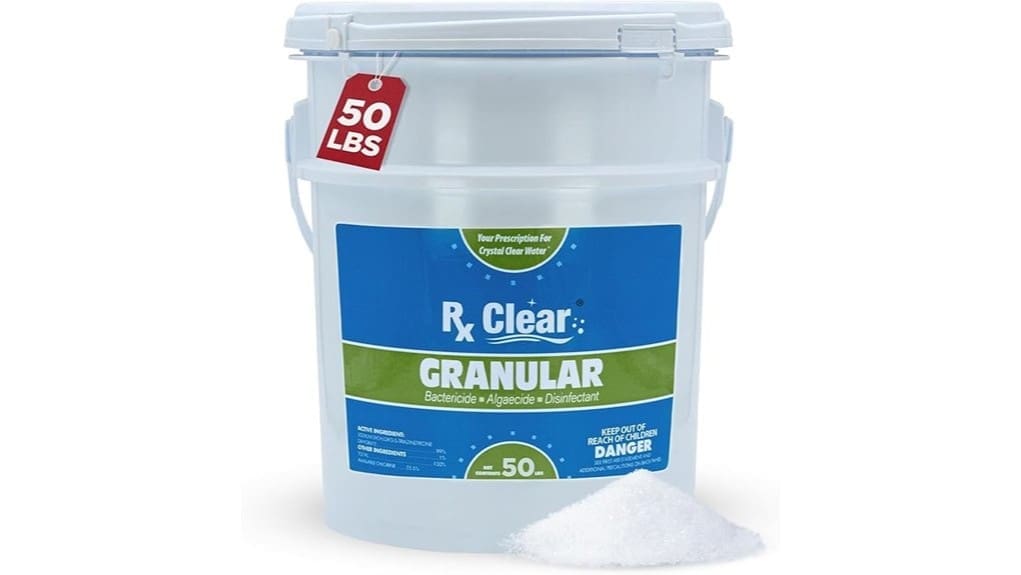
You’ll get a high‑strength, pH‑neutral granular chlorine (55.5% available chlorine) that dissolves fully and includes a cyanuric acid stabilizer to protect residuals in sunlight. It delivers rapid free‑chlorine peaks for routine sanitation and shock dosing, reduces chloramine persistence, and’s compatible with vinyl, fiberglass, and gunite when used per label. Dose by pool volume and monitor free chlorine; store the sealed 50 lb bucket in a cool, ventilated area. Continue for detailed dosing, troubleshooting, and safety tips.
Some Key Takeaways
- Rx Clear 50 lb granular delivers 55.5% available chlorine in fast-dissolving, 100% soluble dichlor granules.
- pH-neutral formulation minimizes pH swings and dissolves uniformly without leaving calcium residue.
- Built-in cyanuric acid stabilizer improves chlorine persistence under sunlight, reducing depletion.
- Effective for routine sanitation and shock dosing; recommended routine 1–3 ppm, shock 10–30 ppm as needed.
- Heavy-duty 50 lb bucket offers cost savings for frequent use; store sealed, cool, dry, away from acids.
Quick Verdict and Key Specs for Rx Clear 50 Lbs Granular Pool Chlorine
While you’re balancing pool chemistry, Rx Clear 50 lb granular chlorine gives a concentrated, fast-dissolving sodium dichlor sanitizer with 55.5% available chlorine and built-in cyanuric acid stabilizer. You’ll find a neutral scent profile typical of stabilized dichlor—minimal odor that won’t overpower pool users. Specs: 55.5% available chlorine, 100% soluble, pH-neutral, compatible with vinyl/fiberglass/gunite, suitable for pools and spas. Packaging durability is robust: heavy-duty 50 lb bag resists moisture and tearing, preserving granule integrity. Use this product for regular sanitation where predictable dosing, quick dissolution, and reduced scaling risk are priorities. Homeowners who enjoy outdoor pool spaces will appreciate reliable sanitation for maintaining sparkling water.
How the Sanitizer Performs: Disinfection, Shock Treatment, and Stabilizer Action
Because it delivers 55.5% available chlorine in a fast-dissolving sodium dichlor matrix, Rx Clear provides rapid microbial kill and reliable residuals for routine sanitization and shock dosing. You’ll observe high microbial killrate against bacteria and algae when dosed per label; free chlorine peaks quickly, achieving shock-level oxidation without prolonged chloramine persistence. Built-in cyanuric acid enhances residual persistence under sunlight, lowering depletion and reducing dosing frequency. The formulation dissolves uniformly, so you can apply for daily maintenance or periodic shock with predictable active release. Monitor free chlorine to confirm target ppm and adjust dosing for load and temperature. Homeowners who use these products can keep outdoor pool areas inviting with regular shock treatments and proper maintenance practices like filtration and brushing to reduce overall shock treatment frequency.
Water Chemistry and Compatibility: pH-Neutral Formula, Solubility, and Pool-Type Safety
When you add Rx Clear to your pool, its pH-neutral sodium dichlor matrix won’t drive rapid pH shifts, helping maintain overall water balance while delivering 100% soluble chlorine. You’ll benefit from inherent pH buffering that minimizes alkalinity swings and reduces corrective dosing. The fast-dissolving granules leave no calcium residue, preventing scaling and clouding. Because the formula contains cyanuric acid stabilizer and is fully soluble, it sustains free chlorine without accelerated loss in sunlight. Material compatibility is strong: it’s suitable for vinyl, fiberglass, and gunite surfaces and works with standard pumps, filters, and skimmers when used per label. Many homeowners find it simplifies maintenance and complements other pool clarifiers designed for clearer water.
Practical Use: Dosing, Dissolution, Routine vs. Shock Schedules, and Troubleshooting
For practical dosing and dissolution, follow label rates and measure active free chlorine targets rather than guessing by volume; you’ll typically add Rx Clear granules directly to the skimmer or disperse them with the pump on to safeguard rapid, uniform dissolution and avoid concentrated contact with pool surfaces or liners. You should calibrate dose using pool volume and target ppm, prioritizing dosing accuracy for routine sanitation (maintain 1–3 ppm) and shock (10–30 ppm depending on contamination). Apply smaller daily doses to prevent algae; use higher shock doses after heavy bather load or contamination. If chlorine demand spikes, troubleshoot by testing CYA, pH, and filter function. For best results when opening a pool for the season, include essential pool opening chemicals like algaecide and shock in your initial treatment plan and follow a checklist to ensure a sparkling start pool opening chemicals.
Value and Buying Guide: Cost per Dose, When to Choose the 50 Lb Bucket, Storage and Safety Tips
After nailing dosing and dissolution practices, you’ll want to evaluate cost-effectiveness and practical storage for the 50 lb Rx Clear bucket. Calculate cost per dose by dividing package price by doses: with 55.5% available chlorine and typical residential doses, the 50 lb option lowers unit cost versus smaller containers. Choose the 50 lb bucket if you maintain medium-to-large pools, perform regular shocking, or manage multiple systems. For storage safety, keep the sealed bucket in a cool, dry, well-ventilated area away from acids and organics; label clearly, restrict access, and follow PPE protocols for handling and spill response. Enhance your backyard maintenance with a durable solid pool cover to complement safe chemical storage and protect pool water quality.
Some Questions Answered
Does Rx Clear Leave an Odor After Treatment?
No, you generally won’t notice a strong chlorine odor after treatment when Rx Clear’s sodium dichlor is used correctly. Its built-in stabilizer and pH-neutral, fast-dissolving formula maintain residual chlorine without excess free chlorine that causes a sharp chlorine odor. However, individuals with sensory sensitivity may still perceive mild chlorine scent if levels are high or combined with contaminants; test and adjust free chlorine and shock as needed to minimize odors.
Is Cyanuric Acid Buildup a Concern Long-Term?
Yes — cyanuric accumulation can become a long-term concern if you don’t manage stabilizer levels. You should monitor cyanuric acid regularly and practice stabilizer management to keep CYA within recommended ranges (usually 30–50 ppm for stabilized chlorine). Excess CYA reduces active chlorine effectiveness, so you’d dilute by partial drain-and-fill or use non-stabilized shock intermittently. Maintain records and adjust dosing to prevent buildup while preserving UV protection.
Can I Pre-Dissolve the Granules in a Bucket Safely?
Yes — you can pre-dissolve the granules in a bucket safely with precautions. For pre dissolution precautions, use a clean plastic or polyethylene bucket, add water first, then slowly add small amounts of granules while stirring to avoid overheating. Wear gloves and eye protection, work outdoors or in well‑ventilated area, and never mix with acids or other chemicals. After bucket dilution, pour solution into deep water near return jets, not directly onto surfaces.
Is This Product Safe for People With Chlorine Allergies?
No — if you have chlorine sensitivity you shouldn’t use this product directly; it releases available chlorine that can trigger reactions. You’ll need to avoid chlorinated pools or limit exposure, shower thoroughly after contact, and consult a physician for testing. Consider alternative sanitizers such as saltwater (electrolytic), ozone, or UV systems; they reduce chlorine residuals but may still require some chlorination or maintenance, so review efficacy and compatibility with your facility.
Does It Affect Pool Cover Materials or Solar Blankets?
Yes — it’s generally safe for pool cover and solar blanket materials when used as directed. You should perform compatibility testing on a small area or sacrificial material first to confirm no unexpected staining or degradation risk. The pH-neutral, fast-dissolving formula minimizes localized chemical exposure, reducing polymer attack. Maintain proper dilution and circulation, avoid concentrate contact with covers, and store chemicals away from covers to further limit long-term degradation risk.