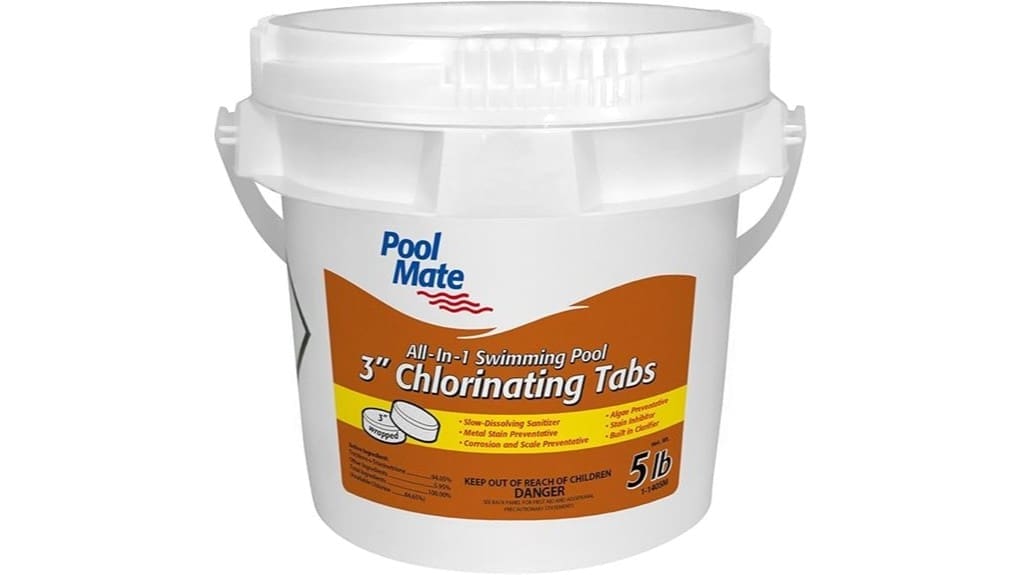
You’ll get concentrated, feeder-ready 3-inch trichlor tablets that reliably maintain 2–4 ppm free chlorine when dosed 16 oz per 10,000 gallons and used only in an automatic feeder or floating dispenser. They offer consistent bactericidal action, algae control at maintenance residuals, organic oxidation for clarity, and built-in metal sequestration. Watch for cyanuric acid buildup, feeder corrosion, and moisture during storage. Continue to the full review for detailed dosing, testing, and alternative options.
Some Key Takeaways
- Highly concentrated 3-inch trichloro tablets (84.65% available chlorine) deliver consistent sanitizer levels when used in feeders or floaters.
- Recommended dosing: start with two tablets (16 oz) per 10,000 gallons; maintain 16 oz weekly to target 2–4 ppm free chlorine.
- Safe use requires feeder/floater placement only, chlorine testing after four hours, and storage sealed, dry, and away from other chemicals.
- Benefits include reliable bactericidal action, algae prevention at residuals, organics oxidation for clearer water, and metal sequestration to reduce staining.
- Drawbacks: cyanuric acid buildup risk, potential feeder corrosion, uneven dissolution in low flow, and accelerated loss in sunlight or heavy bather loads.
What Pool Mate 3-Inch Tablets Are and Who They’re Best For
Think of Pool Mate 3‑inch Chlorinating Tablets as concentrated, all‑in‑one sanitizer tablets designed for routine feeder or floater use in residential and light commercial pools. You’ll get 10 heavy 8‑ounce tablets per 5‑pound pack, formulated with 94.05% trichloro‑s‑triazinetrione (84.65% available chlorine). You use them when you want integrated sanitizer, algae control, clarifier, stain inhibition and scale reduction without juggling multiple products. They suit owners prioritizing household compatibility and simplified maintenance cycles. For seasonal storage, keep tablets sealed, dry and ventilated, away from other chemicals. They’re not for direct addition to pool water or mixed in feeders with other agents. These tablets are a convenient choice for homeowners seeking to keep your pool sparkling with minimal maintenance.
How to Use Pool Mate Tablets Safely and Dose Them for Your Pool
When you’re preparing to add Pool Mate 3‑inch tablets, always place them only in an automatic feeder or a floating dispenser—never toss tablets directly into the pool or mix other chemicals in the device—so the tablet dissolves at a controlled rate and maintains a safe, consistent chlorine residual. Calculate dose: 16 oz (two tablets) per 10,000 gallons for start-up; 16 oz weekly for maintenance to target 2–4 ppm free available chlorine. Maintain pH 7.4–7.6 and alkalinity 80–130 ppm. Use chlorine testing after four hours circulation. Store unopened container dry, locked, and ventilated for safe storage; avoid moisture and heat. Homeowners who enjoy their outdoor spaces should also use pool test strips regularly to help keep pool water clear.
Performance Breakdown: Sanitation, Algae Control, Clarifying, and Stain Prevention
Because Pool Mate 3‑inch tablets release 84.65% available chlorine via trichloro‑s‑triazinetrione, they deliver consistent bactericidal action and oxidizing power when dosed to maintain 2–4 ppm free chlorine, providing reliable sanitation and organic contaminant destruction. You’ll achieve rapid pathogen kill rates and sustained sanitizer longevity when tablets are fed via a floater or feeder at recommended intervals. Algae control is effective at maintenance residuals; brush and shock if bloom occurs. Clarifying occurs through oxidation of organics, improving filter capture. Integrated metal sequestering reduces iron/copper staining risk, though preexisting stains may need targeted treatment. Homeowners opening pools for the season should also stock other essential pool opening chemicals like algaecide, pH balancers, and clarifiers to ensure a sparkling start.
Pros, Cons, and Common Real-World Issues to Watch For
Having established how Pool Mate tablets handle sanitation, algae, clarifying, and stain inhibition, let’s look at practical advantages, drawbacks, and issues you’ll likely encounter. You get concentrated, stable chlorine with multifunction benefits that reduce extra additives and simplify dosing in feeders/floaters. Cons: strong oxidizer risks if misused, incompatible with other chemicals, and potential cyanuric acid build-up. Watch for feeder corrosion, uneven dissolution in low flow, and accelerated chlorine loss from heavy sunlight or bather load. For long term storage inspect seal integrity; packaging durability affects tablet hydration and decomposition. Follow manufacturer handling, maintain target chemistry, and rotate stock to avoid degraded tablets. Many homeowners use chlorine tablets to keep their outdoor pool areas clean and enjoyable by relying on chlorine tablets maintenance to simplify routine care.
Is Pool Mate Worth Buying? Price, Alternatives, and Final Recommendation
So, is Pool Mate worth buying? You’ll find its high available chlorine, multi-function formulation, and 10-tablet 5 lb pack give strong value for routine chlorination. For cost comparison, calculate cost per ppm-maintained per 10,000 gallons versus competitors; Pool Mate’s concentration often lowers dose frequency and ancillary chemical need. Consider alternatives like stabilized trichlor tablets from major brands if feeder compatibility or price is better locally. Check user testimonials for consistency, stability, and handling reports. Final recommendation: if you use an automatic feeder/floater and follow safety/dosage protocols, Pool Mate is a technically sound, cost-effective choice. Many homeowners also appreciate simple tips for maintaining clear pool water to get the most from their pool chemicals.
Some Questions Answered
Are These Tablets Safe for Use With Vinyl-Lined Pools?
Yes — you can use them with vinyl-lined pools if you follow directions. You’ll maintain vinyl compatibility by dosing in a feeder or floater, keeping pH 7.4–7.6, alkalinity 80–130 ppm, and cyanuric acid 40–100 ppm. Avoid direct tablet contact with the liner to prevent liner staining and degradation. Don’t mix chemicals in the feeder; circulate at least four hours before testing and shock as needed to control algae and contaminants.
Can I Use Them in Saltwater or Mineral Pools?
Yes — you can use them in saltwater systems and mineral pools, but you’ll need to monitor chemistry closely. The trichloro tablets deliver stabilized chlorine; they’re compatible with salt chlorine generators and mineral additives but will raise cyanuric acid and chlorine residual. Maintain pH 7.4–7.6, alkalinity 80–130 ppm, cyanuric 40–100 ppm, and target 2–4 ppm free chlorine. Avoid adding tablets directly to pool and follow feeder/ floater instructions.
Do Tablets Expire or Lose Potency Over Time?
Yes — tablets can lose effectiveness over time. You’ll see shelf stability depend on storage: keep tablets sealed, dry, cool, and away from sunlight to minimize potency degradation. Under ideal conditions they remain stable for months to years, but exposure to moisture or heat accelerates decomposition and reduces available chlorine. Inspect tablets for crumbling or strong chlorine odor; test chlorine output before relying on older stock for routine dosing.
Are There Shipping Restrictions for This Chlorine Product?
Yes — you’ll face shipping restrictions and hazmat rules. These tablets contain high‑available chlorine and are classified as hazardous for transport, so carriers limit modes, packaging, labeling, and documentation. You’ll need compliant sealed containers, proper UN markings, and possibly limited quantities. Ground transport often allowed with restrictions; air transport is usually prohibited or tightly controlled. Check carrier, DOT, IATA/IMDG, and seller policies before purchase or shipment.
Is This Product Compatible With Pool Automatic Chlorinators?
Yes — you can use these tablets in automatic chlorinators. They’ll work with standard float valve feeders and many feeder types, but make sure feeder compatibility before loading. Use only in feeders/floaters; don’t drop tablets directly into the pool or mix chemicals inside the unit. Follow startup and maintenance dosing, maintain recommended pH/alkalinity, and allow proper circulation after adding tablets to achieve target free chlorine and avoid equipment or water chemistry issues.