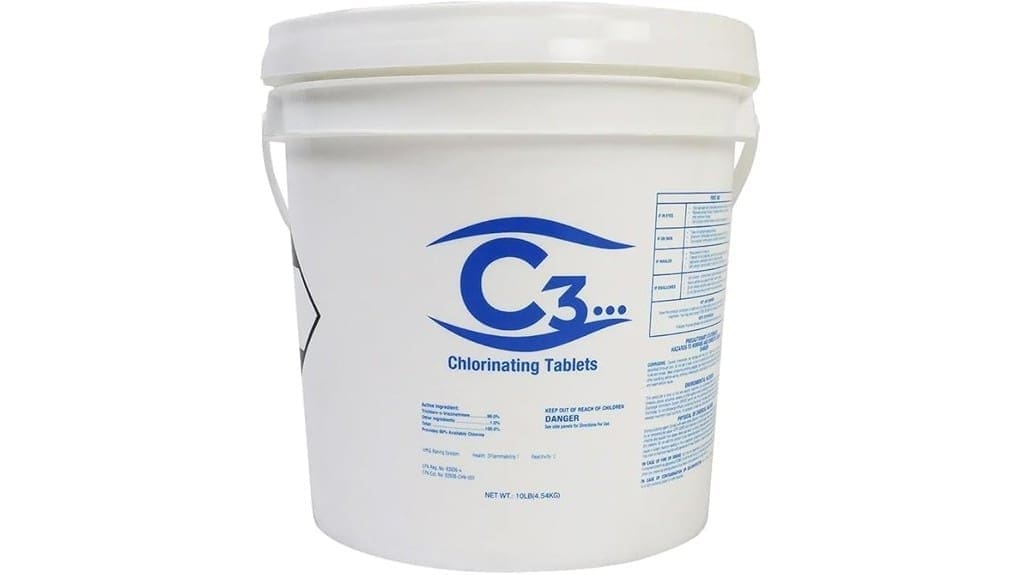
You’ll get dense, slow‑dissolving 3″ tablets that deliver 90% available chlorine with built‑in cyanuric acid to stabilize free chlorine. They fit floaters, skimmers, and feeders and give predictable multi‑day release so you can cut dosing frequency while maintaining steady FC. Monitor CYA because it accumulates and can blunt chlorine efficacy; adjust FC or dilute water if CYA climbs. Store sealed away from organics and test daily until rates stabilize — more detail follows.
Some Key Takeaways
- 3″ tablets are stabilized trichloro-s-triazinetione with 90% available chlorine, offering high oxidizing power per tablet.
- Slow-dissolving, dense matrix provides predictable, multi-day chlorine release for floaters, skimmers, or feeders.
- Integrated cyanuric acid improves UV stability but requires monitoring to keep CYA in the 30–50 ppm target.
- Follow dosing guidance (16 oz per 10,000 gallons weekly baseline) and adjust feeder rates while daily-testing residuals.
- Store sealed in a cool, dry place away from organics and avoid mixing with unstabilized shock to prevent reactions.
What the C3 3 Stabilized Chlorine Tablets Are and How They Work
Think of C3 3″ Stabilized Chlorine Tablets as a concentrated, slow‑dissolving sanitizer designed to keep your pool water disinfected and stabilized. You’ll handle tablets formulated from 99% trichloro‑s‑triazinetione with 90% available chlorine; cyanuric acid is integrated to control free‑chlorine photolysis. You’ll dose via floaters, skimmers or automatic chlorinators; consistent 3″ size enables predictable weekly release. Tablet manufacturing emphasizes density and coating uniformity to standardize dissolution. Stabilizer chemistry balances chlorine release rate against cyanuric acid accumulation so you can maintain effective residuals without rapid loss to sunlight. You’ll follow device and dosage specs to preserve target free‑chlorine levels. Homeowners who enjoy outdoor spaces can use these tablets to simplify routine maintenance and protect pools from bacteria and algae with regular shock treatments.
Performance: Dissolution Rate, Available Chlorine (90%), and Real-World Sanitation
Having covered what these 3″ tablets are and how they’re applied, let’s examine how their slow‑dissolving matrix, 90% available chlorine and built‑in cyanuric acid interplay to deliver real‑world sanitation. You’ll observe slow dissolution that yields predictable chlorine release over days, enabling steady free‑chlorine setpoints with minimal spikes. The 90% available chlorine offers high oxidizing capacity per tablet, reducing dose frequency. Cyanuric acid in the formulation enhances residual stability under UV exposure, keeping free chlorine effective longer. In practice, you’ll get consistent weekly sanitation for typical pool volumes when tablets are used in compatible feeders or chlorinators. Homeowners who enjoy their outdoor spaces can maintain cleaner water with proper chlorine tablet use.
How to Dose C3 Tablets (3) for Floaters, Feeders, and Automatic Chlorinators
Start by matching your chlorinator type and pool volume to a dosing baseline: place one 3″ C3 tablet in a floater or feeder for small to medium pools, or load tablets into an automatic chlorinator per the manufacturer’s capacity, then adjust feed rate to maintain free‑chlorine setpoints. Calculate dose from 16 ounces per 10,000 gallons weekly and convert to tablet count. For floaters, monitor float rates and adjust placement to avoid over‑dissolution at skimmer intakes. In feeders and automatic units, set valve/feed rate to target ppm, make certain even tablet placement to prevent channeling, and verify residuals daily until stabilized. For best results when opening the pool, consider using the proper pool opening chemicals to ensure water clarity and sanitizer effectiveness.
Compatibility, Safety, and Storage: Cyanuric Acid Impact and Handling Tips
Because C3 3″ Stabilized Chlorine Tablets contain cyanuric acid (a stabilizer), they both protect chlorine from UV degradation and gradually raise your pool’s CYA level, so you must monitor and manage CYA to avoid reduced free‑chlorine efficacy. You should test CYA weekly after dosing changes and target 30–50 ppm for most pools; higher levels require increased FC or dilution. Avoid combining with unstabilized shock immediately to prevent excessive chloramine formation. Store tablets in original sealed containers, in a cool dry area with good storage ventilation, away from organic materials and incompatible chemicals to minimize cyanuric buildup and decomposition risks. Regular use of pool pH decreasers and other maintenance products can help maintain water balance and safety, so consider routine testing and treatment with pool pH decreasers.
Is C3 3 Chlorine Right for Your Pool? Cost, Packaging, and Buying Considerations
How do you know if C3 3″ Stabilized Chlorine Tablets are the right choice for your pool? Evaluate capacity, dosing, and chemistry. Each 10 lb pack (160 oz, model 204510) contains slow-dissolving 3″ tablets with 90% available chlorine and 99% trichloro active ingredient; cyanuric acid is included. For dosing, 16 oz treats 10,000 gallons weekly using floaters or feeders. For procurement, perform a cost comparison per ounce against alternatives and factor shipping. Packaging options include 10 lb buckets (may ship as 2×5 lb) with individually wrapped tablets for handling safety. Match product specs to your chlorination system and pool size. Keep your pool water safe with simple test kits to monitor chlorine and cyanuric acid levels pool water safety.
Some Questions Answered
Are These Tablets Safe for Vinyl Pool Liners Long-Term?
Yes — you can use them long-term if you monitor levels and avoid overexposure. The tablets’ slow-dissolving stabilized formula is compatible with vinyl liners, but prolonged high free chlorine and cyanuric acid can increase chemical absorption into vinyl and cause fading or embrittlement. You’ll need to maintain proper pH, free chlorine, and stabilizer ranges, use a floater or feeder correctly, and test regularly to prevent liner compatibility issues.
Can I Use Them With Saltwater Chlorine Generators?
You can, but you shouldn’t place these tablets directly into salt cell housings. The stabilized tablets will raise cyanuric acid and free chlorine effectively, yet can increase corrosion concerns and electrode fouling if granules contact the cell. Use a separate floater or feeder upstream of the salt cell, monitor cyanuric and chlorine, and check your generator manual — warranty implications may arise if manufacturer prohibits external chlorine sources contacting the cell.
Do Tablets Affect Pool pH Significantly Over Time?
Yes — you’ll see gradual effects: stabilized trichloro tablets release acidic byproducts, causing chlorine depletion to consume alkalinity and contribute to alkalinity drift. Over time you’ll need to monitor pH and total alkalinity, because continuous tablet use tends to lower pH and reduce buffering capacity. Test weekly, add alkalinity increaser (bicarbonate) as needed, and adjust pH with sodium carbonate to maintain stable levels and prevent corrosion or scale.
Are Tablets Biodegradable or Environmentally Friendly?
No, they aren’t biodegradable or particularly environmentally friendly. You’ll find the active trichloro-s-triazinetrione degrades in water to release chlorine and cyanuric acid, so environmental persistence of stabilizer residues can occur. You must avoid runoff and over-dosing because residual chlorine and byproducts pose aquatic toxicity risks to fish and invertebrates. You should handle, store, and dispose of tablets per regulations to minimize environmental release and harm.
Can I Store Unopened Buckets Outdoors in Summer?
Yes — you can store unopened buckets outdoors in summer, but don’t. You’ll need controlled store placement away from direct sun, moisture, and temperature extremes to preserve tablet integrity and stabilizer. Keep lids sealed, elevate off ground, and provide ventilation and shade. Avoid freezing or prolonged heat above recommended ranges; extreme temperatures can accelerate decomposition, reduce available chlorine, and increase pressure in packaging. Check manufacturer guidance and inspect before use.