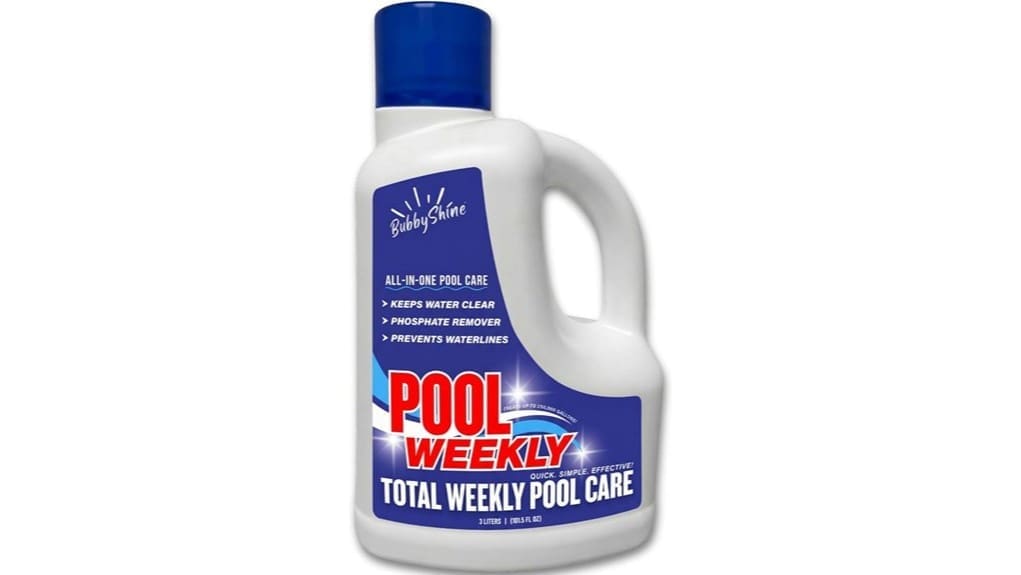
You’ll get one measured weekly dose that replaces multiple specialty bottles and cuts routine steps, so you’ll save time and improve compliance. The 3L formula combines concentrated phosphate removal, polymer clarifiers, enzymes for organics, surfactants for waterline films, and buffer/carrier chemistry that’s filter-friendly and salt-cell compatible. Dose with the calibrated volume around returns when your chlorinator is low, monitor chlorine and pH, and expect clearer water and less film—keep going to learn specifics.
Some Key Takeaways
- Bubbyshine is a single weekly dose combining phosphate remover, clarifier, enzymes, and surfactants for streamlined pool care.
- It’s formulated safe for salt-chlorine systems when dosed per label and applied with chlorinator off or low.
- Users report faster clarity improvements, reduced phosphate levels, and diminished waterline film within one to two cycles.
- Pros: time savings, easier compliance, filter-friendly carriers, and softer-feeling water; cons: less granular control and possible overkill for very small pools.
- Monitor free chlorine, pH, salinity, and monthly cell condition to ensure compatibility and optimal performance.
Does BubbyShine Weekly Pool Treatment Actually Simplify Weekly Care?
Usually, yes—you replace multiple specialty bottles with a single measured dose. You’ll see measurable time savings because one weekly application consolidates phosphate control, clarification, and waterline cleaning into a repeatable protocol. That simplicity improves user compliance; fewer steps mean fewer missed treatments. You’ll still monitor chlorine and pH separately, and you’ll avoid layering incompatible chemistries by following dose timing. The formulation minimizes risky chemical interactions when used as directed, but you should track residuals to detect anomalies. For long term effects, consistent use supports clearer water and reduced buildup, though periodic testing confirms sustained efficacy and surface compatibility. This approach aligns with broader goals of eco-friendly pool care by reducing the number of products homeowners need to store and apply.
What’s Inside the 3L Bottle and How Each Ingredient Helps
Having one weekly bottle does more than simplify tasks—it centralizes specific chemistries that each play a defined role in pool health. You get a concentrated phosphate remover that limits nutrient load, improving sanitizer efficiency. A clarifier uses polymer coagulants to aggregate fines for filter capture. The enzymatic formulation targets organic waste—oils, sunscreen, and nitrogenous residues—breaking them into filterable fragments. Surfactant action reduces surface tension to strip waterline films and disperse oils for removal. Buffering agents stabilize pH, while filter-friendly carriers prevent clogging. Together these components preserve salt system function, enhance clarity, and reduce manual interventions. This all-in-one approach is designed to support routine maintenance for homeowners who care about clear pool water.
How to Use One Weekly Dose Safely With Salt Systems
When you add BubbyShine’s weekly dose to a saltwater pool, follow a measured, system-aware routine to protect salt cells and maintain sanitizer stability: you’ll dose once weekly, adhering to the product’s calibrated volume and ensuring even distribution around return jets. Check salinity and cell condition before application; this product is formulated for salt cell compatibility but won’t compensate for degraded cells. Schedule dosing timing when the chlorinator is off or at low output to allow product integration without immediate electrochemical stress. Monitor free chlorine and stabilize pH within recommended ranges post-dose. Record treatments and inspect cells monthly for deposits. Also consider routine maintenance of your pool equipment to keep the system operating efficiently.
Real-World Performance: Clarity, Phosphate Control, and Waterline Cleaning
Because BubbyShine combines phosphate sequestration, clarifier action, and enzymatic cleaners in a single weekly dose, you should see measurable improvements in water clarity, reduced phosphate readings, and diminished waterline film within one to two treatment cycles. You’ll verify results with standardized clarity tests and routine phosphate trends monitoring; expect turbidity reduction and phosphate ppm declines when dosing per label. Swimmer feedback often reports softer skin and less oily residue, corroborating instrumented measures. Maintain baseline water chemistry and consistent dosing to isolate product effect. Filtration efficiency and skimmer maintenance remain critical variables influencing real-world outcomes. Regular use of phosphate removers helps keep pools free of nutrient buildup that fuels algae growth.
Pros, Cons, and Who Should (or Shouldn’t) Buy This Product
Although it combines multiple chemistries into one weekly dose, BubbyShine’s Weekly Pool Treatment delivers clear advantages and a few trade-offs you should weigh against your pool setup and maintenance habits. You’ll get simplified dosing, phosphate control, clarifier action, waterline cleaning, and enzyme support in one 3L bottle, reducing parts inventory and labor. Pros: streamlined routine, saltwater compatibility, filter-friendly formula, softer-feeling water. Cons: less granular control versus separate products, potential overkill for very small pools, single-formulation limits targeted adjustment. Who should buy: busy owners, salt-system pools, time-constrained customer demographics. Who shouldn’t: hobbyist chemists seeking fine-tuned control; do a cost comparison first. Many homeowners find that consolidating treatments into one product helps maintain their outdoor spaces with less hassle.
Some Questions Answered
Is This Safe for Vinyl, Fiberglass, and Concrete Pool Surfaces?
Yes — you can use it on vinyl, fiberglass, and concrete; it’s formulated for vinyl compatibility and saltwater systems while helping prevent surface staining. You’ll treat weekly with the measured dose, and the clarifier, phosphate remover, and enzymes work to reduce film and mineral buildup that cause staining. Still, test a small area first and follow label directions to avoid prolonged contact or overdosing that could affect finishes.
Can I Swim Immediately After Dosing the Weekly Treatment?
Yes — you can usually swim immediately after dosing, provided your pool’s chlorine and pH remain within safe ranges. The treatment’s formulation minimizes adverse chlorine interaction, but you should test water after application to confirm chlorine residuals and pH stability. If chlorine spikes or pH shifts occur, wait until levels return to recommended ranges. Follow manufacturer dosing instructions and avoid heavy bather load for several hours to optimize clarification and filtration.
Does It Affect Pool pH, Alkalinity, or Calcium Hardness?
No, it won’t markedly change pH stability, and it has minimal Alkalinity interaction when used as directed. You’ll find the formula focuses on phosphate removal, enzymes, clarifier, and waterline cleaning so it doesn’t act as a pH adjuster or calcium modifier. You should still monitor pH, total alkalinity, and calcium hardness routinely; correct imbalances with dedicated chemicals to preserve equipment and water balance while using the weekly treatment.
How Long Does One 3L Bottle Last for an Average Backyard Pool?
For an average backyard pool (15,000–25,000 gallons), one 3L bottle will last roughly 10–12 weekly doses at the manufacturer’s recommended dosage frequency. You’ll adjust based on seasonal adjustment: heavy bather load, hot weather, or high debris periods may raise dose frequency to twice weekly, reducing duration to 5–6 doses. Monitor clarity and phosphate levels, and follow label dosing to maintain effectiveness and filter performance.
Is the Product Safe to Store Near Other Pool Chemicals?
Yes — you can store it near other pool chemicals if you follow guidelines. Keep the container sealed, cool, and away from direct heat or open flames to avoid flammable storage hazards. Check chemical compatibility: segregate oxidizers, acids, and chlorine products; store on non-reactive shelving with secondary containment and clear labeling. Use ventilation, avoid spills, and follow manufacturer and local regulations for safe handling and emergency preparedness.