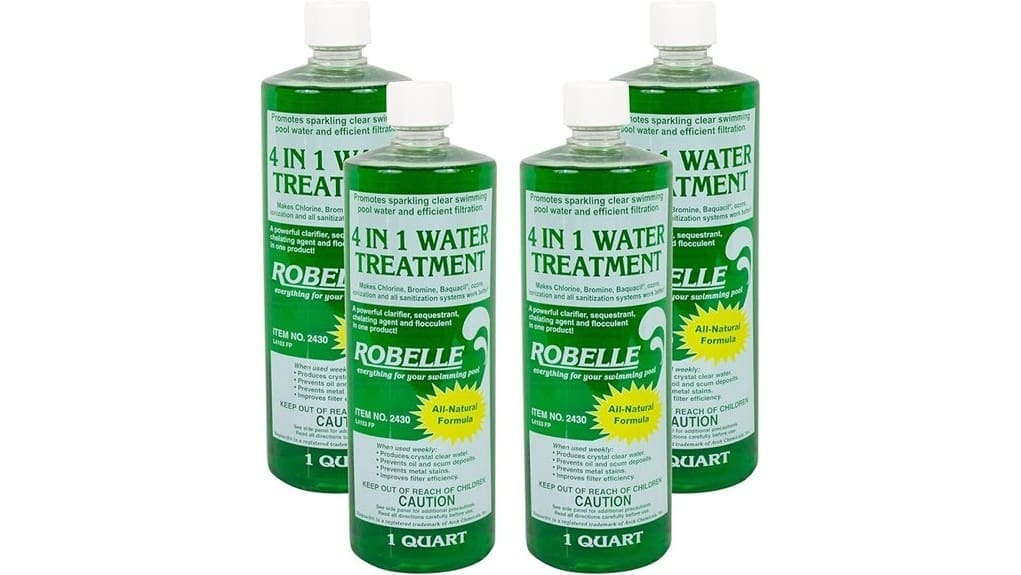
You’ll find Robelle’s 1‑quart 4‑pack a data‑driven, cost‑efficient choice for routine pool clarity and stain control. It acts as a clarifier, flocculant, sequestrant and chelant, binding metals and aggregating fine particulates so your filter removes them without changing pH. Dose 1 oz per 5,000 gallons, run the pump six hours, and expect clearing in 6–24 hours; repeat only if still cloudy after 72 hours. Keep sanitizer and shock routines; more details follow.
Some Key Takeaways
- Effective clarifier/flocculent that rapidly aggregates fine particulates for easier filter capture when dosed 1 oz per 5,000 gallons.
- Sequestrant/chelant action binds iron, copper, and calcium to prevent stains and scale without altering pH.
- Four-quart pack treats ~4,096,000 gallons, offering predictable coverage and lower cost per gallon.
- Requires pump run ≥6 hours; visible clearing often within 6–24 hours, repeat only if cloudy after 72 hours.
- Not a sanitizer or algaecide—use alongside regular chlorine/shock and proper filter maintenance.
Quick Verdict: Is Robelle 1‑Quart 4‑Pack Worth Buying?
Wondering if the Robelle 1‑Quart 4‑Pack is worth buying? You’ll find a data-driven yes for routine pool upkeep. Unit count and concentrated dosing (1 oz/5,000 gal) give predictable coverage; four quarts treat large-season needs and simplify seasonal storage without partial-bottle waste. Independent customer testimonials cite faster clearing and improved filter efficiency after one application, supporting manufacturer claims. You’ll still follow protocol: clean/backwash first, run pump six hours, reapply only if cloudy after 72 hours. Cost-per-treatment and compatibility with all sanitizer systems make it a practical, evidence-backed purchase for steady maintenance. For homeowners who enjoy their outdoor spaces, using a clarifier as part of regular maintenance helps maintain clear pool water and overall pool health.
What the Robelle 4‑in‑1 Actually Does: Clarifier, Sequestrant, Chelant, Flocculent
Because Robelle combines four distinct chemistries into one bottle, it tackles cloudy or contaminated pool water through complementary mechanisms: the clarifier and flocculent aggregate tiny suspended particles into larger clumps your filter can catch, while the sequestrant and chelating agent bind dissolved metals and prevent scale or stains. You’ll see two measurable actions: a clarifier mechanism that increases particle size and filter capture efficiency, and sequestrant chemistry that complexes iron, copper, and calcium to stop staining or clouding. Together they reduce organics, oils, and metals, improving clarity without altering pH or requiring premixing. This makes it a convenient option for maintaining water quality alongside choosing the right sand filter media.
Real‑World Performance and Application: Dosing, Circulation, and Results Timeline
Having seen how Robelle’s clarifier and sequestrant work together, you can now assess how that chemistry performs in real pools under typical dosing and circulation conditions. You’ll dose 1 oz per 5,000 gallons with the pump running, applying along edges or broadcast across the surface; run circulation at least six hours. In practice, visible clearing often begins within 6–24 hours; persistent cloudiness after 72 hours warrants a repeat dose. Regular biweekly maintenance or targeted seasonal dosing preserves clarity and supports filter longevity by reducing particulate load. Results depend on load, sanitizer balance, and proper pre‑filtration/backwash procedures. Proper use of these products supports a sparkling pool and safe outdoor spaces.
Pros, Cons, and Compatibility: What It Removes, What It Won’t Fix, and Sanitizer/Pagе‑Care Fit
When you’re deciding whether Robelle fits your pool-care routine, weigh its strong removal profile—oils, soaps, cosmetics, metals, and fine particulate—with its limits on addressing underlying sanitizer or biological issues; the product acts as a clarifier, sequestrant, chelating agent, and flocculent to improve filter efficiency and clear cloudy water, but it won’t substitute for proper sanitizer levels, shock treatments, or algae control. You’ll get effective stain prevention, reduced scum-line and measurable foaming control, and faster filter capture. Don’t expect microbial kill, pH correction, or long-term algae remediation—use Robelle alongside your sanitizer and shock regimen for best results. It’s intended for homeowners who enjoy their outdoor spaces and want to maintain stain-free water with targeted chemistry adjustments and pool stain removers.
Cost, Coverage, and Maintenance Plan: How Many Treatments Per Pool and Value vs Alternatives
Crunch the numbers: a single 1-quart bottle treats 1,024,000 gallons at the labeled dose (1 oz per 5,000 gallons). You’ll get four quarts in the pack, so one pack treats ~4,096,000 gallons — useful for calculating cost per gallon and per season. Using the maintenance dosage (1 oz/5,000 gal every two weeks) lets you model treatment frequency and plan inventory. For a 20,000-gallon pool you’ll need ~4 oz per maintenance dose, about 26 doses per season → 104 oz (~0.81 packs). Compare retail price to alternatives: this concentrated formula often yields lower cost per treated gallon and reduced labor versus single‑use clarifiers. Homeowners who value easy upkeep and predictable dosing often prefer chlorine tablets for ongoing pool maintenance.
Some Questions Answered
Is This Product Safe for Vinyl and Fiberglass Pool Surfaces?
Yes — you can use it on vinyl and fiberglass pools; the formula’s sequestrant and chelating actions protect surfaces and metals, minimizing surface discoloration risk. You’ll want to follow dosing and circulation instructions (1 oz per 5,000 gallons, run pump) and avoid concentrated contact by broadcasting along edges. Evidence-based use and routine maintenance doses further reduce staining or scum-line buildup, so if you follow directions you shouldn’t see surface discoloration.
Can I Use It With Saltwater Chlorine Generators?
Yes — you can use it with saltwater chlorine generators. The product’s system compatibility is high and won’t interfere with generator function when dosed per instructions. It won’t harm the salt cell chemically, but regular electrode maintenance is still advised because clarifiers can increase particulate capture on the cell. Monitor generator performance to detect any generator interference, and follow pump circulation and dosing rates to minimize deposits and make certain peak operation.
Does It Leave Any Residue on Pool Furniture or Decking?
No — you shouldn’t get residue on furniture or decking when used as directed. Tests and label guidance indicate the formula targets oils, metals, and particulates in water, reducing staining concerns and minimizing slippery buildup on surfaces. Proper dosing, applying with the pump running, and routine backwashing prevent carryover. If overspray or heavy foaming occurs, rinse affected areas; repeat treatment only per instructions to avoid localized deposits.
Is It Safe for Ponds or Water Features With Fish?
No — you shouldn’t assume it’s safe for ponds or water features with fish. The product’s formulation targets pool chemistry, and evidence on aquatic toxicity for wildlife isn’t provided. To protect safe habitats, avoid direct use in fish-containing systems unless the manufacturer certifies non-toxicity. If you must treat nearby water, consult product data sheets, perform small controlled tests, and monitor dissolved oxygen, pH, and fish behavior closely before broader application.
How Should I Store Unopened and Opened Quart Bottles?
Store unopened quarts in cool storage, upright, sealed, away from heat and direct sunlight; UV protection is essential to prevent degradation. Once opened, keep bottles tightly capped, return to cool, dark storage with UV protection, and minimize air headspace to reduce contamination. Label with open date and use within manufacturer-recommended timeframe. If product clarity, odor, or performance changes, discard. Follow local disposal regulations for any remaining liquid.