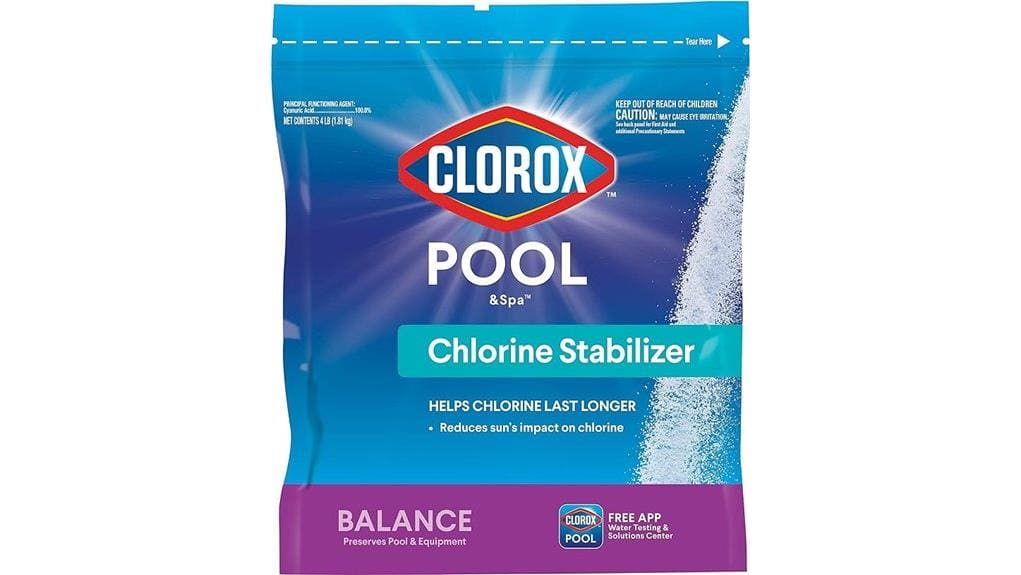
You’ll get steadier free-chlorine levels and less UV loss with Clorox® Pool&Spa™ Chlorine Stabilizer because its cyanuric-acid formula complexes chlorine and slows photolysis. It’s dosed by pool volume and current CYA, mixes as granules or tablets, and works in salt and traditional systems with minimal equipment stress when used per label. Test CYA and free chlorine within 24–72 hours and adjust; follow app guidance for precise dosing and application to optimize longevity and reduce shocks — more specifics follow.
Some Key Takeaways
- Effectively protects free chlorine from UV breakdown, extending sanitizer life and reducing daily chlorine loss.
- Cyanuric acid–based formula requires measuring pool volume and current CYA for accurate dosing.
- Compatible with saltwater systems and most pool equipment when used per label, with predictable chemistry results.
- Adds steady chlorine readings and fewer shock treatments reported when maintained within recommended CYA ranges.
- Apply during low-use periods, circulate 8–12 hours, and test CYA/free chlorine within 24–72 hours after dosing.
Quick Verdict: Is Clorox® Pool&Spa™ Chlorine Stabilizer Worth Buying?
In short, Clorox® Pool&Spa™ Chlorine Stabilizer delivers exactly what it promises: it shields free chlorine from UV degradation so your sanitizer lasts longer and you add chlorine less often. You’ll find it cost-effective in a price comparison against generic cyanuric acid products, given Clorox’s measured purity and dosing guidance. Apply it per label to maintain target stabilizer levels without overshooting. User testimonials consistently note fewer shock treatments and steadier free chlorine readings. You’ll appreciate the predictable dosing, compatibility with salt systems, and reduced equipment stress—practical benefits that make it a defensible purchase for pool owners. Proper stabilizer levels also help maintain balanced pool chemistry and extend sanitizer effectiveness.
How the Stabilizer Works and Why UV Protection Matters for Chlorine
Having covered why you’ll likely appreciate steadier chlorine readings, let’s look at how the stabilizer actually works to protect that chlorine. You add cyanuric acid-based stabilizer; it binds free chlorine in equilibrium, forming a UV-resistant complex that slows photolytic breakdown. That UV protection reduces daily chlorine loss, so you maintain target residuals longer. Practically, you’ll see fewer shock additions and steadier sanitization, enhancing chlorine longevity and lowering dose variance. The mechanism is chemical buffering, not sanitizer replacement, so you still monitor free and combined chlorine. You’re part of a community that values efficient, science-based pool care. Proper maintenance includes addressing other factors like phosphate buildup that can affect overall pool health.
Step-By-Step Use: Dosing, Application Tips, and How to Test With the Clorox Pool App
Get your dosage right the first time by measuring pool volume, current cyanuric acid (CYA) level, and target CYA before you add any stabilizer. Calculate required grams or ounces per manufacturer guidance; the Clorox Pool App will confirm amounts after you enter measurements. For application timing, add stabilizer during low-use periods and circulate for 8–12 hours. If using tablets, plan tablet integration in a floater or feeder to avoid clouding; granules should be pre-dissolved and introduced near return jets. Test CYA and free chlorine within 24–72 hours via the app, record results, and adjust future dosing accordingly. Proper pool opening preparation helps homeowners enjoy their outdoor spaces safely and sooner.
Performance and Compatibility: Results in Saltwater, Salt-Cell Systems, and Different Pool Types
After you’ve confirmed proper CYA levels and circulated the stabilizer, evaluate how Clorox Pool&Spa Chlorine Stabilizer performs across pool systems—especially saltwater and salt-cell setups—since application outcomes and maintenance routines differ by equipment and pool type. You’ll find consistent saltwater longevity: stabilized chlorine produced by salt cells persists longer under sunlight, reducing dosing frequency. Measure residual free chlorine regularly and adjust CYA to target ranges. The formula shows broad equipment compatibility, posing minimal risk to salt cells, liners, and plaster when used per label. For shared community pools, this predictable performance helps you maintain balanced chemistry and confidence in results. Many homeowners use simple test kits to monitor their pool chemistry and ensure safe, enjoyable outdoor spaces.
When to Choose This Stabilizer and Maintenance Tips to Keep Chlorine Effective
If you want longer-lasting chlorine and fewer shock treatments, choose Clorox Pool&Spa Chlorine Stabilizer when your cyanuric acid (CYA) is below the recommended range for your pool type—typically 30–50 ppm for residential pools and up to 70–80 ppm for some outdoor, high‑UV or commercial situations—and when you’re using free chlorine sources that are exposed to sunlight (including salt-cell–generated chlorine). Add during warm seasons for seasonal timing, after dilution or fresh fill, and avoid overdosing. Test CYA regularly with the Clorox Pool app, maintain pH 7.2–7.8, monitor chlorine residuals, and combine stabilizer use with routine brushing for reliable algae prevention. This product is aimed at homeowners who enjoy their outdoor spaces and want fewer maintenance hassles, including reduced frequency of shock treatments when used properly with shock treatment routines.
Some Questions Answered
Is the Stabilizer Safe for Koi or Decorative Ponds?
No, you shouldn’t use this stabilizer in koi or decorative ponds; koi toxicity risk and altered pond aesthetics make it unsuitable. You’ll avoid stressing fish and disrupting biofiltration by keeping stabilizer out of ornamental systems. For shared-use statements, follow pond-specific products and test water frequently. You’ll preserve clarity, minimize chemical buildup, and protect koi health while maintaining pond aesthetics and balanced, low-risk water chemistry.
Can It Be Used With Biguanide (PHMB) Systems?
No — you shouldn’t use the stabilizer with biguanide (PHMB) systems. PHMB systems rely on non-chlorine chemistry; adding a cyanuric acid stabilizer creates stabilizer incompatibility and persistent residual cyanuric that binds to any incidental chlorine, undermining PHMB effectiveness and complicating treatment. If you want combined approaches, test and consult a pro; otherwise keep PHMB pools free of cyanuric-stabilized chlorine to preserve chemical balance and equipment longevity.
Does It Affect Pool Water pH or Alkalinity Readings?
No — it won’t markedly change pH interaction or cause alkalinity interference. You’ll find stabilizer (cyanuric acid) is chemically inert regarding acid/base balance at normal doses, so it doesn’t alter pH or total alkalinity readings directly. You should still monitor and adjust pH and alkalinity routinely, because water chemistry changes from other sources can occur. Use the Clorox Pool App for personalized testing and dosage guidance to keep your group’s pool balanced.
Is the Product Biodegradable or Environmentally Friendly?
No — the product itself isn’t biodegradable and you shouldn’t expect it to fully break down; it’s a synthetic stabilizer that resists UV degradation to protect chlorine. You can look for biodegradable packaging, but the chemical can pose aquatic toxicity risks if overapplied or discharged. You’ll want to follow dosage guidance, use the Clorox Pool App for testing, and avoid releasing treated water into sensitive waterways to protect your community and local ecosystems.
What Is the Shelf Life Once the Bottle Is Opened?
Once opened, you can expect usable product for about 1–2 years if you store it properly. You’ll minimize degradation rate by keeping the bottle sealed, in a cool, dry place away from direct sunlight and extreme temperatures. Maintain recommended storage conditions and you’ll preserve effectiveness for longer, reducing frequent retesting. You’ll feel confident treating your pool when you follow these practical, community-minded handling and storage practices.