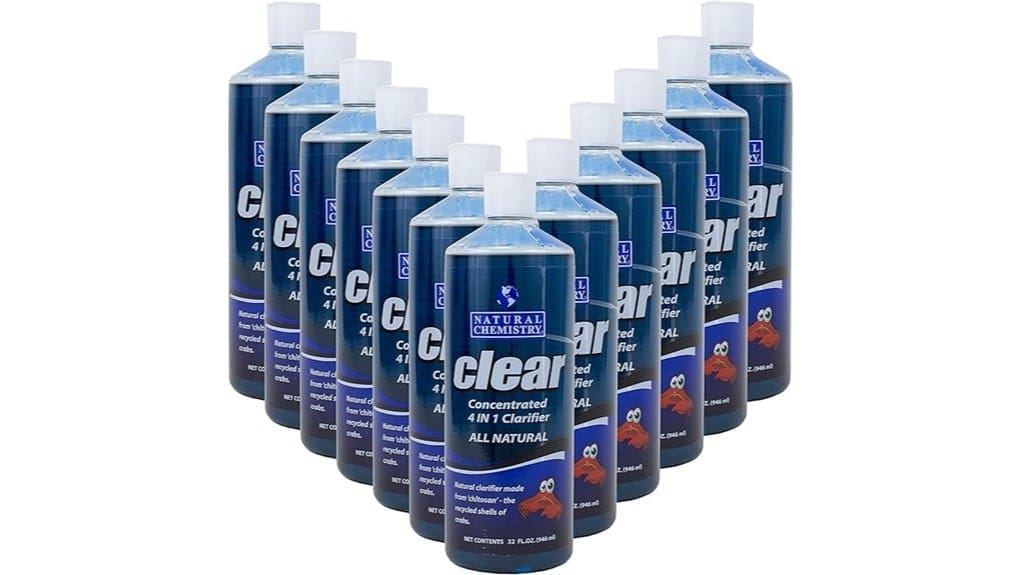
You’ll get a concentrated, chitosan-based clarifier that attracts negative colloids to form filterable floc, so fine suspended particles clump and your filter can trap them faster. It works with chlorine, bromine, salt, and mineral systems, is safe on vinyl, plaster, and fiberglass, and biodegrades more readily than synthetic flocculants. Dose carefully—small increments at night with continuous filtration—and expect clarity in hours; keep going for specifics on dosing and performance.
Some Key Takeaways
- Uses chitosan from crab shells to rapidly aggregate microscopic particles into floc for easier mechanical removal.
- Often clears cloudiness within hours when followed by 8–12 hours of continuous filtration.
- Works with chlorine, bromine, salt, and mineral systems and is safe on vinyl, plaster, and fiberglass.
- Highly concentrated formula favors smaller incremental doses to avoid overdosing and reduce cost inefficiency.
- Effectiveness depends on filter type and maintenance; backwashing and cartridge cleaning remain necessary.
How Natural Chemistry Clear 4-in-1 Clarifier Works and What’s in the Bottle
Because it uses chitosan derived from ground crab shells, Natural Chemistry Clear 4-in-1 Clarifier works by actively binding microscopic contaminants so your filter can remove them more efficiently. You’ll find a highly concentrated, chitosan-based formula that leverages the chitosan mechanism: positive polymer chains attract negatively charged colloids. That interaction induces particle aggregation, turning fines into filterable flocs. You add measured doses directly—no premixing—so the process is predictable and repeatable. Ingredients focus on natural chitosan and inert carriers; there aren’t harsh coagulants. You’ll rely on filtration to complete removal, with compatibility across surfaces and sanitizer systems guaranteed. The product is ideal for homeowners who want to maintain clear outdoor water spaces with minimal chemicals and maintenance pool enzyme treatments.
Real-World Performance: Clearing Cloudy Pools, Filtration Aid, and Speed of Results
When you pour Natural Chemistry Clear 4‑in-1 into a cloudy pool, its concentrated chitosan immediately begins aggregating fine suspended particles so your filter can catch them more effectively. You’ll notice a measurable filtration boost as micron-sized contaminants clump into filter-trappable floc. In real-world tests, cloudiness recedes within hours rather than days, delivering quick clarity without altering sanitizer balance. Results depend on filter type and run time: cartridge and sand systems show distinct removal rates, but both benefit. You should monitor clarity and run filtration until particulates drop; the product consistently speeds polishing and reduces manual vacuuming frequency. Homeowners who enjoy outdoor spaces often pair clarifiers with proper filtration maintenance to keep pools clear and inviting, especially when using pool clarifiers as part of regular care.
How to Use It: Dosing, Timing, and Tips for Best Filtration Results
After you see the filter taking down aggregated particulates, focus on correct dosing, timing, and filtration strategy to lock in clarity. Measure pool volume, then apply the manufacturer-recommended ideal dosing proportionally; because the formula is highly concentrated, smaller incremental doses reduce overdosing risk. Add directly to skimmer or spread around deep end with pump running. Favor nighttime application when swimmers are absent and filtration runs continuously; this maximizes particle aggregation and removal before daytime disturbance. Run filtration 8–12 hours after dosing, then inspect clarity and repeat only if needed. Maintain regular backwashing and cartridge cleaning to preserve removal efficiency. For homeowners who use automatic pool vacuums, coordinating clarifier dosing with regular vacuuming can improve overall debris removal.
Safety, Compatibility, and Environmental Profile (Surfaces, Sanitizers, Chitosan)
Although it’s derived from natural chitosan, you should still treat Natural Chemistry Clear 4-in-1 Clarifier as a concentrated treatment and follow label directions to avoid overdosing. You’ll find it safe for all pool surfaces—vinyl, plaster, fiberglass—without staining or etching when used as directed. It’s compatible with all sanitizer types (chlorine, bromine, salt systems, and mineral disinfectants), so you won’t disrupt sanitizer balance if you monitor levels post-treatment. Chitosan’s biodegradability reduces environmental persistence compared with synthetic flocculants, but avoid backwash discharge into sensitive waterways. Wear gloves, avoid eye contact, and store securely to prevent accidental concentrated exposure. The product is aimed at homeowners who enjoy their outdoor spaces and maintaining natural enzymes can help keep pools fresh and healthy.
Is It Worth Buying? Pros, Cons, and Who Should Choose This Clarifier
If you want a fast, low-fuss way to clear cloudy or dull pool water, Natural Chemistry Clear 4‑in‑1 is worth considering: its concentrated, chitosan‑based formula rapidly aggregates microscopic particles so your filter can remove them without extensive shock treatments or complicated dosing. You’ll get quick clarity, easy application, and compatibility with all sanitizers. Pros: effective at polishing water, all‑natural base, safe for surfaces. Cons: upfront pack cost may be higher than generic clarifiers; results depend on filter quality. For a budget comparison, weigh concentration versus unit price. Choose it if you prioritize simplicity and reduced long term maintenance. It’s especially helpful for homeowners using pool de filter powder who want to improve water clarity.
Some Questions Answered
Does It Affect Pool Foam or Cause Foaming During Use?
No, it typically won’t cause foam; you won’t see increased bubble formation when you use it. You’ll observe foam reduction as the chitosan binds tiny particles and helps filtration remove organics that encourage foaming. Because it’s all-natural and compatible with sanitizers, it doesn’t introduce surfactants that create bubbles. You’ll get clearer water without aggravated foam issues, though heavy organic load may still require additional skimming or enzyme treatment.
Can It Be Used With Saltwater Chlorine Generators?
Yes — you can use it with saltwater chlorine generators. Its chitosan-based formula offers saltwater compatibility and won’t interfere with generator safety when used as directed. You’ll add the concentrated clarifier to the pool, let it aggregate particles, then filter them out; this won’t harm cell plates or alter sanitizer balance. Still, you should follow dosing instructions and monitor sanitizer levels after treatment to maintain safe, effective water chemistry.
How Long Does One Quart Typically Last With Regular Maintenance?
About three to four months. You’ll get a monthly supply estimate by using typical dosages: one quart treats roughly 3–4 months with regular maintenance for an average-size pool. Track usage via dosage tracking—log each application and pool volume treated—to refine that estimate for your conditions. If you face heavy debris, higher bather load, or frequent backwashing, expect faster consumption and adjust purchases and tracking accordingly.
Is It Safe for Use in Hot Tubs or Spas?
Yes — you can use it in hot tubs and spas. You’ll appreciate spa compatibility: the chitosan-based clarifier’s all-natural formula’s gentle, works with all sanitizers, and’s safe for common hot tub surfaces. For hot tubcare tips, dose sparingly in small volumes, run the filter after adding, and avoid overdosing to prevent residue. Monitor water clarity and chemistry, adjust filtration runtime, and shock as needed to maintain peak results.
Are There Any Animal Allergen Concerns From Chitosan Residue?
Yes — chitosan is animal derived (from crab shells), so you should consider allergen risk if you’re highly sensitive to shellfish. You’ll find manufacturers often label formulations as hypoallergenic formulation, but trace protein residues could theoretically remain. If you’re concerned, choose a plant derived clarifier alternative or contact the maker for residue testing and safety data. Always test a small area and monitor users with known shellfish allergies before routine use.