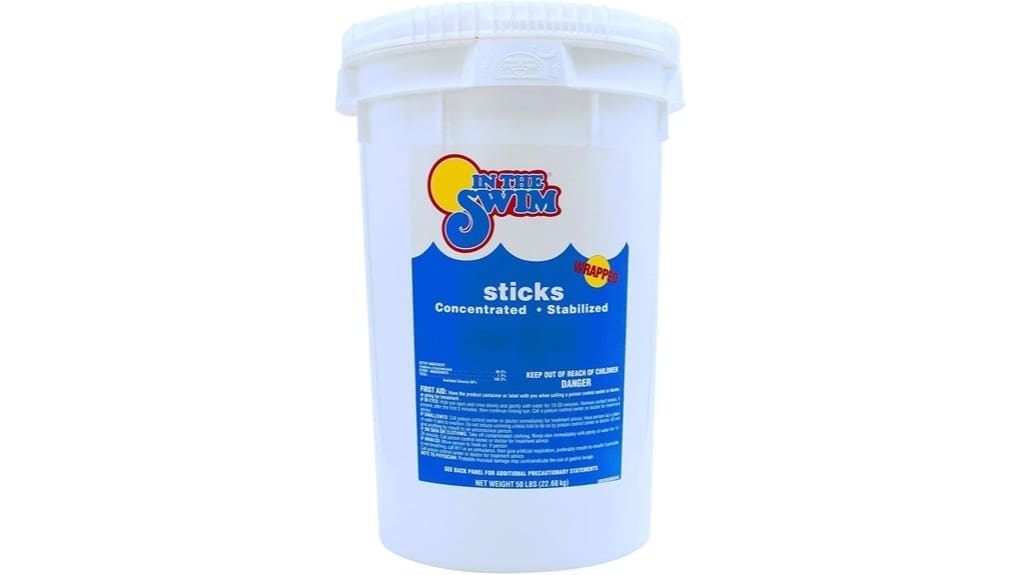
You’ll get steady, low‑maintenance chlorination with In The Swim’s 4‑inch trichlor sticks; they’re nearly pure trichlor (about 99%) and deliver ~90% available chlorine with built‑in stabilizer to resist UV loss. They dissolve slowly in floaters or feeders, speed up in warm water, and give predictable residuals—while lowering pH and adding cyanuric acid. Use one stick per ~5,000–10,000 gallons to start, monitor levels, and follow safety guidance; continue for details on performance and alternatives.
Some Key Takeaways
- Stabilized 4-inch trichlor sticks (≈90% available chlorine, 99% trichlor) deliver dependable, slow-release sanitization for routine pool maintenance.
- Individually wrapped 8‑oz sticks resist moisture and heat, giving predictable dissolution suited to floaters and feeders.
- Temperature-sensitive dissolution increases in warm water but built-in stabilizer minimizes UV-driven chlorine loss and spikes.
- Pros: high chlorine content and set‑and‑forget convenience; cons: lowers pH and raises cyanuric acid over time.
- Start with one stick per 5,000–10,000 gallons, monitor free chlorine and CYA, and adjust dosing for pool size and bather load.
Quick Product Overview and Who These 4-Inch Chlorine Sticks Are Best For
If you need a dependable, low-maintenance sanitizer for routine pool chlorination, these In The Swim 4-inch chlorine sticks deliver a slow, temperature-responsive release of stabilized trichlor—each 8‑oz stick contains about 90% available chlorine and is 99% trichlor—packaged in 50‑lb quantities for frequent or large pools. You’ll find them suited to pool owners who prioritize steady residuals and simplified dosing. Use with floaters or feeders for set-and-forget operation. They integrate into regular maintenance routines, supporting consistent free chlorine levels without daily intervention. Ideal for above-ground, in-ground, and saltwater setups needing long-term, predictable chlorination. These products are commonly marketed alongside other pool shock treatments and accessories to help homeowners Keep Your Pool Sparkling.
What’s Inside the Stick: Composition, Chlorine Concentration, and Sun/Heat Resistance
Look inside an In The Swim 4‑inch stick and you’ll find a stabilized trichlor formulation composed almost entirely of trichloro-s-triazinetrione (about 99%), delivering roughly 90% available chlorine by weight. You’ll notice the stabilizer chemistry (isocyanuric acid built into the molecule) reduces ultraviolet degradation, so active chlorine persists in sun-exposed and warm pools. The sticks are individually wrapped to preserve packaging integrity and limit moisture uptake during storage and transport. You can handle and load them into floaters or feeders knowing the formulation resists heat-driven breakdown, offering predictable, long-term residual chlorine without premature decomposition. These sticks are a convenient option for homeowners maintaining outdoor pools.
How They Perform: Dissolution Behavior, Temperature Response, and Real-World Chlorination Results
Having established the stick’s stabilized trichlor chemistry and packaging, we can examine how that formulation controls dissolution and delivers real-world chlorination. You’ll observe consistent slow-dissolving sticks with predictable dissolution consistency and controlled release kinetics; individually wrapped 8 oz units limit premature loss. The material shows measurable temperature sensitivity: warmer water increases dissolution rate but stabilization minimizes spikes. In field use you’ll get steady residual stabilization day after day, avoiding large free-chlorine swings. Overall performance is balanced—reliable baseline chlorination, responsive yet damped temperature effects, and release kinetics suited to floaters/feeders for routine maintenance. They also help maintain proper pool water balance by avoiding sudden drops in calcium hardness that can affect pool surfaces.
How to Use Them Safely and Effectively (Floaters/Feeders, Dosages, Saltwater and Pool-Type Tips)
When you deploy these 4-inch trichlor sticks, place them in a floater or feeder and adjust the output to match pool volume and daily bather load so you maintain a target free chlorine residual without overshooting. You’ll dose based on volume: start with one 8 oz stick per 5,000–10,000 gallons, monitor free chlorine 24–48 hours, then fine-tune. They’re compatible with above-ground, in-ground, and saltwater pools due to stabilized trichlor. For pool maintenance, store wrapped sticks dry and ventilated. Observe safety precautions: wear gloves and eye protection, avoid mixing with other chemicals, and keep away from children and pets. For homeowners, using simple test kits regularly helps ensure safe, balanced pool water and optimal dosing.
Value Check: Pros, Cons, Alternatives, and Final Buying Recommendation
Because these 4-inch trichlor sticks combine high available chlorine, slow dissolution, and UV stabilization, they offer predictable, low-maintenance chlorination for a wide range of pools. You get concentrated 90% available chlorine in 8 oz, individually wrapped sticks that feed steadily via floaters or feeders. Pros: long-lasting, temperature-responsive dissolution, sun resistance, set-and-forget convenience. Cons: trichlor lowers pH, adds cyanuric acid, and poses disposal and environmental impact concerns. For alternatives, consider unstabilized granular chlorine or lithium hypochlorite for lower stabilizer load. Recommendation: choose In The Swim if you prioritize convenience and stable residuals; monitor CYA and pH. Many homeowners also use pool flocculants to help maintain clearer water and complement routine chlorination.
Some Questions Answered
Can These Sticks Stain Pool Liners or Decking?
They generally won’t stain liners or decking if used properly; you’re more likely to see chlorine discoloration or liner bleaching from prolonged, localized contact with high-concentration trichlor. You should keep sticks in floaters/feeders, avoid direct contact with vinyl liners or porous decking, and make certain good circulation. Test a small area if concerned, maintain proper sanitizer levels, and follow manufacturer spacing guidelines to prevent concentrated exposure and potential bleaching or discoloration.
Are They Safe Around Pets and Wildlife?
No — they’re not safe if pets access concentrated sticks or granules; you should prevent pet exposure and avoid runoff that raises wildlife toxicity. You’ll keep sticks in floaters/feeders and store them securely; direct contact, ingestion, or high local concentrations can harm animals. Use barriers, supervise pets near pools, and follow label instructions to minimize risk. If exposure occurs, contact a veterinarian or local wildlife rehabilitator immediately.
Do They Expire or Lose Potency Over Time?
Yes — they slowly lose potency. You’ll note a practical shelf life: stored sealed, cool, dry, they remain effective for about 1–2 years; exposure to heat, humidity or sunlight accelerates degradation. Perform periodic potency testing with a test strip or kit before heavy use. If sticks show crumbling, discoloration, or reduced available chlorine on testing, replace them to guarantee reliable chlorination and safe pool chemistry.
Can Sticks Be Used With Chemical Automation Systems?
Yes — you can use the sticks with chemical automation, but you should avoid direct feed into tablet feeders that have flow sensors calibrated for different tablet sizes. The 4-inch trichlor sticks dissolve slowly and can be placed in floaters or external feeders, yet some automated systems expect uniform tablets and may misread flow sensors or clog. Verify manufacturer specs, use compatible feeders, and monitor residual chlorine to make certain proper dosing.
How Should Leftover Sticks Be Stored Long-Term?
Store leftover sticks in a cool, dry place with proper ventilation to prevent moisture buildup; don’t keep them in damp areas. Keep original individual wrap intact, then place wrapped sticks in airtight containers or sealed plastic bins to limit air exposure and stabilize concentration. Avoid heat, direct sunlight, and combustible materials. Label containers with date and contents, and inspect periodically for degradation or moisture before use, discarding compromised sticks.