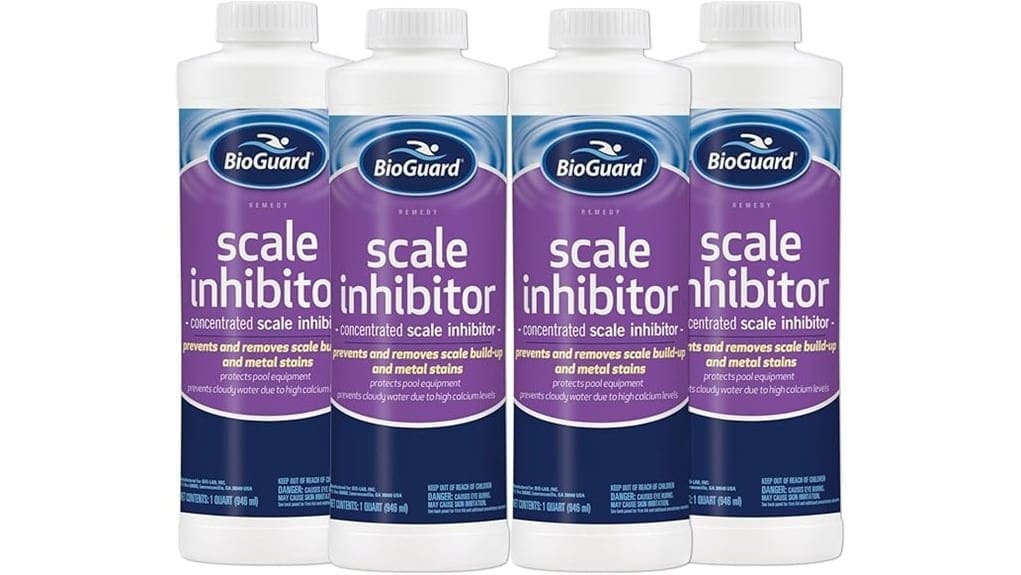
You’ll find the BioGuard Scale Inhibitor 4-pack effective at preventing new scale and metal stains when you dose per instructions and run circulation; it sequesters calcium and metals, disperses micro-deposits, and keeps hardness in solution. It reduces mild existing buildup with proper initial and maintenance dosing, but won’t fully remove deep, aged stains without mechanical or chemical follow-up. Coverage and per-ounce value are strong for mid-to-large pools, and the following sections explain dosing, limits, cost, and troubleshooting.
Some Key Takeaways
- Prevents new scale and metal stains when dosed correctly and circulation runs 24–48 hours.
- Initial 32 fl oz per 10,000 gal reduces mild existing deposits; measurable improvement with proper follow-up dosing.
- Maintenance 16 fl oz per 10,000 gal monthly keeps hardness sequestered and limits reoccurrence.
- Works by chelating metal ions and dispersing micro-deposits, but won’t fully reverse deep or aged stains.
- Four-pack (128 fl oz) offers better cost-per-ounce for recurring treatments of mid- to large-sized pools.
Real-World Summary: Does the BioGuard Scale Inhibitor 4-Pack Work?
While results vary with water chemistry and staining severity, the BioGuard Scale Inhibitor 4-pack generally works as advertised: it prevents new scale and metal stains and reduces mild existing deposits when dosed correctly and run with circulation. You’ll find customer reviews and field tests aligning on consistent prevention and measurable reduction of light deposits with proper initial and maintenance dosing. You should follow the 32 fl oz per 10,000 gallons initial dose, monitor hardness and metals, and maintain monthly dosing. In tougher cases, expect slower progress or professional intervention; the product excels as preventive, not miracle remediation. Proper filtration and using the right filter powder can help maintain the clarity improvements over time.
How the Concentrated Formula Performs on Scale and Metal Stains
When you dose BioGuard Scale Inhibitor at the recommended concentrations, its concentrated chelating and dispersant chemistry actively sequesters calcium and metal ions to inhibit nucleation and loosen existing micro-deposits, reducing visible scale formation and metal staining over successive treatment cycles. You’ll see concentrated efficacy in pools with recurring hardness or metal issues: hardness ions remain in solution rather than precipitating, and copper/iron complexes are held in suspension for filtration. Stain penetration is limited as the formula targets surface-bound ions and subsurface, aged stains may not fully reverse. Expect gradual improvement; persistent stains need mechanical or chemical follow-up. This product is well-suited for homeowners who want to maintain clear pool water in their outdoor spaces.
Using the 4-Pack: Dosing, Treatment Timing, and Maintenance Tips
Having seen how the concentrated formula sequesters hardness and metal ions, you can plan dosing across the 4-pack to match pool volume and treatment cadence. Calculate volume, then apply 32 fl oz per 10,000 gallons for initial treatment with pump running; run 24–48 hours. For maintenance, schedule 16 fl oz per 10,000 gallons monthly; log dates to guarantee consistency. For targeted stain work, use the same quart rate and brush daily 3–5 days. Align applications with pool dosing records and adjust for seasonal timing—increase vigilance entering hard-water months, decrease frequency during low-use periods while monitoring water chemistry. Consider how your choice of sand filter media can affect overall stain prevention and water clarity when planning treatments with pool sand filter media.
Costs, Coverage, and Value Compared to Single Bottles and Rivals
Because the 4-pack gives you 128 fl oz at a per-bottle price that’s typically lower than buying singles, you’ll pay less per treatment and get predictable coverage: one quart treats 10,000 gallons for initial shock and 16 fl oz for monthly maintenance, so a single 32 fl oz bottle covers two monthly maintenance doses for 10,000 gallons or one initial plus no-maintenance for that volume. Do a simple price comparison: divide pack price by 128 fl oz to get cost-per-ounce, then multiply by treatment volumes. Volume savings are clear for recurring maintenance cycles; rivals may match chemistry but rarely beat the per-ounce cost of this pack. Homeowners who enjoy maintaining their outdoor spaces will appreciate how the pack supports pool budget planning and repeat maintenance.
Who Should Buy This 4-Pack and Common Troubleshooting Tips
If you manage a mid- to large-sized pool or you perform routine seasonal maintenance, this 4‑pack is a cost-effective choice that reduces per-treatment cost and keeps you stocked for recurring monthly dosing; buy it if you treat 10,000‑gallon increments regularly or maintain multiple pools of similar size. You should buy this if you’re a pool owner who needs predictable, monthly preventative maintenance and wants to avoid scale-related equipment failures. Troubleshooting: verify dosing per 10,000 gal, confirm pump runs 24–48 hours after initial dose, check pH (product pH 3.0) and total hardness. For persistent stains, repeat treatments or consult drain/acid wash guidance. Maintaining proper pool pH and balanced water chemistry helps ensure the scale inhibitor performs effectively, so regularly test and adjust pool pH.
Some Questions Answered
Is This Safe for Vinyl and Fiberglass Pool Liners?
Yes — it’s liner safe? You can use BioGuard Scale Inhibitor in vinyl and fiberglass liners, as it’s formulated for all pool types and won’t harm typical liner materials when used per directions. You’ll prevent surface staining? by following dosing and circulation guidelines, avoiding overdosing, and treating stains promptly. For aged, stubborn stains on plaster they note more intensive measures, but vinyl/fiberglass generally remain protected with proper application.
Can It Be Used With Saltwater Chlorine Generators?
Yes — you can use it with saltwater chlorine generators. You’re treating mineral issues while protecting the cell, so the formula is compatible with generators and offers cell protection when used as directed. Add initial and maintenance doses with the pump running, monitor hardness and pH, and follow manufacturer intervals. If you’re treating heavy scaling or metal stains, inspect the cell regularly and clean per generator guidelines to guarantee continued performance and longevity.
Does It Affect Water Test Readings or Require Recalibration?
No, it generally won’t cause significant test interference or calibration drift, but you should monitor readings after dosing. You’ll see no persistent bias on standard chlorine, pH, or alkalinity strips; metal or hardness tests may show transient changes as sequestrant binds ions. To avoid misreads, take baseline measurements, add the inhibitor, then retest after 24–48 hours. If your electronic meter shows drift, perform a quick recalibration per the manufacturer.
Is the Product Biodegradable or Environmentally Safe?
No — it’s not labeled as biodegradable or explicitly environmentally safe. You should expect limited biodegradation testing information and no published aquatic toxicity data from the manufacturer. You’ll want to treat waste and backwash cautiously, avoid direct discharge to sensitive waterways, and follow local disposal regulations. For definitive assessment, request biodegradation testing results and aquatic toxicity studies from the seller or manufacturer before assuming environmental safety.
Can Bottles Be Stored Frozen or Exposed to High Heat?
No, you shouldn’t store the bottles frozen or expose them to high heat. The concentrated liquid can be damaged by freeze storage, causing expansion, container rupture, or reduced efficacy; prolonged heat exposure can degrade active ingredients and lower performance. Store bottles upright in a cool, dry place above freezing and away from direct sunlight or heat sources. Follow label instructions for temperature ranges and inspect containers before use for leaks or cloudiness.