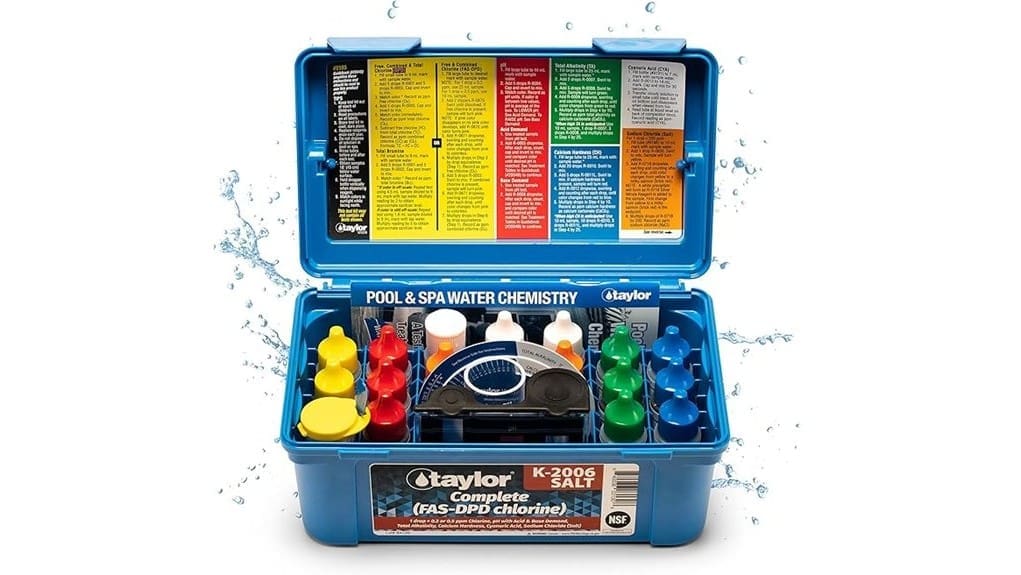
The Taylor K-2006-SALT FAS-DPD 9‑in‑1 gives you a compact, reliable kit for saltwater pools and spas, measuring free and combined chlorine, pH, CYA, chloride and more with FAS‑DPD accuracy. It’s fast and straightforward: sample, add reagents, compare colors, then act on clear thresholds for sanitation, pH, alkalinity, hardness and salt. Reagent size affects per‑test cost and longevity, and parts are replaceable. Continue for details on performance, costs and who should buy which version.
Some Key Takeaways
- Accurate FAS-DPD titrations and color matches give reliable free/combined chlorine, pH, and other readings suitable for saltwater pools and spas.
- Measures nine parameters including free/combined chlorine, pH, CYA, and chloride for direct salt-system monitoring.
- Fast, straightforward procedure with clear instructions and pictograms enables quick, repeatable results for homeowners and pros.
- .75 oz reagents suit occasional testers; Service Complete 2 oz bottles lower per-test cost for frequent use or multiple pools.
- Durable comparator with replaceable reagents and professional-grade reliability, but factor reagent lead time and inventory management.
Quick Verdict: Is the Taylor K-2006-SALT 9‑in‑1 Right for Your Pool or Spa?
If you want a compact, reliable kit that handles saltwater pools and spas, the Taylor K-2006‑SALT 9‑in‑1 is a solid choice. You’ll get clear Saltwater suitability: it measures free and combined chlorine, pH, CYA and chloride so you can monitor salt systems directly. The kit’s procedure is straightforward, yielding rapid results with concise instructions. Consider Maintenance frequency: the .75 oz reagents suit occasional testers; choose the Service Complete version if you test often. You’ll find the comparator durable and reagents replaceable. Overall, it’s practical for homeowners and professionals who need dependable, methodical testing. Many homeowners find that regular testing is essential to keeping outdoor pools safe and balanced, especially when using saltwater systems.
What the Kit Tests and What Each Result Means for Pool Care
Wondering what each measurement actually tells you about pool health? The kit measures free and combined chlorine, pH, acid and base demand, total alkalinity, calcium hardness, cyanuric acid, and chloride. For each test you get interpretation thresholds that indicate safe, marginal, or hazardous ranges. Use those thresholds to decide maintenance actions: adjust sanitizer for free chlorine, shock for high combined chlorine, add acid or base per demand results to correct pH, raise alkalinity or add muriatic soda per total alkalinity, add calcium for low hardness, dilute or stabilize depending on CYA, and manage salt levels for chloride. Follow the comparator results methodically. Keep your pool water perfect with easy digital testers for consistent, accurate readings and simple maintenance decisions using digital pool testers.
Real-World Performance: Accuracy, Speed, and Ease of Use
Having clear thresholds for each parameter helps you act, but you’ll still need a tester that delivers accurate, fast, and easy-to-read results in everyday use. You’ll find accuracy trends stable: FAS-DPD titrations and color matches reproduce within expected tolerances for pool maintenance. Speed is good — sample, add reagents, and compare colors in seconds — so you can test frequently. Ease of use is high; instructions and pictograms reduce errors and make procedures repeatable. User feedback echoes these points, noting professional-grade reliability for homeowners and technicians. Overall, the kit balances precision, quick turnaround, and straightforward operation. It’s a solid choice for homeowners who enjoy outdoor spaces and want reliable shock-treatment testing results.
Running Costs and Options: Reagent Sizes, Replacement Parts, and Test Capacity
When planning long-term use, consider reagent size and replacement frequency because they determine your per-test cost and how often you’ll need to re-order. You’ll evaluate reagent economics by comparing the .75 oz kit versus the Service Complete 2 oz bottles; larger bottle sizing yields over 2.5× test longevity and lower per-test cost. Check refill logistics: replacement reagents are sold separately and shipped from the US manufacturer, so factor lead time and availability into inventory. Also budget for occasional replacement parts and comparator wear. Track consumption rates against pool usage to set reorder points and minimize downtime. Keeping a logbook helps homeowners monitor reagent use and service intervals with pool care records.
How It Compares to Alternatives and Who Should Buy Which Version
Balancing reagent economics and inventory planning naturally leads to choosing the right kit for your needs: compare the K-2006-SALT .75 oz set and the Service Complete K-2006C-SALT 2 oz bottles against other market options by looking at test capacity, per-test cost, and usage patterns. You’ll find Taylor’s kits suit saltwater maintenance with professional comparisons favoring durability and accuracy. Choose .75 oz if you test seasonally or own one pool; choose 2 oz if you service multiple pools, run a commercial site, or want fewer reorder cycles. Alternatives may be cheaper but trade off range, longevity, and vendor support. Proper storage in a cool, dry place away from direct sunlight and incompatible chemicals helps maintain reagent effectiveness, especially for homeowners following pool chemical storage best practices.
Some Questions Answered
Is This Kit Suitable for Testing Salt Levels in Seawater Pools?
Yes — you can use it, but note limits: the kit offers seawater compatibility for saltwater pools and spas and measures chloride (sodium chloride) rather than ocean-specific salinity. You’ll need to follow salt calibration guidance and compare results against your pool’s target salt ppm. Don’t expect direct seawater salinity conversions; use the chloride reading with appropriate conversion factors or manufacturer guidance. Replace reagents or choose the Service Complete for frequent testing.
Are Replacement Reagents Available Individually and Where to Buy Them?
Yes — replacement reagents are available individually. You can buy them from authorized retailers, Taylor’s official distributors, and many pool-supply stores online. Search for Taylor replacement reagents by model (K-2006-SALT or TTK2006SALT) or reagent name to make certain compatibility. Order from authorized retailers to guarantee genuine reagents and proper expiration dates, or contact Taylor customer service for a verified supplier near you.
Does the Kit Include a Hard Carrying Case for Storage and Transport?
No — the kit doesn’t include a hard case for storage and transport. You’ll get the comparator and reagent bottles, but no hard case or built-in protective foam. If you want rugged transport, you should purchase a separate hard case with protective foam inserts sized for .75 oz reagent bottles and the comparator. Choose a case with customization options to secure vials, prevent spills, and protect reagents during field use and travel.
Can Reagents Be Shipped Internationally Without Restrictions?
No — reagents may face shipping restrictions and customs regulations. You’ll need to check carrier policies and destination country rules for hazardous or liquid chemicals; some jurisdictions require special documentation, permits, or prohibit certain reagents. Contact Taylor or your supplier for MSDS and specific export guidance, and confirm with the courier about allowed classes, labeling, and packaging. Plan for possible delays, additional fees, or blocked shipments if requirements aren’t met.
What Is the Shelf Life and Recommended Storage Temperature for Reagents?
You should store reagents at a cool, dry storage temperature between 15–25°C (59–77°F); avoid freezing and direct sunlight. Shelf life is typically 1–2 years unopened depending on reagent and lot; once opened, expect reduced shelf life — generally 6–12 months. Keep caps tightly closed, label open dates, and store reagents upright. If reagents change color, clarity, or odor, discard them regardless of stated shelf life.