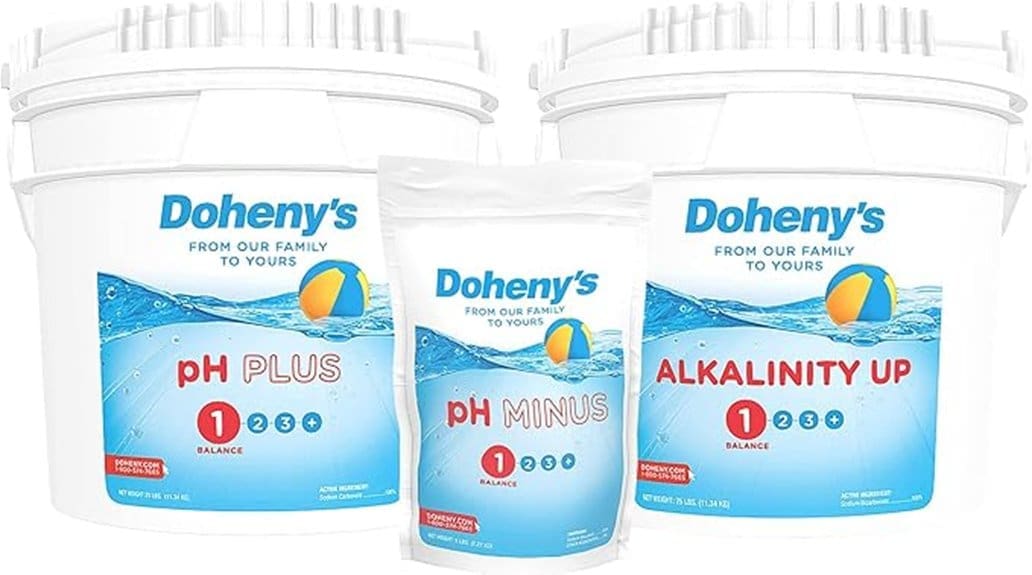
You’ll get a labeled set of alkalinity and pH adjusters aimed at homeowners and small commercial pools, providing predictable, test-driven control of total alkalinity and pH. The bundle pairs sodium bicarbonate/soda ash for raising TA and pH with sodium bisulfate for lowering pH, and includes dosing guidance for safe, incremental additions and retesting after 4–6 hours. Store chemicals separately, use PPE, and follow MSDS and label instructions — keep going to see full dosing, safety, and value details.
Some Key Takeaways
- Bundle provides labeled sodium bicarbonate/soda ash and sodium bisulfate for reliable pH and total alkalinity control.
- Ideal for routine maintenance after heavy bather load, rain, or chemical shocks for clearer, safer water.
- Includes dosing guidance (e.g., 1.5 lbs per 10,000 gal raises TA ~10 ppm) and stepwise adjustment procedures.
- Safety-focused packaging: separate containers, PPE recommendations, MSDS access, and secure storage guidance.
- Convenient matched quantities simplify inventory but may cost more per unit than buying components separately.
The Buying Intent: Who Needs Doheny’s pH Balancing Bundle and Why
If you manage a residential or commercial pool and want reliable control over pH and alkalinity, Doheny’s pH Balancing Bundle gives you the specific reagents—sodium bicarbonate/soda ash for alkalinity and pH raising, plus sodium bisulfate for pH lowering—so you can correct imbalances quickly and safely. You’ll use it when routine testing shows drift or after heavy bather load, rain, or chemical shocks. It’s suited to homeowners, pool managers, recreational facilities, and chemical suppliers who need standardized, labeled reagents for predictable dosing. You’ll follow label directions, maintain dry storage, segregate incompatible chemicals, and wear PPE during handling. Keeping your pool pH balanced is essential for clearer, safer water and optimal sanitizer effectiveness.
What’s Inside the Bundle and How Each Chemical Works
Because proper pool chemistry depends on controlling both pH and total alkalinity, Doheny’s pH Balancing Bundle contains three targeted reagents—alkalinity increaser (sodium bicarbonate or soda ash), pH increaser (sodium bicarbonate or soda ash formulation), and pH decreaser (sodium bisulfate)—each supplied in separate, labeled containers for clear dosing and safe handling. You’ll find specific chemical roles: alkalinity increaser buffers total alkalinity to stabilize pH; pH increaser raises free hydrogen ion concentration control; pH decreaser acidifies to lower pH. Labels explain dosing mechanisms and safety precautions. Store original containers, avoid cross contamination, and follow label PPE and handling instructions. Proper stabilizer levels help protect chlorine from rapid degradation and maintain effective sanitation stabilizer tips.
How to Dose the Alkalinity, pH Up, and pH Down for Typical Pools
Start by testing your pool’s total alkalinity and pH with reliable test strips or a digital meter so you know exact values before adding chemicals. Calculate required amounts using dosage calculators or label tables: raise TA with sodium bicarbonate (typically 1.5 lbs per 10,000 gal raises TA ~10 ppm), adjust pH with soda ash (pH Up) in small increments, lower pH with sodium bisulfate (pH Down) per label guidance. Add chemicals to deep end with pump running, wait 4–6 hours, retest and repeat as needed. Account for seasonal adjustments—higher dosing frequency in summer—and always follow product label concentrations. Keep shock treatments and pH adjustments in the recommended ranges to maintain water balance and protect pool equipment.
Safety, Storage, and Compatibility Tips for Home Pool Owners
After you’ve balanced alkalinity and pH, shift attention to safety, storage, and compatibility to keep chemicals stable and people safe. Store each product in its original, labeled container in a cool, dry, ventilated area elevated off concrete. Separate alkaline products (sodium bicarbonate/soda ash) from acid (sodium bisulfate) to prevent hazardous reactions; never mix. Use personal protective equipment—chemical-resistant gloves, goggles, and an apron—when measuring or adding chemicals. Keep material safety data sheets accessible and post an emergency spill response plan with neutralization and containment steps. Secure containers from children and pets and inspect seals regularly for degradation. Consider choosing purpose-built pool chemical storage containers that provide ventilation and secure locking features to further reduce risk.
Value Assessment: Cost, Convenience, and When to Choose Separate Products
When you weigh Doheny’s pH Balancing Bundle against buying components individually, consider both per‑unit cost and the operational convenience of having matched quantities on hand; the bundle saves time sourcing products and guarantees compatible formulations (sodium bicarbonate/soda ash for alkalinity/pH up and sodium bisulfate for pH down), but may not be the lowest cost per pound for every use case. You should run a price comparison based on how frequently you dose and pool volume. The bundle favors predictable maintenance schedules and simplified inventory control. Buy separately when you need atypical ratios, want bulk savings, or adjust purchase timing for sales. Homeowners who enjoy their outdoor spaces often prefer simple, reliable solutions for regular maintenance and testing with pool water test kits.
Some Questions Answered
Can I Use These Chemicals in a Saltwater Pool?
Yes — you can use them in a saltwater pool, but you’ll monitor chemistry closely for saltwater compatibility and electrode corrosion. You’ll add alkalinity up, pH up, or pH down per label dosing to maintain pH 7.2–7.6 and TA 80–120 ppm. You’ll avoid overdosing near the chlorinator/electrodes, store dry, and follow safety instructions. Regularly inspect and flush electrode surfaces to mitigate corrosion risk.
Are These Products Compatible With Metal-Stained Pools?
Yes — you can use them, but you shouldn’t expect stain prevention by themselves. You’ll control metal corrosion risk by maintaining proper pH and alkalinity; these products adjust alkalinity and pH which reduces corrosive conditions that promote metal staining. For true stain prevention or metal sequestration you’ll need a dedicated metal sequestering agent. Always follow label dosing, test frequently, and wear PPE to avoid chemical hazards and unintended reactions.
How Long After Dosing Can People Swim Safely?
You should generally wait 15–30 minutes after dosing before allowing swimmers, but always confirm with product label instructions and test the pool water. Wait times vary with dose, circulation, and pH/alkalinity change magnitude. If you used concentrated pH Down (sodium bisulfate) or large corrections, extend wait times and fully circulate. People with skin sensitivity should wait until chemical levels stabilize and pH/alkalinity are within recommended ranges.
Do These Chemicals Affect Pool Chlorine Effectiveness?
Yes — they do. You’ll affect chlorine interaction and sanitizer stability by changing pH and alkalinity: high pH reduces free chlorine effectiveness, low pH increases corrosivity and can destabilize sanitizer, and low alkalinity causes pH swings that stress chlorine residuals. You’ll dose per label, monitor free chlorine and pH after adjustments, and aim for pH 7.2–7.6 and TA 80–120 ppm to maintain ideal sanitizer stability and safe disinfection.
Can I Mix pH up and pH Down in the Same Bucket?
No — don’t mix pH Up and pH Down in the same bucket. You’ll create a neutralizing reaction that releases heat and dust; that’s hazardous. For safety timing, always dissolve and dose one product, rinse the bucket, then wait until the container and bucket are dry before using the other. Use separate labeled buckets if you must handle both simultaneously, wear PPE, and follow label instructions to prevent chemical reactions and exposure.