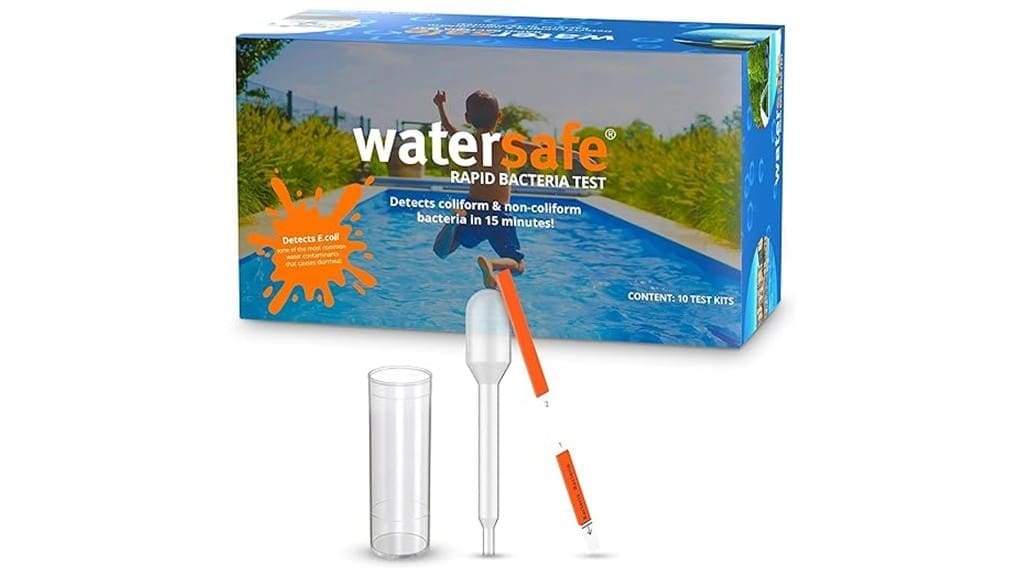
You’ll get a fast, on‑site yes/no screen for E. coli and Salmonella in pools, hot tubs, and spas using Watersafe’s WS‑359BP; you fill the vial, dip the antibody‑coated strip, wait ~10 minutes, and read a color/line signal with a detection limit near 1 bacterium/µL. It’s optimized for routine enteric bacterial screening, not full microbiological profiling, and is best for homeowners and small teams who want quick checks—keep going for practical setup, limits, and follow‑up guidance.
Some Key Takeaways
- Detects E. coli and Salmonella in pools, hot tubs, and spas with a visual result in about 10 minutes.
- Sensitivity approximately 1 bacteria/µL, giving a binary present/absent readout near that threshold.
- Simple fill–dip–read procedure requires no lab training, suitable for homeowners and small maintenance teams.
- Follow exact timing, consistent lighting, and proper sampling; repeat ambiguous positives and document conditions.
- Use for routine screening only; get professional lab analysis for persistent positives, symptoms, or regulatory needs.
Search Intent and Quick Verdict: Who Should Use the Watersafe Pool and Spa Rapid Bacteria Test
If you manage a residential pool, hot tub, or spa and need quick, on-site screening for common pathogens, the Watersafe Pool and Spa Rapid Bacteria Test gives a concise, technical option: it detects E. coli and Salmonella down to 1 bacteria/µL and returns a visual result in about 10 minutes with a simple fill-dip-read procedure, so you can routinely monitor water safety without specialized training. You’ll find it suited to homeowners and small maintenance teams based on user demographics and intended use. Integrate the kit into maintenance schedules for routine checks; it’s optimized for rapid, repeatable screening rather than exhaustive laboratory analysis. Consider pairing routine testing with pool water test kits to keep your outdoor water features safe and well-maintained.
How the 3‑Step Test Works and What It Detects (E. Coli, Salmonella, Sensitivity 1 Bacteria/µL)
Because the Watersafe Pool and Spa Rapid Bacteria Test condenses laboratory principles into three user actions—fill, dip, read—you perform a rapid, on‑site immunoassay that visually indicates the presence of target bacteria (notably E. coli and Salmonella) at concentrations down to approximately 1 bacteria/µL; you fill the provided vessel with sample water, immerse the test strip or cartridge to expose its reagent zone to the sample, then read a colorimetric or line-based result after the 10‑minute reaction period, where the test reagents bind specific bacterial antigens and produce a detectable signal if target organisms exceed the kit’s sensitivity threshold. The assay uses immobilized antibodies to capture bacterial antigens, generating a visible signal proportional to target load. Its rapid detection capability covers a limited pathogen spectrum focused on enteric bacteria; it’s optimized for screening rather than extensive microbiological profiling. Interpretation is binary—signal present or absent relative to the 1 bacteria/µL sensitivity—so confirmatory culture or lab testing is recommended for positive results. Homeowners should also maintain proper sanitation and regular testing to keep pool water clear and safe.
Real‑World Setup and Step‑by‑Step Usage Tips for Pools, Hot Tubs, and Spas
When you set up the Watersafe Pool and Spa Rapid Bacteria Test for routine use, position yourself near a stable work surface and collect a representative sample from mid-depth away from returns or skimmers to avoid localized contamination; this guarantees the sample reflects bulk water quality. Assemble components per installation tips: verify kit integrity, ambient temperature, and tool placement. Fill sample vial to indicated mark, dip reagent strip, time precisely 10 minutes, then read visual indicator under consistent lighting. For hot tubs and seasonal maintenance, record results, dispose used strips safely, and store kits dry at recommended temperature for repeatable, traceable onsite monitoring. For homeowners who enjoy their outdoor spaces, consider integrating routine testing with your regular maintenance schedule to keep both pools and surrounding areas pristine and inviting for guests, especially when using robotic pool vacuums as part of your cleanup routine.
Interpreting Results, Accuracy Limits, and When to Retest or Seek Professional Help
Having collected and recorded your sample per the setup steps, you’ll next interpret the visual readout and understand the test’s accuracy limits to decide on retesting or professional consultation. Read the indicator against the provided chart within the 10-minute window; results outside that window may be unreliable. Note that low-level positives near detection limit can reflect false positives or sample contamination; document environmental conditions and repeat the test with a fresh kit if results are unexpected. Retest immediately if color is ambiguous or handling errors occurred. Seek professional laboratory analysis when repeated positives persist, symptoms appear, or regulatory compliance is required. Cold months can affect test performance, so consider winter-specific pool winter protection measures when interpreting results.
Value and Suitability: Cost, Convenience, and Who the WS‑359BP 10‑Pack Is Best For
As a cost-effective, user-friendly option, the WS‑359BP 10-pack balances affordability with practical convenience for routine residential screening; each plastic test delivers a 10-minute, 1 bacteria/µL sensitivity check without lab access or technical training, making bulk purchase economical for homeowners, property managers, and small-service teams who monitor multiple pools or spas on a regular schedule. You’ll find long term affordability in the low per-test cost and minimal supplies required. The kit’s simplicity supports seasonal suitability for peak-use months and off-season checks. If you manage several sites or need frequent rapid checks, this pack fits practical, routine onsite monitoring needs. For added safety around backyard pools, consider pairing testing with essential pool rescue gear to help ensure a safer outdoor swimming space.
Some Questions Answered
Are These Tests Safe for Children and Pets if Ingested Accidentally?
No, they aren’t child safe formulation for ingestion; you should treat accidental ingestion seriously. If a child or pet swallows kit contents, consider pet exposure risks and call emergency services or poison control immediately for emergency response guidance. You should avoid inducing vomiting unless instructed, rinse mouths if contact occurred, and bring kit packaging to medical responders. Store kits out of reach and supervise testing to minimize accidental exposure.
How Should Unused Test Strips Be Stored and for How Long?
Store cool and store dark: keep unused test strips sealed in their original container, away from heat, direct sunlight, and moisture. You should store them at room temperature or below (ideally 15–25°C), avoiding temperature extremes. Use strips before the manufacturer’s expiration date; once opened, consume within the specified timeframe (typically several months) and follow kit labeling. Handle with dry, clean hands to prevent contamination and maintain accuracy.
Can Chlorine, Bromine, or Sanitizer Levels Affect Results?
Yes. You’ll see chlorine interference: residual chlorine or bromine can inactivate bacteria and yield false-negative readings. High sanitizer levels cause sanitizer degradation of detectable organisms before testing, reducing sensitivity. To minimize this, neutralize oxidizers or wait until sanitizer concentrations fall within acceptable ranges before sampling. Follow manufacturer guidance on sterility pH (7.2–7.8) and use the three-step protocol to guarantee consistent, reliable results.
Are Test Components Single-Use or Reusable After Cleaning?
The test components are single use components: the sterile sampling strips and reaction elements aren’t intended for reuse. You can clean external cleanable parts (plastic housing or caps) with mild disinfectant and allow thorough drying, but do not attempt to sterilize or reuse the reactive materials. Reusing consumables will compromise sensitivity (down to 1 bacteria/µL) and test integrity. Always replace single use components per kit instructions to maintain reliable, quantitative-like rapid assessments.
Do Test Kits Require Disposal as Biohazardous Waste?
No, you typically don’t need to treat these single-use test components as regulated biohazardous waste. You should, however, follow local biohazard handling and waste regulations: if tests contacted known pathogenic samples or are used in commercial/clinical settings, dispose per institutional protocols. For routine residential pool/spa screening, seal used strips in a bag and discard with regular trash unless local rules state otherwise. Contact local authorities for definitive guidance.