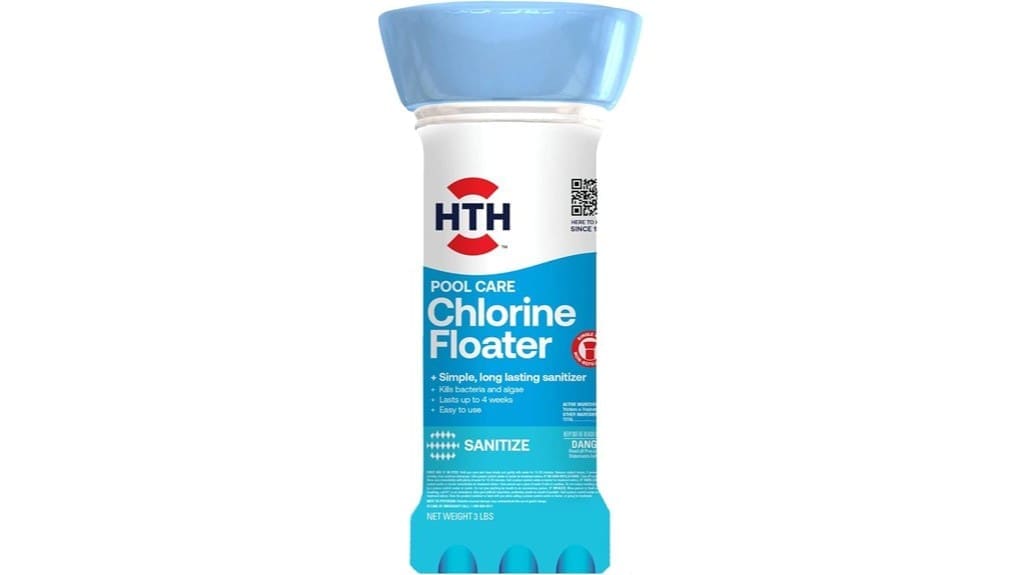
You’ll get predictable, low‑maintenance chlorination for small-to-medium pools with the HTH 42057 pre‑filled floater; it ships sealed with a trichloroisocyanurate tablet and adjustable vents to regulate dissolution and maintain 1–4 ppm free chlorine for up to four weeks in pools up to ~20,000 gallons. It’s compatible with vinyl and salt systems and simplifies dosing, but it’s single‑use plastic and offers less bulk control than feeders; keep testing and follow placement guidance to optimize performance if you want more details.
Some Key Takeaways
- Delivers steady stabilized chlorine (trichloroisocyanurate) for up to four weeks in pools up to 20,000 gallons when vents set properly.
- Adjustable vents and buoyant, sealed housing provide predictable passive diffusion without pumps, batteries, or user refilling.
- Maintains free chlorine typically in the 1–4 ppm range but requires twice-weekly testing and adjustments for demand changes.
- Pre-filled, non-refillable design simplifies use but increases single-use plastic waste and disposal concerns.
- Best for small-to-medium seasonal pools or low-maintenance owners; consider inline feeders for lower cost or tighter automation.
Product Snapshot and Quick Verdict: Does the HTH 42057 Chlorine Floater Work?
Wondering if the HTH 42057 Chlorine Floater actually works? You’ll find it delivers steady chlorination for up to four weeks per unit in pools to 20,000 gallons, minimizing manual dosing. Technical performance aligns with manufacturer claims: compatible with vinyl and salt systems, maintains 1–4 ppm when monitored. Customer reviews report reliable sanitization and reduced maintenance; some note variability in dissolution rate under extreme temperatures. Consider environmental impact: being pre-filled and non-refillable simplifies use but increases single-use plastic and chemical disposal concerns. Verdict: effective for routine sanitization, with trade-offs in waste and end-of-life handling. It’s a convenient option for homeowners who use outdoor pool spaces and want low-maintenance chlorine delivery.
How the Pre-Filled, Non-Refillable Floater Works and What’s Inside
Although it looks simple, the pre-filled HTH 42057 floater uses a controlled-diffusion design to deliver stabilized chlorine steadily into your pool: a sealed, non-refillable housing contains a slow-dissolving trichloroisocyanurate (stabilized chlorine) tablet whose exposed surface area is regulated by adjustable vents and buoyancy so the tablet dissolves at a predictable rate, maintaining sanitizer levels without manual dosing. You inspect vents and buoyancy settings to set flow; the chemical composition (trichloroisocyanurate with stabilizer) provides consistent free chlorine. The release mechanism is passive diffusion through vented openings; no pumps or batteries are required, reducing failure points. Many homeowners rely on such products as part of their pool opening routine to jump-start backyard water care.
Performance in Real Pools: Dosing, Duration (Up to 4 Weeks), and Compatibility With Pool Types
When you place an HTH 42057 floater in a pool, its controlled-diffusion venting and buoyancy deliver a steady dose of stabilized trichloroisocyanurate that will maintain free chlorine within the recommended 1–4 ppm range for up to four weeks in pools up to 20,000 gallons, provided you set the vents appropriately and monitor levels twice weekly with test strips. In practice you’ll see predictable dosing if you account for flow dynamics, ambient temperature, bather load, and stabilizer breakdown over time. It’s compatible with vinyl, concrete, fiberglass, and salt systems. Integrate remote monitoring or manual checks to confirm duration and adjust replacements. Homeowners who enjoy their outdoor spaces should pair this floater with digital testing tools for easy, accurate maintenance of pool chemistry and safety, especially when tracking free chlorine.
Practical Use: Setup, Recommended Chlorine Targets (1–4 Ppm), Testing Cadence, and Troubleshooting
Before you place the HTH 42057 floater, confirm pool volume and circulation are adequate and set the vent to match expected chlorine demand; then drop the pre-filled, non-refillable floater into the skimmer-return flow or open water area so it can circulate freely. You should maintain free chlorine at 1–4 ppm for effective sanitation and chlorine stabilization; adjust vents if levels drift. Test twice weekly with test strips and after heavy bather load, rain, or shock. For cloudy water or algae, check cyanuric acid, raise chlorine briefly, brush surfaces, and ensure pump runtime. Replace floater per manufacturer interval; monitor for uneven dissolution. Homeowners who enjoy outdoor spaces should consider routine shock treatments as part of pool care to keep water clear and safe.
Value and Final Recommendation: Cost, Convenience vs. Alternatives, Who Should Buy
While the HTH 42057 floater keeps maintenance minimal and dosing predictable, you’ll weigh its cost per season against other options like granular dosing, inline feeders, or refillable floaters. In a cost comparison, pre-filled floaters cost more per tablet but reduce labor and dosing errors. You’ll prefer this unit if you value convenience, predictable 1–4 ppm control, and minimal weekly attention. It suits small-to-medium seasonal pools, owners with limited time, or those avoiding equipment installation. If you need lower operating cost, tighter automation, or bulk chemical control, consider inline feeders or granular systems instead. Homeowners who prioritize simple, tool-free maintenance may find the floater ideal for outdoor pool setups.
Some Questions Answered
Is This Floater Safe to Store Indoors Between Seasons?
Yes. You can store the floater indoors between seasons if you keep it dry, sealed in its original packaging, and away from heat sources. Make sure indoor ventilation in the storage area to prevent chlorine odor buildup. Avoid storing near incompatible chemicals—check chemical compatibility and keep it separate from acids, fuels, or ammonium compounds. Label the container, follow manufacturer disposal/warranty guidance, and inspect for degradation before reuse.
Can Pets Swimming Nearby Be Affected by the Floater?
Yes — pets can be affected by pet exposure to treated water. You should prevent prolonged animal swimming or drinking while chlorine levels exceed 1–4 ppm; brief contact is generally safe but may irritate eyes, skin, or mucous membranes. Monitor animals, rinse with fresh water after swimming, and keep wildlife impact minimal by covering or isolating the floater when pets or wild animals frequent the pool area. Test chlorine regularly.
Are Replacement or Refill Tablets Available for This Model?
No — replacement tablets aren’t available for this floater; it’s a pre-filled, non-refillable unit. You’ll need to replace the entire floater when its active tablet is spent. For tablet availability in general, you can buy compatible 3‑inch chlorine tablets from HTH or other manufacturers, but they won’t fit into this sealed model. Check product specs and manufacturer guidance before attempting any modifications or using alternative tablet systems.
Does the Floater Float Steadily in High Wind or Waves?
No, it won’t hold perfectly steady in high wind or significant waves. You’ll find the floater offers good wind stability and buoyancy in calm to moderate conditions, but strong gusts or choppy surfaces cause drifting and tipping. Buoyancy tests show it remains afloat and dispenses tablets, yet it lacks anchoring for severe conditions. You’ll need a tether or sheltered placement for reliable, steady operation in windy weather.
Is This Product Allowed for Use in Public/Commercial Pools?
No — you shouldn’t assume use in public pools. Public pools? typically require specific regulatory compliance; many jurisdictions mandate commercial-grade feeders and documented dosing. The HTH 42057 is designed for residential, seasonal maintenance and is a pre-filled, non-refillable floater not intended as a primary sanitizer in commercial settings. You’ll need to consult local health codes and pool operators to confirm approved equipment and required monitoring protocols before using it publicly.