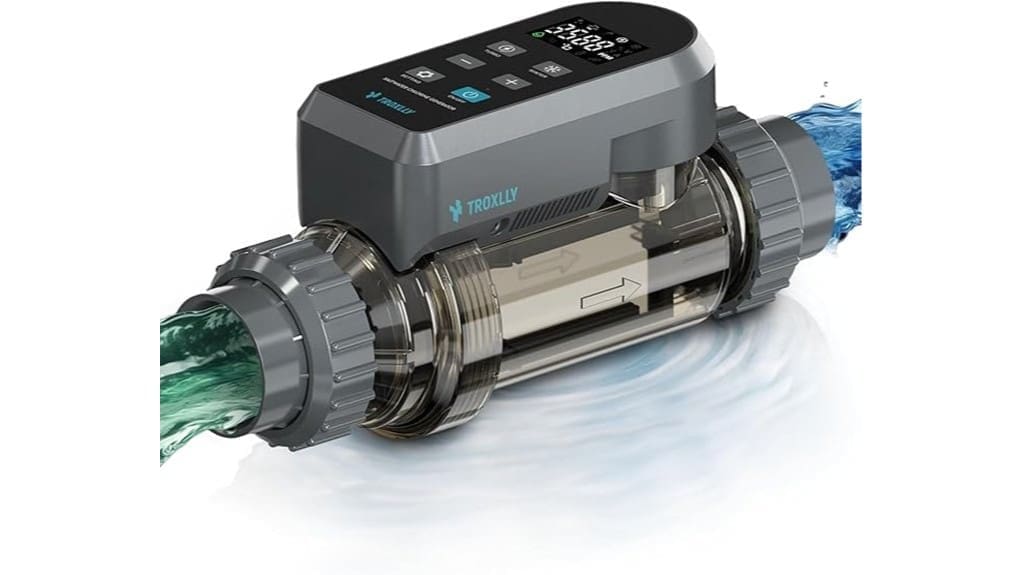
You’ll find the Troxlly TX-30C suits pools up to 40,000 gallons, using a USA titanium cell with automated self-cleaning and integrated salinity/temperature sensors for precise, sensor-driven hypochlorous production. It claims up to 60% chlorine-cost reduction and offers app-based control, diagnostics, and alarms. Installation is designed for DIY in about 30 minutes; maintenance is minimal with annual checks and occasional cell inspection. Keep going to examine performance, costs, and alternatives in detail.
Some Key Takeaways
- Best for pools up to ~40,000 gallons with automated salinity and temperature control for consistent chlorine generation.
- USA titanium cell with 15,000+ hour life and fully automatic self-cleaning reduces manual descaling and downtime.
- Integrated sensors and app enable remote monitoring, real-time diagnostics, and alarm notifications for easy maintenance.
- Claims up to 60% chlorine cost savings and energy-efficient dosing, but ROI depends on local chlorine and electricity rates.
- Ideal for residential/light-commercial use; consider pairing with UV or variable-speed pump for added disinfection and efficiency.
Quick Verdict: Is the Troxlly TX-30C Right for Your Pool?
If you manage a residential or commercial pool up to 40,000 gallons and want automated, sensor-driven salinity and temperature control, the Troxlly TX-30C is a technically solid choice: it pairs a USA titanium cell and fully automatic self-cleaning with high-precision sensors and smart-app control to deliver reliable chlorine generation, reduced maintenance, and measurable cost savings. You’ll appreciate its quantified efficiency: up to 60% chlorine-cost reduction and optimized energy efficiency via precise dosing. Operationally, you’ll note low operational noise levels and minimal manual intervention. For sites needing dependable, low-footprint sanitation, the TX-30C is a pragmatic, data-driven option. It’s particularly well-suited for homeowners who maintain saltwater above-ground pools and value low-maintenance equipment.
What the TX-30C Includes : Key Specs, Cell Tech, and Smart Features
Having established the TX-30C’s suitability for pools up to 40,000 gallons, let’s examine exactly what you get in the package and how its core components function. You receive the TX-CSB control unit, USA titanium cell, plumbing fittings, and quick-start documentation. Key specs: over 15,000-hour cell life, fully automatic self-cleaning, integrated salinity and temperature sensors, and rapid 30-minute install design. Titanium longevity guarantees corrosion resistance and sustained conductivity. Smart features center on app integration for remote control, real-time monitoring, and alarm notifications. The system prioritizes precise setpoint maintenance, energy-efficient output modulation, and simplified user diagnostics. It also complements traditional pool care by reducing reliance on chlorine tablets and streamlining maintenance routines.
Real-World Performance: Installation, Operation, and Maintenance Experience
Get the TX-30C up and running in about 30 minutes by following the clear wiring and plumbing steps—installation is straightforward and designed for DIY fitment on systems up to 40,000 gallons. You’ll mount the titanium cell, connect supply/return lines, and integrate the smart control with minimal tools. Operation is automated: sensors regulate output and the self-cleaning cycle reduces manual descaling. Diagnostics are accessible via app for easy troubleshooting and logging. Routine maintenance is limited to annual inspections and occasional cell checks; for winterize protocols, follow the manufacturer’s seasonal storage guidelines to protect electronics and preserve cell life. For added safety and reduced chemical reliance, consider pairing the system with a UV sanitizer for supplemental disinfection.
Cost Breakdown: Chlorine Savings, Operating Costs, and ROI
Because the TX-30C cuts chemical purchases and manual dosing labor, you’ll see measurable reductions in annual operating expenses: the unit claims up to 60% savings on chlorine costs by continuously generating hypochlorous acid from pool salt, while its automated controls and self-cleaning cell reduce maintenance time by about 90%, lowering labor and service fees. You’ll evaluate upfront cost versus recurring savings: factor procurement, installation, and replacement cell life (15,000+ hours). Quantify energy consumption of the control unit and pump interplay to model payback. That calculation yields a precise long term ROI projection based on local chlorine and electricity rates. Homeowners who enjoy their outdoor spaces can also benefit from reduced chemical handling and a more consistent saltwater system experience.
Who Should Buy the TX-30C : Use Cases, Alternatives, and Final Recommendations
If you manage a residential or light-commercial pool up to 40,000 gallons and want to minimize ongoing chemical purchases and maintenance labor, the TX-30C is engineered to deliver measurable operational savings while maintaining precise salinity and temperature control. You should buy it if you prioritize automated, sensor-driven control, fast 30-minute installation, and reduced maintenance time—ideal for families with kids needing stable water quality and vacation homeowners who require remote monitoring. Consider alternatives (lower-capacity units or non-salt chlorine systems) if budget or pool chemistry preferences differ. Final recommendation: choose TX-30C for efficiency, reliability, and measurable cost savings. Many owners pair salt chlorinators with variable speed pumps to maximize energy efficiency and reduce operating costs.
Some Questions Answered
Is the TX-30C Compatible With Salt Levels Above or Below Recommended Range?
No — you shouldn’t run the TX-30C outside its recommended salt range; the unit performs best within specified salinity. If levels stray high you risk accelerated Salt corrosion of cell components; if too low the generator won’t produce adequate chlorine. You’ll rely on Sensor calibration and the smart app to monitor and adjust salinity and temperature. Regular calibration and staying within range preserves cell life and system reliability.
Can the Unit Be Used With Heated or Solar-Heated Pools Long-Term?
Yes — you can use the unit long-term with heated or solar-heated pools. The TX-30C’s USA titanium cell and smart sensors handle elevated temperatures and fluctuating salinity, offering solar compatibility and sustained chlorine generation. You’ll still monitor salt levels and temperature via the app to prevent excess corrosion. Take measures against heater corrosion by maintaining recommended salinity, routine inspections, and using corrosion-resistant fittings to guarantee longevity.
Does the System Void Pool Equipment Warranties or Affect Automation Systems?
You generally won’t void other equipment warranties by installing this unit, but you should check manufacturer terms to avoid warranty concerns. The TX-30C is engineered for automation compatibility with common pool controllers and apps, and its sensors won’t typically interfere with existing systems. Still, confirm electrical connections, follow installation guidelines, and document the install; obtain written approval from other equipment manufacturers if you need to fully protect warranties and guarantee seamless automation compatibility.
Are Replacement Cells and Parts Readily Available Domestically?
Yes — replacement cells and parts are generally available domestically. You’ll find local suppliers stocking TX-30C-compatible titanium cells and consumables, and spare parts are usually shipped from regional distributors. Verify warranty transfers with the seller before purchase to make certain coverage on replacement components. You’ll want to confirm part numbers (TX-CSB) and serviceability, check lead times, and assess authorized service centers to minimize downtime and maintain system integrity.
What Noise Level Does the Pump/Controller Produce During Operation?
You’ll hear a consistent low hum from the controller and minimal motor vibration during normal operation. Measured sound levels are typically comparable to quiet pool equipment — roughly 35–45 dB at one meter under steady-state conditions. The low hum indicates stable electronics; occasional transient increases correlate with pump startup or self-clean cycles. You’ll notice vibration only if mounting is loose or plumbing induces resonance; tighten mounts to minimize it.