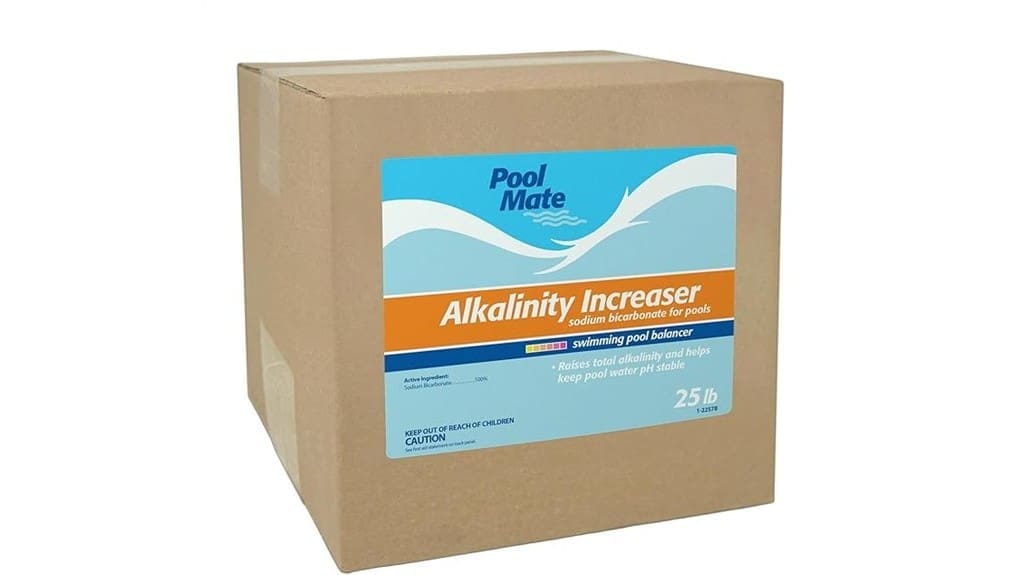
You’ll find Pool Mate Premium Alkalinity Increaser reliable and cost‑effective for raising total alkalinity: it’s 100% sodium bicarbonate in a 25 lb sealed bag with clear dosing tables, predictable +10 ppm per ~11 oz per 5,000 gallons, and fast dissolution when the pump’s running. Use proper PPE, measure precisely, broadcast slowly at returns, and retest after 4–6 hours to avoid overcorrection and equipment damage. Continue for full specs, dosing examples, and safety tips.
Some Key Takeaways
- Raises total alkalinity predictably; 11 oz ≈ +10 ppm per 5,000 gallons when mixed and circulated.
- Contains 100% high‑purity sodium bicarbonate in a durable 25‑lb sealed polyethylene bag (model 1‑225‑25).
- Fast dissolution and recommended broadcast application around return jets minimize localized concentration and surface risk.
- Best for routine maintenance when used with accurate test kits; does not directly change pH and adds sodium.
- Follow safety/dosing instructions, retest after 4–6 hours, and store sealed in a dry, ventilated chemical area.
Quick Verdict : Is Pool Mate Alkalinity Increaser Worth Buying?
Because maintaining stable alkalinity is critical for safe, effective pool chemistry, Pool Mate Premium Alkalinity Increaser is worth buying if you need a reliable, cost‑effective way to raise total alkalinity. You’ll find precise dosing guidance, rapid dissolution, and sodium bicarbonate’s predictable buffering action reduce pH bounce and protect surfaces and equipment. In a cost comparison with similar sodium bicarbonate products, it’s competitively priced per ounce for 25‑lb packaging. You’ll also limit environmental impact by avoiding over‑dosing and reducing sanitizer demand; follow test‑and‑dose procedures, run the pump during application, and store the bag dry and secure. Many homeowners also use calcium hardness increasers to keep pool water balanced alongside alkalinity management.
What’s in the Bag : Specs, Active Ingredient, Packaging, and Key Claims
When you open the 25‑pound bag of Pool Mate Premium Alkalinity Increaser, you get a single, powder‑form package containing 100% sodium bicarbonate (net weight 25 lb / 400 oz; model/part 1‑225‑25, UPC 034261003371), designed specifically as a total alkalinity increaser for swimming pools. You’ll note high ingredient purity with no fillers listed; the active ingredient is sodium bicarbonate. Packaging is a sealed polyethylene bag engineered for bag durability during handling and storage. Included is a dosing table and safety guidance. Key claims: raises total alkalinity, stabilizes pH, prevents scale and corrosion when used per instructions. Keeping pool alkalinity balanced helps maintain healthy water and a comfortable swimming environment, especially for homeowners who enjoy their outdoor spaces and use alkalinity increasers as part of regular maintenance.
Real-World Performance : How Well It Raises Alkalinity and Stabilizes pH
Measure results, then adjust: Pool Mate’s sodium bicarbonate reliably raises total alkalinity in predictable increments, and if you follow the dosing guidance (11 oz ≈ +10 ppm per 5,000 gallons) you’ll see the expected jump within hours of circulation. You’ll monitor reduced alkalinity drift when you dose to target ranges; pH fluctuations diminish as buffering capacity increases. For best outcomes, test pre- and post-dose, record values, and apply dosing precision to avoid overshoot. Product dissolves quickly, minimizing localized high-concentration pockets that could harm plaster or equipment. Maintain circulation during and after application to guarantee uniform distribution and safe correction. Proper alkalinity helps keep pool water clear and safe for homeowners who enjoy their outdoor spaces.
How to Use It Safely and Accurately (Dosing Examples by Pool Size)
Having verified that alkalinity has risen as expected, you’ll proceed to safe, accurate dosing by calculating volume and applying the recommended amounts while the pump runs. Follow these steps: confirm pool volume, consult dosage tables (11 ounces raises 10 ppm per 5,000 gallons), and prepare measured portions. Wear gloves and eye protection for proper chemical handling; keep a clear poolside safety zone. Broadcast granules slowly around return jets with pump on to guarantee rapid dissolution. Re-test total alkalinity after 4–6 hours and repeat only if measurement accuracy shows further adjustment is required. Store bag sealed, labeled, away from moisture. Consider keeping chemicals in a dedicated, ventilated storage container designed for pool products to reduce accidental mixing and moisture exposure.
Pros, Cons, and Who Should Buy This 25 Lb Sodium Bicarbonate Bag
You’ll find this 25 lb bag of 100% sodium bicarbonate is a straightforward, low‑risk option for raising and stabilizing total alkalinity in most residential pools. You’ll get predictable chemistry control, rapid dissolution, clear dosing guidance, and manufacturer support—benefits that suit budget buyers and facility owners running regular maintenance schedules. Cons: bulk weight can be awkward to handle, sodium load may be a concern for sensitive systems, and it won’t adjust pH directly. Buy if you monitor with a reliable test kit, follow dosing tables, and include alkalinity adjustments in your maintenance schedules. Don’t buy if you need multi‑function treatment or low‑sodium formulas. This product pairs well with simple pool water test kits for homeowners who enjoy their outdoor spaces.
Some Questions Answered
Will This Product Affect Cyanuric Acid (Stabilizer) Levels?
No — it won’t change cyanuric acid levels. You’ll see no cyanuric interaction or stabilizer impact from sodium bicarbonate; it only raises total alkalinity and buffers pH. You should still test stabilizer separately when adjusting chemistry. Follow dosing tables, run the pump during application, and use proper PPE to avoid inhalation or eye contact. Maintain recommended pool CYA ranges with dedicated stabilizer products if levels need adjustment.
Is Sodium Bicarbonate Safe for Saltwater Pools?
Yes — you can safely use baking soda (sodium bicarbonate) in saltwater pools to raise total alkalinity and stabilize pH. You’ll follow dosage guidelines, dissolve and add with the pump running, and retest alkalinity. It won’t directly affect chlorine stabilizer, but monitor combined chemistry: excessive alkalinity or pH drift can increase corrosion risk to metallic components and salt cell electrodes. Adjust slowly and document readings for safe operation.
Can I Use It With Other Pool Chemicals Immediately?
Yes — but you shouldn’t mix chemicals directly and you must manage dosing timing. You can add the alkalinity increaser while the pump runs, then wait at least 15–30 minutes before adding other powders or liquids to avoid adverse chemical interactions. Test alkalinity and pH after initial dosing and before further treatment. Follow label directions and allow circulation and dissolution; if using strong acids or sanitizers, stagger dosing and wear appropriate PPE.
Is This Suitable for Indoor Heated Pools?
Yes — you can use it in indoor heated pools. You’ll monitor alkalinity closely because indoor corrosion risk rises with improper pH/TA; maintaining recommended TA (per pool surface) stabilizes pH and reduces corrosion. Add product while the pump runs, test before dosing, and allow full circulation. Check heater compatibility with your manufacturer if high alkalinity is present long‑term; follow dosing table and manufacturer warranty/safety guidance.
Are There Vegan or Animal-Derived Additives?
No — there aren’t vegan sourcing or animal-derived additives in this product; it’s 100% sodium bicarbonate. You’ll want to confirm vendor policies if you need formal animal testing assurances, but chemically it contains no animal-sourced components. Handle with standard safety precautions: avoid inhalation, eye contact, and use gloves and goggles when dosing. Store dry, sealed, and away from acids to prevent CO2 release and guarantee stable performance.