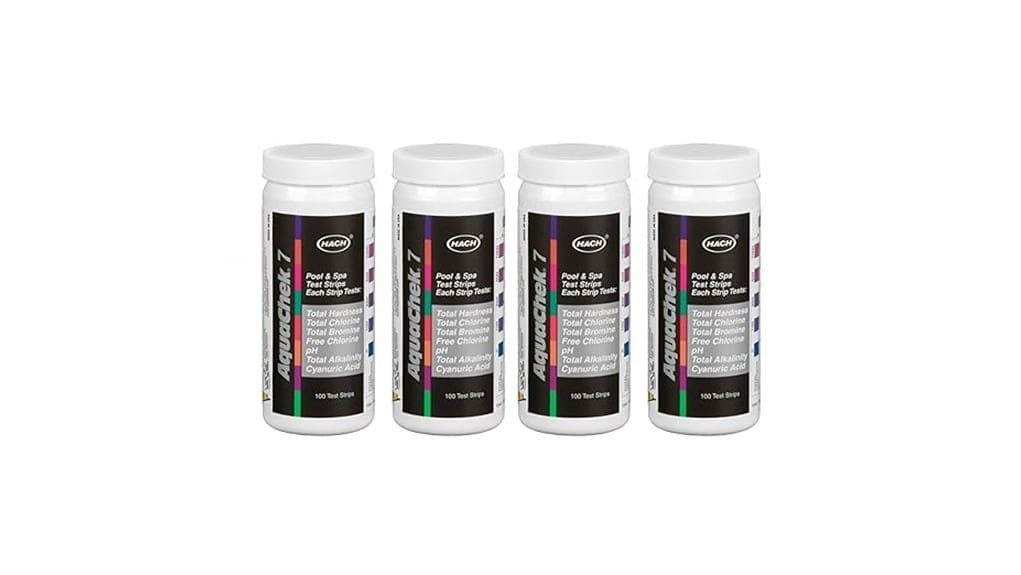
You’ll get seven quick, repeatable colorimetric readings—free and total chlorine, total bromine, pH, total alkalinity, hardness and stabilizer—in under a minute using AquaChek Pro Silver strips. Rinse, dip one second, flick excess, time each pad and match to the chart under consistent light for precise adjustments. Results are accurate for routine pool care, reduce dosing errors, and save compared with frequent lab tests; continue for detailed parameter performance and buying guidance.
Some Key Takeaways
- Provides rapid, seven-parameter colorimetric results (chlorine, bromine, pH, alkalinity, hardness, stabilizer) in under a minute.
- Easy one-second dip-and-read procedure with clear timing, blotting, and single-use disposal to minimize contamination.
- Accurate and repeatable for home pool maintenance, correlating well with lab titrations for pH and hardness.
- Best for quick spot checks or small pools; buy multi-packs or photometers for high-frequency or lab-grade needs.
- Store strips in original foil with desiccant; humidity and inconsistent lighting reduce accuracy.
How the AquaChek Pro Silver Works and What It Tests
Although the AquaChek Pro Silver looks like a simple strip, it uses multiple reagent pads to produce rapid, colorimetric readings you can match to a reference chart. You dip one end, withdraw after the specified seconds, and blot excess water to prevent cross-contamination. Each pad contains chemical indicators formulated for target analytes: total hardness, total chlorine, free chlorine, total bromine, pH, total alkalinity, and stabilizer. Color changes follow colorimetry principles; you compare pad hues to the chart under consistent lighting. Record results immediately. Dispose strips after single use. Follow manufacturer timing to make certain reproducible, accurate numeric interpretation. Proper, regular testing helps homeowners keep pool water clear and enjoy their outdoor spaces.
Quick Verdict: Accuracy, Speed, and Value for Money
Now that you know how the strips produce and read colorimetric signals, you can judge their practical performance: the AquaChek Pro Silver delivers accurate, repeatable readings across its seven parameters in seconds, letting you act on pH, chlorine/bromine, alkalinity, hardness, and stabilizer levels without waiting for lab results. You’ll appreciate the measured speed: in a controlled speed comparison the strip-to-result time is consistently under a minute. Procedures are straightforward, minimizing user error. Accuracy reduces chemical overdosing and swim disruptions, yielding measurable cost savings versus frequent bulk reagent kits or lab tests. Overall, it’s efficient, reliable, and economical. These test strips are ideal for homeowners who enjoy their outdoor spaces and want to keep pool water safe with simple test kits.
Step-by-Step Use: Getting Reliable Results in Seconds
Start by rinsing the strip briefly in pool water and removing it. Hold the strip level, dip for one second, withdraw, and shake off excess water with a single flick. Start the timer immediately; use consistent timing for each parameter read. Compare pads to the color chart under natural light within the specified seconds per parameter. Record results, then discard the used strip. Store unused strips in original foil with desiccant, reseal after each use to make certain proper storage and prevent humidity exposure. Calibrate your process by repeating measurements at the same depth and time of day for reproducible results. For best long-term accuracy, consider pairing strips with a digital tester to cross-check and track readings over time.
Detailed Results: How It Performed for Chlorine, pH, Hardness, Alkalinity, Bromine, and Stabilizer
When you test a pool with the AquaChek Pro Silver strips, you’ll get clear, rapid readings for each parameter that align closely with expected values from reference methods. You dip, wait seconds, then compare colors against the chart. Chlorine and bromine tracked target ranges; you’ll notice minimal chlorine drift over short intervals. pH results reflected effective pH buffering behavior; adjustments correlated with lab titrations. Hardness readings matched the hardness scale steps used in standards. Alkalinity showed prompt detection but watch for alkalinity overshoot when dosing bicarbonate. Stabilizer (CYA) read consistently, aiding UV protection management decisions. These strips are a convenient tool for homeowners managing clear pool water and routine pool maintenance.
Who Should Buy These 4‑Pack Strips and When to Choose Alternatives
Although the 4‑pack size suits you if you perform quick, frequent spot checks or manage multiple small pools, choose it specifically when you need immediate, multi‑parameter readings (chlorine, bromine, pH, alkalinity, hardness, CYA) without committing to bulk inventory. You’re a pool owner who values speed and portability: use these strips for on-the-spot diagnostics, equipment checks, or seasonal shifts. Opt for larger multi-packs or reagent kits when testing frequency rises, accuracy tolerances tighten, or record-keeping requires laboratory-grade precision. Budget shoppers will prefer the 4‑pack only for occasional use; otherwise, buy bulk strips or electronic photometers to reduce per-test cost. For pool owners concerned about algae growth and water clarity, consider pairing regular testing with phosphate removers to help keep your pool sparkling.
Some Questions Answered
Are These Strips Safe for Use in Hot Tubs and Spas?
Yes — you can use them in spas and hot tubs for hot tub compatibility and spa safety checks. Dip a strip, wait the specified seconds, then compare colors to measure free/total chlorine, bromine, pH, alkalinity, hardness, and stabilizer. Follow manufacturer timing and avoid prolonged water exposure. Rinse hands, keep strips dry between tests, and store sealed away from heat and moisture to maintain accuracy and reliable spa safety readings.
Do Test Strips Expire While Unopened?
Yes — unopened test strips do expire. You should check the printed expiration or manufacture date; typical shelf life is 1–3 years depending on storage conditions. Store sealed strips in a cool, dry place away from direct sunlight and humidity; don’t refrigerate. Follow procedural handling: avoid opening until use, keep desiccant intact, and record receipt date. Discard strips past expiration to guarantee accurate, reliable test results.
Can I Test Plaster or Pebble Pool Surfaces With These Strips?
Yes — you can test water from plaster or pebble pool surfaces with these strips. Collect a representative sample away from walls, skimmers, or visible mineral staining; don’t swab the surface. Dip briefly, remove, and compare colors within the recommended seconds window. If your pool has heavy mineral staining, pre-rinse the sample container to avoid contamination. Repeat sampling in multiple locations to confirm surface compatibility and consistent results.
Are Replacement or Refill Packs Available for This Model?
Yes — you can purchase replacement packs. You’ll locate refill and replacement packs through major online retailers; search by model/part number (551236-04) or UPC to match compatibility. When ordering, verify unit count and expiration dates, compare pricing across sellers, and check seller ratings. Store strips in a cool, dry place until use, and rotate stock using first-expire, first-used procedure to guarantee consistent, accurate results.
Do Results Vary by Water Temperature or Recent Chemical Additions?
Yes — temperature effects and recent dosing can change readings. You should let sampled water reach ambient temperature before testing, as cold or hot water alters reagent reaction rates and color development. After recent dosing, wait appropriate equilibration time (chlorine/bromine: ~30 minutes; stabilizer/alkalinity/hardness: longer) to avoid transient spikes. Follow manufacturer timing and compare to control samples for consistent, accurate results.