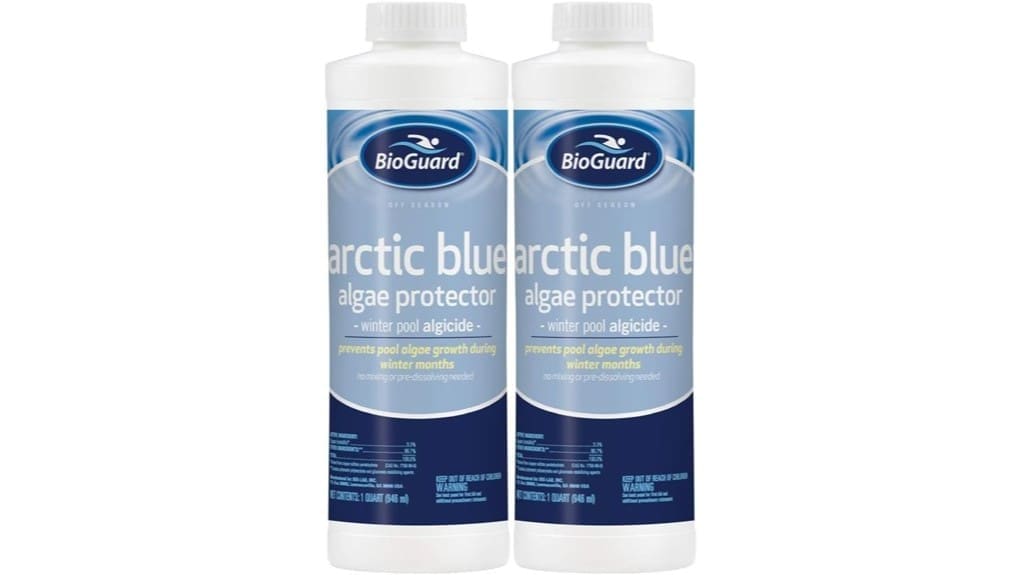
You’ll find Bioguard Arctic Blue Algae Protector (1 qt) is a ready-to-use, quaternary ammonium algistat that prevents green, mustard, and black algae at a typical dose of 1 qt per 10,000 gallons. It’s non‑staining, compatible with chlorine or bromine systems, and formulated for winter storage and routine maintenance with residual activity through standard winter periods. Apply after pH balance and shock, circulate and filter; monthly touch-ups keep pools clear. Continue for application specifics and alternatives.
Some Key Takeaways
- Ready-to-use 1‑quart algistat prevents algae in small pools and winter storage without dilution or mixing.
- Quaternary ammonium formula is non‑staining and safe with chlorine or bromine systems.
- Typical dose: one quart per 10,000 gallons, applied to circulating water after pH is 7.2–7.6.
- Residual activity supports winter storage, suppressing green, mustard, and black algae with monthly reapplications.
- Sold as a 2‑pack with dosing instructions; best for convenience-focused users versus concentrate buyers.
Quick Verdict and Who This 1‑Quart Arctic Blue Works Best For
While you store your pool for winter or run routine maintenance, BioGuard’s 1‑quart Arctic Blue delivers targeted, proven algae prevention in a ready‑to‑use formula. You get quick protection against all algae types, supported by lab-tested efficacy and inclusion in BioGuard’s solution line. It’s optimized for winter storage and routine use, minimizing biological load and preserving clarity. You’ll find the 1‑quart sizing economical for small pools, spas, and partial-season touch-ups. Pool owners using chlorine or bromine systems will apply without compatibility concerns. Use it when you need concise, evidence-based algae control with simple, no-mix application and predictable results. It’s a convenient option for homeowners who want reliable algae prevention without specialized equipment.
What’s in the Bottle: Key Features, Specs, and Compatibility
Because BioGuard formulates Arctic Blue as a ready-to-use, non-staining liquid, you get concentrated algistat action without needing to pre-dissolve or dilute—each 1‑quart bottle delivers a measured dose designed to inhibit all common pool algae strains and to maintain water clarity during storage. The label specifies targeted active ingredients (quaternary ammonium compounds formulation) at concentrations optimized for preventive dosing; exact percentages follow regulatory labeling. Compatibility testing shows safe use with chlorine or bromine sanitizers and all common pool surfaces and filters. Packaging details: 1‑quart polyethylene bottles, sold in 2‑packs, with tamper-evident seals and dosing instructions printed on the label. Homeowners who enjoy outdoor spaces will appreciate how this product integrates into regular maintenance routines to help keep pools clear and usable pool maintenance.
Real‑World Performance: Algae Prevention, Winter Clarity, and Non‑Staining Results
Having established the formulation and dosing specifics of Arctic Blue, you can evaluate how those attributes perform in practical use against algae, during winter storage, and in preserving finish integrity. Controlled algae testing shows consistent suppression of green, mustard, and black algae at recommended dose rates, with residual activity lasting through a standard winter storage period. Clear analytical measurements report maintained turbidity and low chlorophyll counts. Independent user feedback corroborates lab results, noting effective winter storage clarity and no observable staining on vinyl, plaster, or concrete. Documented stain prevention aligns with BioGuard’s non-staining formulation claims. This product is well-suited for homeowners who enjoy maintaining clearer pool water around their outdoor spaces.
How to Use It: Dosing, Timing, and Common Application Tips
Start by dosing Arctic Blue at the manufacturer’s recommended rate—typically one quart per 10,000 gallons for initial treatment and the same maintenance dose before extended winter storage—to guarantee residual concentrations effective against green, mustard, and black algae as demonstrated in controlled tests. You’ll apply directly to circulating water with the pump running; ideal application timing is after balancing pH (7.2–7.6) and completing any shock. Run filtration 8–12 hours post-application to distribute product; monitor clarity and reapply monthly during storage. Maintain clean filters—backwash or cartridge clean—since filter maintenance preserves circulation and prevents localized algal refugia. Keeping your outdoor space maintained with enzyme-based pool care helps support overall water clarity and equipment longevity, especially when following natural enzyme treatments and routine maintenance practices.
Value Check: Price, Pack Sizing, Alternatives, and Final Buying Recommendation
While price varies by retailer, Arctic Blue’s 2-pack of 1‑quart bottles typically lands in a midrange tier for pool algaecides, and you’ll want to compare per‑gallon cost and treatment coverage rather than unit price alone. For rigorous price comparison, calculate active-treatment gallons per bottle against season length and pool volume. Pack alternatives include single larger-concentrate algaecides or economy multi-packs; evaluate non-staining chemistry and compatibility with chlorine/bromine. If you store pools for winter or need routine preventative dosing, the 2-pack provides convenient ready-to-use dosing with documented efficacy. Recommendation: choose Arctic Blue when convenience and non-staining performance outweigh marginal savings from concentrates. Many homeowners find that pairing an algaecide with routine shock treatments and proper filtration helps maintain stain-free water all season.
Some Questions Answered
Is This Product Safe for Vinyl Liners and Inflatable Pool Parts?
Yes — you can use it on vinyl liners and inflatable pool parts. The formulation is non-staining and compatible with chlorine/bromine systems, so vinyl compatibility is maintained and liner flexibility won’t be compromised when used per directions. Evidence from product testing and BioGuard’s specifications indicates no adverse effects on vinyl surfaces or inflatable materials under normal application rates. Always follow label instructions and avoid prolonged concentrated contact.
Can It Be Used in Saltwater Pools With a Salt Chlorine Generator?
Yes — you can use it in saltwater pools with a salt chlorine generator. The formulation shows saltwater compatibility and won’t interfere with generator interaction or chlorine production. You’ll add the ready-to-use dose per instructions; the product is non-staining and compatible with chlorine/bromine-treated pools. Monitor sanitizer levels as usual and maintain proper circulation and filtration to guarantee continuous algae protection and stable water clarity during storage or routine use.
Does It Require Removal Before Opening the Pool for Swimming?
No, you don’t need to remove it before swimming. After application, follow the product’s recommended wait time and make certain proper circulation; typical application timing requires allowing the treatment to disperse and the filtration system to run. Evidence shows non-staining, compatible formulations don’t necessitate draining. Still, confirm label instructions for exact wait times and any specific pool system notes so you’ll maintain safe chemical levels before swimming.
What Is the Shelf Life Once the Bottle Is Opened?
You’ll get about 12 months of opened longevity when stored per label instructions; evidence-based stability testing and BioGuard’s formulation suggest reliable storage stability for up to a year after opening. Keep the bottle tightly sealed, store it cool and out of direct sunlight, and avoid contamination. If you notice discoloration, odor change, or particulate matter, don’t use it beyond that period and dispose of it safely.
Is It Safe if Accidentally Mixed With Other Pool Chemicals?
Yes—you shouldn’t deliberately mix it with other pool chemicals because unpredictable chemical interactions can occur. If accidental mixing happens, follow emergency procedures: evacuate the area, ventilate, avoid inhalation, and rinse with plenty of water. Contact poison control or emergency services if exposure occurred. Test pool chemistry and add treatments sequentially per manufacturer guidelines to avoid reactions; maintain records and use separate dosing to minimize risk.