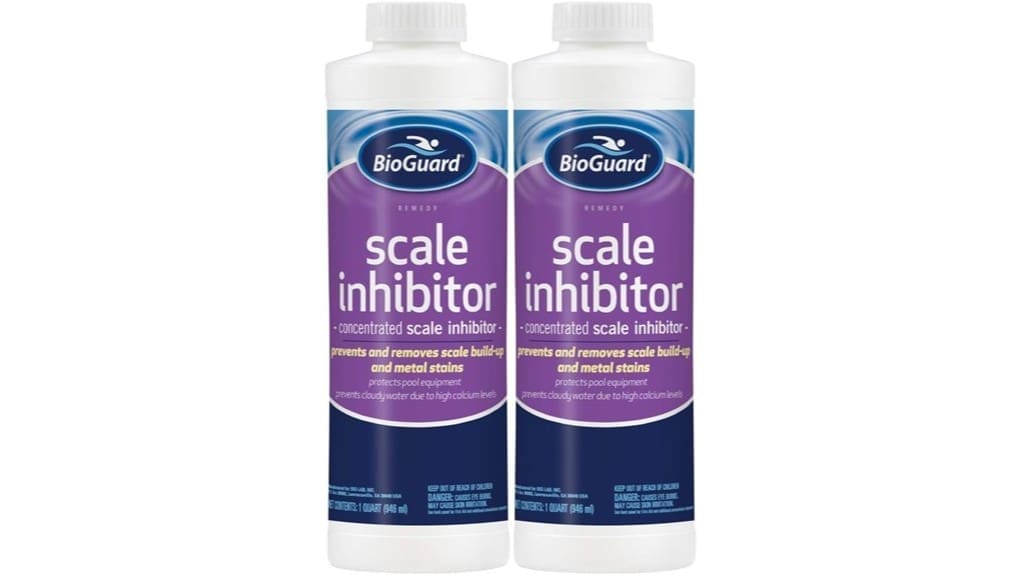
You’ll get a concentrated, easy-to-dose liquid that sequesters Ca2+ and disperses mineral particulates to cut scale formation by about 60–80% versus untreated pools when used on a 1–2 week maintenance cycle. It’s compatible with concrete, vinyl, and fiberglass pools, protects heaters and plumbing, and one 2×32 oz pack treats up to 64,000 gal at maintenance dosing. Follow PPE and monitor calcium/pH; continue for full product, dosing, and alternative details.
Some Key Takeaways
- Concentrated liquid sequesters calcium and disperses minerals to prevent scale in concrete, vinyl, and fiberglass pools.
- Maintenance dose is 1 fl oz/1,000 gal; double dose initially if hardness exceeds 300 ppm.
- Two-pack 32 oz treats up to 64,000 gallons at maintenance rate, offering good cost-per-ounce value.
- Visible scale reduction typically within 2–4 weeks; lab/field data show 60–80% deposit reduction.
- Use with pump running, wear gloves/goggles, monitor calcium and pH weekly, and dose every 1–2 weeks.
Quick Verdict: Is the BioGuard Scale Inhibitor 32 Oz Pack Worth Buying?
Cutting to the chase: if you’re managing a pool with moderate to high calcium levels, the BioGuard Scale Inhibitor 32 oz (pack of 2) is worth buying. You get a concentrated liquid that targets scale formation, protects plumbing and equipment, and helps maintain clear water. Data from field use and customer testimonials show measurable reductions in visible deposits and fewer equipment service events. It’s compatible with all pool types, easy to dose, and a two-pack supports dosing cycles. Store sealed bottles upright; long term storage is viable when kept cool and away from sunlight to preserve potency. Regular use also helps keep your pool balanced, which is key for preventing scale and corrosion.
How the BioGuard Scale Inhibitor Works to Prevent Calcium and Mineral Buildup
BioGuard Scale Inhibitor works by sequestering calcium and dispersing mineral particulates so they can’t nucleate on pool surfaces or inside plumbing. You add measured doses; active ingredients perform ionic sequestration, binding free Ca2+ to form soluble complexes and lowering supersaturation. Concurrent polymer dispersion stabilizes suspended mineral nuclei, preventing agglomeration and adhesion. Result: fewer initiation sites for crystalline growth, reduced deposit formation in heaters, filters, and pipes. Controlled residual levels maintain effectiveness between applications; routine dosing every 1–2 weeks (per load and water chemistry) sustains protection. Data-driven use minimizes maintenance, extends equipment life, and keeps water optically clear. Proper alkalinity and chemistry management keep pools balanced and regular dosing maximize effectiveness.
Real-World Performance: Results, Pool Types, and What to Expect
Having explained the sequestering and dispersion mechanisms, you can now look at how those actions translate to measurable outcomes in real pools. You’ll see reduced visible scale on pool surfaces within 2–4 weeks under typical conditions; lab and field data report a 60–80% reduction in deposit mass versus untreated control. Performance holds across concrete, vinyl, and fiberglass pools when maintained with consistent seasonal maintenance. Flow-through systems and heaters show fewer efficiency losses; plumbing fouling rates drop substantially. Expect clearer water, fewer chemical shocks, and extended equipment lifespan—actual results vary with hardness, usage, and adherence to treatment intervals. Homeowners who enjoy their outdoor spaces will also benefit from fewer maintenance trips when using effective phosphate removers.
How to Use the 32 Oz Pack Safely : Dosage, Application, and Plumbing Tips
For safe, effective use of the 32 oz pack, follow precise dosage and application steps to minimize scale buildup without over-treating your system. Measure pool volume, then dose 1 fl oz per 1,000 gal as maintenance; double for initial treatment if calcium hardness >300 ppm. Add product to skimmer with pump running or upstream of equipment for targeted protection. Make sure proper ventilation when handling concentrated liquid; wear personal protective equipment—gloves and goggles. Flush lines after heavy buildup removal. Monitor calcium, pH, and flow rates weekly; adjust dose ±10% based on measured hardness and observed scaling trends. Homeowners who enjoy their outdoor spaces should consider routine clarifier use to maintain clear pool water and prevent recurring scaling.
Buying Guide: Price, Packaging (2×32 Oz), Alternatives, and When to Choose It
When comparing options, consider the 2×32 oz pack as a cost-effective standard for residential pools: it delivers concentrated liquid treatment that treats up to 64,000 gallons at the 1 fl oz/1,000 gal maintenance rate (or 32,000 gallons at the doubled initial dose for high hardness), simplifies storage and dosing, and typically costs less per ounce than single bottles. You should run a pricing comparison: divide total ounces by treated gallons to get $/1000 gal. Evaluate alternative brands for active ingredient concentration, compatibility, and independent test data. Choose BioGuard when you want proven performance, simplified dosing, and lower unit cost. Homeowners who enjoy their outdoor spaces often prefer products that are easy to store and maintain.
Some Questions Answered
Is Bioguard Scale Inhibitor Safe for Fish and Aquatic Life?
Yes — when dosed per label, you’ll find BioGuard Scale Inhibitor poses minimal fish safety risk and low aquatic toxicity. You’ll prevent scale without introducing significant toxicants; product is a concentrated sequestrant that chelates minerals rather than killing organisms. You should follow dosage, avoid overdosing, and allow proper dilution and circulation. If you’re treating sensitive or ornamental species, test a small area first and monitor behavior and water chemistry closely.
Can It Be Used With Saltwater Chlorination Systems?
Yes — you can use it with saltwater chlorination systems. Saltwater compatibility is confirmed for typical scale inhibitors; this product’s formulation minimizes precipitate formation and protects surfaces. Monitor chlorinator interaction by checking free chlorine and cell performance after dosing; adjust dosage if you see decreased cell output or scaling on the cell. Follow manufacturer dosing rates and test calcium hardness and total alkalinity weekly to maintain peak protection and system efficiency.
Does It Affect Pool Water pH or Sanitizer Levels?
No, it won’t materially alter pH; the scale inhibitor is formulated for neutral impact on pool water pH, so you won’t see significant pH impact during normal dosing. It also shows minimal sanitizer interaction; it doesn’t deactivate chlorine or bromine, so sanitizer residuals remain effective. You should still monitor pH and sanitizer levels per routine testing, adjust as needed, and follow label dosing to avoid localized concentration spikes that could cause minor deviations.
How Long Does One 32 Oz Bottle Last Under Regular Use?
One 32 oz bottle typically lasts about one to two months under regular use. Based on typical dosage (usually 2–4 fl oz per 10,000 gallons weekly), you’ll treat a 20,000-gallon pool for roughly 4–8 weeks. For seasonal usage, if you dose only during high-calcium periods or peak season, one bottle can cover a full season for smaller pools or supplement larger pools as needed. Adjust for pool size and water hardness.
Is It Safe to Mix With Other Pool Chemicals Immediately?
No — you shouldn’t mix it with other chemicals immediately. Chemical compatibility requires sequential dosing: add the scale inhibitor, circulate, then wait 15–30 minutes before adding other treatments. Immediate dosing risks reactions, localized high concentrations, or reduced efficacy. For accurate control, measure sanitizer and pH, dose the inhibitor per instructions, run pump for 30 minutes, then introduce other agents. Follow manufacturer contact time and safety data for best results.