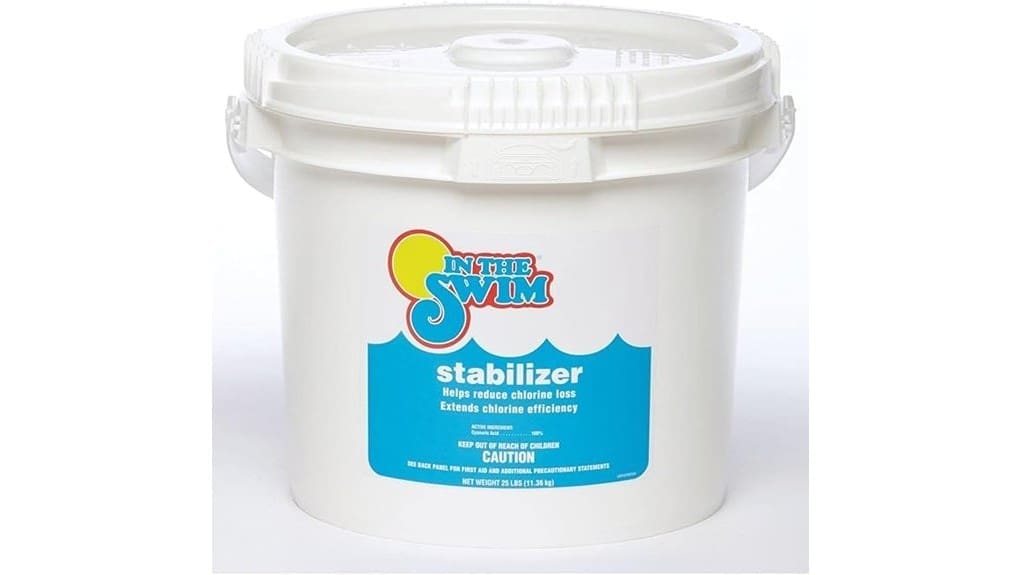
You’ll get a 100% cyanuric acid granule that reliably raises and maintains CYA to the 20–50 ppm range to shield chlorine from UV and extend sanitizer life. It’s compatible with inground, above‑ground, saltwater, and conventional chlorine systems and typically reduces chlorine consumption by about 20–25% when dosed properly. Add gradually, retest CYA in 24–48 hours, and monitor free chlorine; the 25‑lb pack suits medium to large pools and pros — more practical details follow.
Some Key Takeaways
- 100% cyanuric acid granules designed to maintain CYA at 20–50 ppm to protect chlorine from UV degradation.
- Concentrated 25-lb package offers economical dosing for medium to large pools and frequent use.
- Proper dosing extends chlorine life, potentially reducing chlorine usage by up to ~25% when CYA is maintained.
- Compatible with inground, above-ground, and saltwater systems, but monitor corrosion risk and metal components.
- Requires gradual addition, CYA retest in 24–48 hours, and ongoing free-chlorine monitoring to avoid over-stabilization.
What In the Swim Pool Stabilizer Is and Who It’s For
Think of In The Swim Pool Stabilizer as a concentrated cyanuric acid product designed to shield your pool chlorine from UV degradation. You’ll handle a 100% cyanuric acid granule formulated to raise and maintain CYA within a 20–50 ppm target, compatible with inground, above-ground, saltwater, and chlorine systems. You’ll use precise dosing to avoid over-stabilizing while improving sanitizer persistence. Address cyanuric misconceptions by explaining that controlled CYA increases chlorine longevity without eliminating disinfection when dosed correctly. Consumer demographics include backyard owners, pool service professionals, and saltwater pool operators seeking measurable chlorine efficiency and reduced consumption. It also pairs well with calcium hardness increasers for homeowners who want to keep water balanced and enjoy their outdoor spaces.
How 100% Cyanuric Acid Protects Chlorine and Cuts Chlorine Use
Reduce chlorine loss by understanding how 100% cyanuric acid (CYA) binds free chlorine and absorbs UV energy, slowing photolytic degradation so your sanitizer remains active longer. You’ll leverage stabilizer dynamics: CYA forms reversible complexes with hypochlorous acid, lowering free-chlorine photoreactivity and providing UV shielding across UVA/UVB. This decreases instantaneous chlorine destruction, enabling chlorine preservation and measurable reduction in dosing frequency. Mechanistically, CYA shifts chlorine speciation and attenuates photon-driven bond cleavage, a direct photodegradation prevention effect. You’ll monitor CYA to balance protection versus over-stabilization, optimizing sanitizer efficacy while reducing overall chlorine consumption. Maintain proper alkalinity and pH to support effective sanitizer action and overall pool health, including balanced total alkalinity for stable water chemistry.
Real-World Performance: Results, Expected Chlorine Savings, and CYA Targets (20–50 Ppm)
When you maintain cyanuric acid (CYA) in the 20–50 ppm range, you’ll see consistent, measurable reductions in chlorine demand: field tests and manufacturer data typically show up to ~25% less chlorine required for equivalent free-chlorine maintenance compared with unstabilized pools. You’ll observe measured savings across seasons; summer UV peaks drive highest baseline chlorine loss, while seasonal decline in UV intensity lowers required dosing. In practice, you’ll target 20–50 ppm CYA to optimize protection without over-stabilizing. Expect proportional reduction in routine chlorination, validated by logged residuals and dose tracking. Monitor CYA and free chlorine to confirm savings. Proper pool stabilizer selection can help homeowners maintain these targets and protect chlorine.
Compatibility and Practical Dosing for All Pool Types (Inground, Above-Ground, Saltwater)
Having established the CYA target range and measurable chlorine savings, turn attention to how In The Swim Pool Stabilizer performs across pool types and how to dose it practically. You’ll apply the same chemistry: 100% cyanuric acid raises CYA to the 20–50 ppm target in inground, above‑ground, and saltwater systems. Use a dosing calculator to determine pounds per gallon adjustment for your volume and current CYA. Add gradually to avoid over‑stabilizing; dissolve or broadcast per label. For saltwater pools, monitor metallic components and saltwater corrosion risk when handling concentrated product. Recheck CYA after 24–48 hours and adjust as needed. This product pairs well with routine shock treatments to keep your pool sparkling clean and properly balanced.
Pros, Cons, and Who Should Buy the 25‑lb Package
Because the 25‑lb In The Swim Pool Stabilizer is pure cyanuric acid in a single, concentrated package, you get predictable dosing and long‑term economy for medium to large pools; it reliably raises and maintains CYA within the 20–50 ppm target, cuts chlorine consumption by up to 25%, and works across inground, above‑ground, saltwater, and conventional chlorine systems. You’ll benefit from clear cost savings and fewer additions. Pros: high concentration, consistent results, reduced chlorine usage. Cons: bulk handling risk, potential over‑stabilization if misapplied. Follow storage tips to limit moisture. Reduce dosage errors with measured additions; consider environmental impact when disposing. Many homeowners find complementary test kits useful to monitor CYA and chlorine levels after adding stabilizer.
Some Questions Answered
Does Cyanuric Acid Affect Pool Water Clarity or Cause Cloudiness?
Yes — cyanuric acid can affect water clarity if misused. You’ll maintain clarity when you keep CYA in the ideal 20–50 ppm range; excessive CYA increases combined chlorine and can reduce sanitizer efficacy, risking cloudiness. Overstabilization doesn’t directly clog filters, but poorer sanitizer performance burdens filter performance and leads to particulate buildup. Monitor levels, adjust dilution or use partial drains, and guarantee proper filtration and backwashing to preserve clear water.
How Long After Adding Will CYA Reach Target Ppm?
You’ll typically see CYA reach target ppm within 24–48 hours after adding product. Pool equilibration and chemical diffusion drive that timeframe: dissolved cyanuric acid disperses through the water column via diffusion and circulation from your pump/return jets. Run filtration continuously for at least 24 hours, brush to prevent pockets, and retest after 24–48 hours. If readings lag, continue circulating and allow up to 72 hours for full equilibration.
Can CYA Be Pre-Dissolved Before Adding to the Pool?
Yes. You can pre-dissolve cyanuric acid using pre dissolution techniques: add measured CYA to a plastic bucket, slowly pour warm water while stirring, avoid splashes, let solids fully dissolve. Use dosage calculations to determine pounds per gallon for target ppm, accounting for pool volume. Add solution to deep end with pump running to disperse evenly. Don’t mix with chlorine or acids; wear protection and dissolve in a well-ventilated area.
Is the Stabilizer Safe for Pool Plants and Landscaping Runoff?
Yes — the stabilizer is generally safe for plants when used correctly; it’s 100% cyanuric acid and won’t acutely harm vegetation at normal pool CYA levels. You should monitor runoff impact, though: concentrated granules or undiluted spills can raise local CYA and alter soil chemistry. Avoid dumping product near landscaping, pre-dissolve and dilute before adding, and prevent direct runoff to sensitive plants to minimize long-term accumulation risks.
Does CYA Interact With Algaecides or Shock Treatments?
Yes — CYA alters chlorine binding and can reduce shock/oxidizer effectiveness if levels are high. You’ll find cyanuric acid complexes with free chlorine, slowing its oxidizing reactions; that means shocks and some algaecides may act slower. Keep CYA within 20–50 ppm to preserve chlorine potency and algae resistance. You should adjust shock dosage based on CYA, follow product labels, and allow adequate contact time for treatments to work effectively.