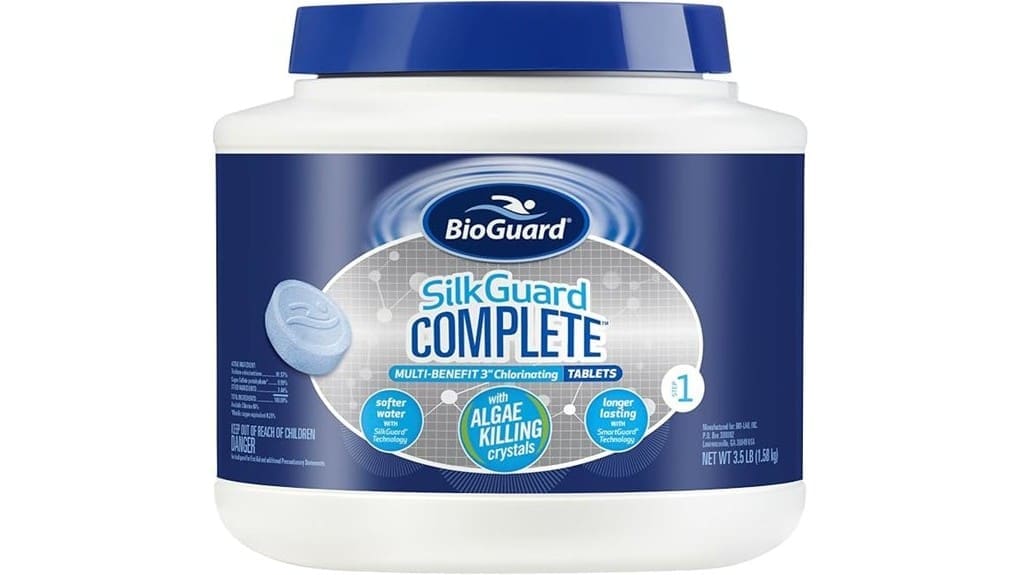
You’ll get steady, slow-dissolving chlorination with BioGuard SilkGuard Complete 3” tablets, which release stabilized free chlorine and include algae-inhibiting crystals for multi-day residual control. They’re engineered for floaters, inline feeders, and metal-sensitive systems, with predictable mass loss and minimal spiking. Verify material compatibility, monitor pH, and inspect equipment routinely to limit corrosion. Use gloves and goggles, check free chlorine frequently, and pair with shocks for heavy demand—keep going to see detailed usage and value guidance.
Some Key Takeaways
- Slow-dissolving 3” trichlor tablets provide steady, predictable free chlorine with reduced concentration spikes.
- Embedded algae-inhibiting crystals improve algae resistance and limit regrowth under proper circulation.
- Compatible with floaters, inline feeders, and most pool materials when feeders are rated for 3” trichlor tablets.
- Requires routine pH control, daily-to-every-3-day residual checks, and periodic shock treatments for heavy demand.
- Higher upfront cost but potential lower maintenance and equipment stress from steady dosing and corrosion protection.
What SilkGuard Complete 3” Tablets Are and How They Work
Although they dissolve slowly, SilkGuard Complete 3” tablets deliver a consistent, controlled dose of chlorine to your pool, providing long-lasting sanitation with minimal maintenance. You’ll handle 3-inch, slow-dissolving trichloro-s-triazinetrione tablets formulated for steady free chlorine generation; the chemical composition includes stabilized chlorine and algae-inhibiting additives. You’ll place tablets in an inline feeder, floater, or skimmer per dosing guidelines based on pool volume and bather load. You’ll monitor free chlorine and adjust feed rate; residuals should remain within target ppm. You’ll follow manufacturer safety and storage instructions to prevent degradation and guarantee predictable chlorination performance. These tablets are ideal for homeowners who enjoy their outdoor spaces and want consistent chlorination with minimal effort.
Performance: Chlorine Release, Longevity, and Algae Control
Building on how SilkGuard tablets deliver steady chlorine, you’ll see their performance reflected in three measurable areas: release rate, tablet longevity, and algae suppression. You’ll observe a controlled, slow-dissolving release that maintains target free chlorine without large concentration spikes, supporting chlorine stability in varying bather loads and sunlight. Tablet mass loss is predictable; a single 3” tablet provides multi-day residual depending on pool volume and demand, reducing dosing frequency. Embedded algae-fighting crystals enhance algae resistance, attacking cell structures and limiting regrowth when combined with proper circulation. Overall, you get consistent sanitization, extended service intervals, and proactive algae control. Many homeowners pair these tablets with regular shock treatment to handle sudden chlorine demand and keep outdoor pools sparkling.
Compatibility and Equipment Safety: Saltwater, Feeders, and Corrosion Protection
When you use BioGuard SilkGuard 3” tablets in chlorinated or saltwater systems, they dissolve slowly and release stabilized chlorine without producing atypical byproducts that can harm standard feeders or inline chlorinators; their formulation is engineered to be compatible with automated floaters, feeder pumps, and tablet feeders rated for 3‑inch trichlor tablets. You’ll find clear saltwater compatibility, but verify material compatibility for PVC, stainless, and elastomers. Adjust feeder calibration to match dissolution rate and target free chlorine. Routine inspection and pH control support corrosion prevention. Proper use minimizes chemical stress, preserving seals and heat exchangers and promoting equipment longevity. Regularly cleaning strainers and pump baskets helps maintain equipment performance.
How to Use These 3” Tablets Safely and Get Steady Results
Now that you’ve checked feeder compatibility and corrosion risks, you’ll set up and monitor the tablets to achieve steady sanitation. Position 3” tablets in a dedicated floating feeder or inline chlorinator per manufacturer specs; don’t drop tablets into skimmers. Wear protection—gloves and goggles—when handling to avoid skin or eye irritation. Establish a dosing schedule based on pool volume and target free chlorine (1–3 ppm); check levels daily initially, then every 2–3 days once stable. Record residuals, adjust feeder settings incrementally, and shock after heavy bather load or contamination. Rinse equipment after contact with tablets and store sealed, cool, dry. For a successful start to the season, also use pool opening chemicals to properly prepare water and equipment before regular chlorination.
Value and Buying Decision: Cost, Alternatives, and Who Should Choose Them
Although the upfront cost per 3.5 lb container of BioGuard SilkGuard 3” tablets may be higher than generic chlorine tablets, their slow-dissolving formula, integrated algae-fighting crystals, and SilkGuard corrosion protection deliver steadier dosing and lower maintenance interventions over a season, which can reduce total ownership costs for routine chlorinated or saltwater pools. Assess price comparison against performance: calculate chlorine release rate, algae-control efficacy, and equipment longevity to quantify lifecycle cost. Buyer profiles: choose SilkGuard if you run automated feeders, have metal-sensitive equipment, or prefer reduced manual dosing. Opt for generics if initial budget constraints outweigh long-term benefits. For homeowners focused on sustainable outdoor living, consider how eco-friendly pool care practices and products fit into your overall yard stewardship and chemical use.
Some Questions Answered
Do These Tablets Affect Pool Water pH Levels Over Time?
Yes — you can see pH drift over time if you don’t monitor and adjust. These slow‑dissolving tablets release chlorine steadily and can gradually influence alkalinity changes, which in turn affect pH. You’ll need to test pH and total alkalinity regularly and add buffering agents (sodium bicarbonate or acid) as required. Proper circulation and calibrated dosing minimize drift and maintain stable sanitizer efficacy and equipment protection.
Can I Store Unused Tablets in Freezing Temperatures?
No — you shouldn’t store unused tablets in freezing temperatures. Freeze storage can compromise tablet integrity by causing moisture-driven crumbling or binder separation, reducing dissolution consistency and chlorine output. Keep tablets dry in a cool, ventilated area away from direct sunlight and temperature extremes, ideally in their original sealed container with desiccant. Inspect tablets before use; discard any that show excessive powdering or physical degradation to maintain predictable sanitation performance.
Are These Tablets Safe for Vinyl or Fiberglass Liners?
Yes — you can use them with vinyl and fiberglass liners. Their slow-dissolving, SilkGuard formula maintains steady chlorine levels that reduce oxidizer spikes which cause liner discoloration. You should monitor free chlorine and stabilizer levels, follow label dosing, and make sure tablets don’t sit against the liner or concentrated on one spot. Proper feeder or float use prevents localized overexposure and helps protect liner integrity and overall surface appearance.
Do the Tablets Have a Noticeable Chemical Odor After Application?
You’ll usually notice only a mild chlorine scent, not a strong chlorine odor, after tablets dissolve. The slow-dissolving formula moderates chlorine release, reducing peak vapor concentrations that drive odor perception. Indoor or poorly ventilated spaces, recently shocked pools, or high application rates can temporarily increase perceivable odors. Maintain recommended dosing, guarantee good circulation and aeration, and test combined chlorine levels to minimize any noticeable chemical smell and optimize comfort.
Is There a Recycling Program for the Product Packaging?
No—there isn’t a manufacturer-run recycling program for the packaging. You can use local recycling drop offs for the cardboard box if your municipality accepts corrugated fiberboard, but the plastic pail or liner often isn’t accepted curbside. Check with nearby hazardous-waste or pool-supply stores about packaging refunds or take-back options; some retailers offer limited returns. Always rinse and follow local disposal rules to avoid chemical contamination and fines.