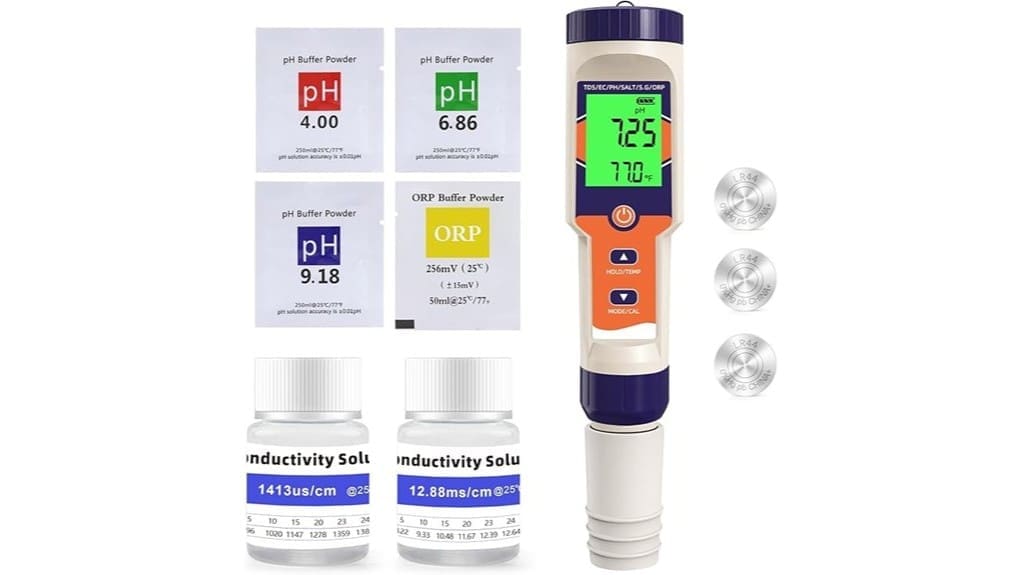
You’ll get a compact, technician-grade 7‑in‑1 meter that quickly reads pH, ORP, salinity, TDS, EC, specific gravity and temperature so you can diagnose pool and spa issues fast. It’s precise enough for field decisions, stabilizes pH/temperature with ATC, and shows prompt ORP and salt responses. Expect routine pH/ORP calibration, periodic cleaning, and manual logging for trends. If you want practical performance beyond strips and single meters, keep going for full details.
Some Key Takeaways
- Compact 7-in-1 meter measures pH, ORP, salinity, TDS, EC, specific gravity, and temperature for pool/spa maintenance.
- Quick, near-instant digital readouts with automatic temperature compensation make field testing fast and reliable.
- ORP and salinity readings help assess salt-chlorine generator performance and sanitizer effectiveness in real time.
- Accuracy and repeatability suit homeowners and pros, though pH/ORP require periodic calibration and electrode care.
- No long-term electronic logging; manual record-keeping recommended, and replaceable electrodes extend device lifespan.
Quick Verdict : Is the Terronix 7-in-1 Digital Pool Salt Tester Worth It?
While it’s compact and straightforward, the Terronix 7-in-1 Digital Pool Salt Tester delivers precise multi-parameter readings you can trust for routine pool and spa maintenance. You’ll appreciate the clear user interface that presents pH, ORP, salinity, TDS, EC, S.G., and temperature without guesswork. Battery life’s adequate for seasonal use, though you should budget replacements before heavy testing periods. Calibration frequency is moderate — recalibrate pH and ORP per manufacturer guidance to maintain accuracy. Basic data logging is manual; it doesn’t store long-term logs electronically, so plan to record results externally for trend analysis and maintenance records. Perfect for homeowners who enjoy their outdoor spaces, it helps keep pool chemistry in check with easy-to-use digital measurements and straightforward upkeep, ideal for routine at-home testing and care digital pool testers.
What the Tester Measures and Why Each Metric Matters for Pools and Spas
Because water chemistry affects safety, equipment longevity, and swimmer comfort, the Terronix 7-in-1 reports seven core parameters you’ll use to keep pools and spas within target ranges: pH for acidity/alkalinity control, ORP for real-time disinfection effectiveness, salinity for salt-chlorine generator performance, TDS to gauge dissolved solids buildup, EC as a conductivity proxy tied to ionic concentration, specific gravity for density checks (useful in salt systems and for comparing against calibration fluids), and temperature to correct readings and assess thermal stress—each metric provides actionable data for dosing, equipment maintenance, and troubleshooting.
You’ll monitor pH and TDS to maintain water balance, use ORP plus salinity to infer sanitizer efficacy, track EC and S.G. for ionic shifts and dilution effects, and log temperature to normalize measurements. Regular checks also protect sensor lifespan by preventing corrosive or scaling conditions that shorten electrode life. Homeowners who enjoy their outdoor spaces should also perform routine testing to keep pools clear and usable, with simple tips helping reduce common problems.
Real-World Performance : Accuracy, Speed, and Ease of Use (pH, Salt, ORP, TDS, EC, S.G., Temp)
When you drop the Terronix 7-in-1 into a sample, it delivers near-instant digital readouts that you can rely on for routine pool and spa checks—pH and temperature stabilize within seconds thanks to the built-in ATC, salinity and TDS readings update quickly across its 0–10,000 ppm and standard TDS ranges, and ORP responds promptly to changes in oxidizer levels so you can infer sanitizer performance in real time. Accuracy matches expectations for field meters: pH and ORP precise enough for maintenance decisions, salinity/TDS/EC consistent across repeats. Calibration frequency is moderate; you’ll plan periodic calibrations and monitor battery life for dependable results. For best long-term performance, periodically clean and store the unit according to floating thermometer care guidelines to prevent buildup and sensor drift.
Who Should Buy It : Best Use Cases and Comparisons to Strips or Single-Parameter Meters
If you manage a saltwater pool, hot tub, or any system where multiple parameters affect sanitizer performance, the Terronix 7-in-1 is a pragmatic upgrade over single-parameter meters and test strips: it gives you quick, repeatable digital readings for pH, salinity, ORP, TDS, EC, specific gravity and temperature so you can correlate salinity with ORP to assess chlorine effectiveness and avoid the subjective errors of colorimetric strips. You should buy it if you need rigorous saltwater diagnostics: backyard owners wanting reliable DIY control, and pool pros needing rapid field data. It improves maintenance planning versus strips or single meters. Many homeowners also use pool chillers and other cooling equipment to keep their outdoor pools refreshingly cool during hot summers.
Maintenance, Warranty, and What You Get in the Box
While you’ll mostly be doing simple upkeep, regular electrode checks and correct storage keep the Terronix 7-in-1 reliable, and the kit ships with everything you need to start: the digital meter, an instruction manual, and a carrying case. You’ll perform a brief cleaning procedure after heavy use — rinse electrodes with deionized water, blot dry, avoid solvents. Follow calibration frequency in the manual; calibrate pH and ORP periodically, and verify salinity against a reference. Replaceable electrodes extend service life. Observe battery care: remove batteries for long storage, replace promptly when low. Six-month warranty covers manufacturing faults. These test kits are designed for homeowners who want to keep pool water safe with simple, at-home measurements.
Some Questions Answered
Can This Meter Be Calibrated by the User for pH and ORP?
Yes — you can perform user calibration for pH; ORP calibration is typically not user-adjustable on this model. You’ll follow the manual’s calibration routine using standard pH buffers, and you’ll perform regular probe maintenance to keep readings accurate. Replaceable electrodes let you restore performance when drift occurs. Calibrate pH before critical tests, clean and store probes per instructions, and document calibration results to guarantee reliable measurements over time.
How Long Does the Battery Typically Last Before Replacement?
You’ll typically get several months of battery lifespan with moderate use; heavy field testing shortens that. Power management relies on occasional automatic shutoff and low-power LCD/ATC operation, so replacing the coin cell every 3–9 months is common depending on frequency and sensor warm-up cycles. To maximize life, turn it off between measurements, store dry, and swap batteries when the low-battery indicator appears; replaceable electrodes also help overall efficiency.
Is the Device Waterproof for Pool-Side Accidental Splashes?
Yes — it’s splash resistant, so you can handle pool-side accidental splashes, but it’s not designed for submersion. You should avoid prolonged water exposure and inspect the device’s gasket regularly; a worn gasket compromises protection. Check the product literature for the specific IP rating before heavy use. If you expect frequent wet conditions, use additional waterproof housing or limit exposure to maintain sensor integrity and prevent corrosion or electronic failure.
Are Replacement Electrodes and Parts Readily Available?
Yes — replacement availability is reasonable: Terronix offers replaceable electrodes and you can get OEM parts through their channels; third party parts are also available from online retailers and marketplaces. You’ll want to match model YY-C600S-US specs (electrode type, connector, calibration solutions). Keep spare electrodes on hand, verify compatibility, and follow manufacturer calibration/installation guidelines to maintain measurement accuracy and avoid voiding the six-month warranty.
Does It Measure Salt in Both Ppm and Percentage Salinity?
Yes — it reads salt ppm directly and can display salinity percentage. You’ll get numeric salt ppm (0–10,000 ppm) and a converted salinity percentage for practical reference. Use the unit selection to toggle displays; the meter relies on conductivity-based calculations to derive both values. That lets you monitor target ranges (e.g., 2,700–3,400 ppm) and compare percent salinity for system-specific thresholds in pools, spas, or RO setups.