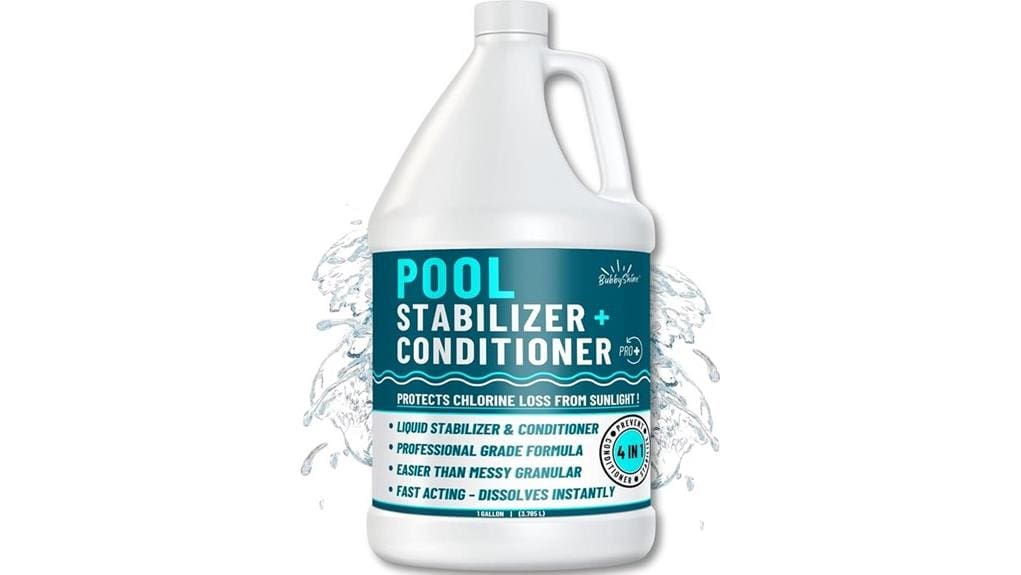
A cyanuric acid pool stabilizer will preserve your free chlorine under sunlight, cut dosing frequency, and yield steadier residuals by reversibly binding HOCl and slowing photodecomposition. You’ll see longer-lasting sanitizer, fewer dosing spikes, and improved clarity with less organic load on filters. Target about 30–50 ppm outdoors (20–30 ppm indoors/salt), add based on volume, retest in 24–48 hours, and avoid over-stabilizing. Continue for specifics on dosing, compatibility, and maintenance best practices.
Some Key Takeaways
- Cyanuric acid (CYA) effectively protects free chlorine from UV-driven degradation, extending sanitizer life in outdoor pools.
- Target CYA levels: 30–50 ppm outdoors and 20–30 ppm for indoor or salt systems to balance protection and disinfection.
- Proper dosing requires measuring current CYA, calculating by pool volume, adding evenly, and retesting 24–48 hours later.
- Stabilizer reduces chlorine consumption and maintenance frequency while improving residual persistence and water clarity.
- Avoid over-stabilization; monitor monthly, adjust after heavy bather or sunscreen use, and coordinate with shock treatments.
Quick Verdict: Does This Cyanuric Acid Pool Stabilizer Work and Who Should Buy It?
In short, this liquid cyanuric acid stabilizer does what it’s designed to do: it reduces UV-driven chlorine degradation, extends sanitizer life, and helps maintain clearer water with fewer chemical interventions. You’ll notice faster stabilization times and reduced chlorine dosing; that means predictable residuals and lower chemical consumption. If you manage a residential or community pool and want reliable sunburn protection for swimmers and improved algae prevention, this product fits. It’s compatible with common chemistries and pool types, acts quickly, and lowers maintenance frequency. You’ll join other responsible owners seeking consistent, professional-grade water quality with less effort. Proper stabilizer use also helps keep your pool balanced by reducing unnecessary chemical adjustments and maintaining stabilizer levels.
How the Stabilizer Works: What Cyanuric Acid Does in Your Pool
When you add cyanuric acid to pool water, it binds with free chlorine to form a weakly stable complex that absorbs ultraviolet light and slows photodecomposition, so a higher fraction of your sanitizer remains active over time. You’ll see sunlight protection through reduced chlorine loss; the CYA–HOCl equilibrium acts as chlorine buffering, lowering free radical formation while releasing active chlorine as needed. Stabilizer chemistry centers on reversible ligand binding and controlled dissociation rates, which preserve disinfection efficacy in outdoor pools. You get predictable residuals, fewer dosing spikes, and a shared confidence in pool safety and water quality. Homeowners often use solid forms like chlorine tablets for convenient, consistent stabilizer and sanitizer management.
Real-World Performance: Chlorine Retention, Clarity, and Maintenance Time Saved
Because cyanuric acid stabilizes free chlorine in the water, you’ll see measurable improvements in residual chlorine persistence, pool clarity, and reduced maintenance intervals. You’ll observe slower chlorine decay rates under sunlight, maintaining effective free chlorine concentrations longer and lowering daily dosing. That persistence yields quantifiable clarity improvement: fewer particulates and organics survive, so filtration cycles clear water faster. You’ll spend less time testing and adjusting chemistry; chemical consumption drops as disinfectant efficiency rises. The product integrates with typical systems, so your routine simplifies without extra process steps. You’re part of a community prioritizing reliable, time-efficient pool care. Many homeowners also pair stabilizer use with solar blankets to maximize heat retention and further reduce evaporation.
How to Use It Safely and Get Optimal Cyanuric Acid Levels
Although you’ll apply this stabilizer like other liquid additives, follow target cyanuric acid (CYA) ranges and dosing protocols to avoid over-stabilization: aim for 30–50 ppm for outdoor chlorinated pools (20–30 ppm for indoor/salt systems), measure CYA with a reliable test kit before dosing, calculate dose based on pool volume and product concentration, add the product to the skimmer or distributed evenly with the pump running, and retest 24–48 hours after dosing to confirm next-step adjustments. You’ll monitor testing frequency monthly in-season, increase checks after heavy bather load or sunscreen interactions, avoid exceeding targets, and adjust chlorine to preserve safety and clarity. For best results when using shock treatments and stabilizers together, follow manufacturer guidelines and consider coordinating additions to protect free chlorine efficacy.
Value and Compatibility: Cost Savings, Pool Types, and When to Choose This Product
If you manage multiple pools or aim to cut recurring chemical costs, this cyanuric acid stabilizer delivers measurable savings by preserving chlorine residuals and reducing dosing frequency. You’ll realize cost savings through lower chlorine consumption and fewer adjustment cycles, saving time and budget. Use it across in-ground, above-ground, saltwater and traditional chlorine systems; the compatibility guide confirms safe integration with common maintenance chemicals. Choose this product when sunlight-driven chlorine loss is your primary issue, when managing several installations, or when you want professional-grade stability without harsh additives. It’s precise, fast-acting, and promotes consistent, crystal-clear water for your community. Maintaining proper alkalinity helps keep stabilized chlorine effective, so monitor and adjust total alkalinity as needed to support balanced pool water.
Some Questions Answered
Does This Stabilizer Affect Pool Heater Performance?
No, it won’t directly degrade your heater’s performance. You’ll maintain heater efficiency because cyanuric acid stabilizes chlorine and doesn’t alter heat-exchange mechanics. By improving temperature retention through reduced water chemistry swings and fewer shock treatments, you’ll see more consistent operating conditions and less scale-inducing fluctuation. You’ll still follow manufacturer maintenance and monitor CYA levels to avoid secondary effects like scaling that could indirectly affect long-term heater efficiency.
Can Pets Swim Immediately After Application?
No, don’t let pets swim immediately after application. You’ll avoid pet exposure and reduce risk of pet irritation by waiting until the product fully disperses and the pool’s sanitizer levels are back in the recommended range. Circulate for the specified time, test cyanuric acid and chlorine, then confirm readings meet safe thresholds. Once levels are stable and within guidelines, you can safely allow pets to re-enter the water.
Is the Product Safe for Vinyl or Fiberglass Liners Long-Term?
Yes — you’ll find vinyl compatibility is high and the formulation preserves liner integrity over time. You’ll use a professional-grade, clear liquid that’s free of bleach and harsh reagents, so it won’t degrade vinyl or fiberglass when dosed per instructions. You’ll still monitor cyanuric acid levels and follow maintenance intervals to protect materials and guarantee consistent chemistry, keeping your pool community safe and included in routine care.
Does It Alter Pool Water pH Significantly?
No, it won’t markedly alter your pool water pH; cyanuric impact primarily provides pH buffering by stabilizing free chlorine against UV breakdown rather than shifting acidity. You’ll notice minimal immediate pH change when you dose correctly, though cumulative cyanurate buildup can modestly affect alkalinity dynamics over time. You’ll still monitor pH and total alkalinity routinely, because balanced chemistry keeps the whole pool system comfortable and consistent for everyone.
What Is the Product’s Shelf Life Once Opened?
You can expect about 12–24 months shelf life once opened if you follow storage instructions: keep the container tightly sealed, store upright in a cool, dry place away from sunlight and temperature extremes. You’ll limit the degradation timeline by avoiding contamination and thermal cycling. Use within that window for predictable performance; you’ll feel confident maintaining pool chemistry and saving time when you and others follow these concise care steps.