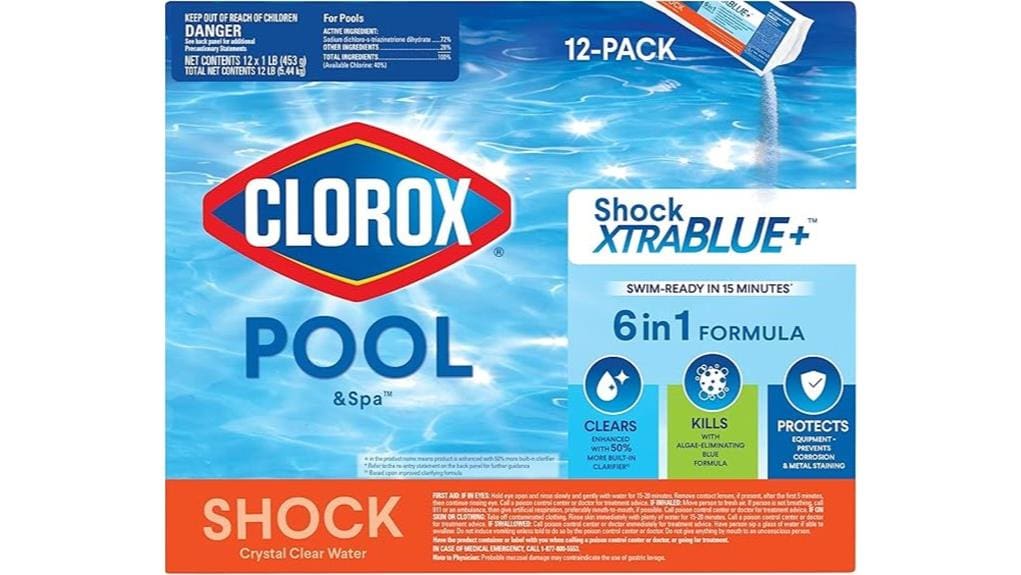
You’ll get a fast-dissolving granular oxidizer that raises free chlorine quickly and, when dosed at about 1 lb per 12,000 gallons and circulated properly, can make pools swim-ready in roughly 15 minutes. It oxidizes organics, reduces bacteria and algae risk, and converts particulates for easier filter capture. Don’t mix chemicals, use PPE, and confirm surface compatibility; shock weekly or after heavy use. Continue for application tips, testing guidance, and dosing scenarios.
Some Key Takeaways
- Fast-dissolving granular oxidizer that rapidly raises free chlorine for quick disinfection and oxidation of contaminants.
- Label claims swimmers may re-enter after 15 minutes, but multi-location testing is advised to confirm safe residuals.
- Effectively kills bacteria and algae, disrupts biofilms, and converts organics into filter-capturable particles.
- Use 1 lb per 12,000 gallons as typical dosing; ensure thorough circulation and avoid mixing with other chemicals.
- Sold in 12-pack granular format for cost-effective weekly shocks; store unopened packs cool and dry.
What Shock XTRABLUE® Plus Is and How It Works
When you add Clorox® Pool&Spa™ Shock XTRABLUE® Plus to your pool, its fast-dissolving granular oxidizer releases active chlorine agents that rapidly kill bacteria and algae, break down organic contaminants, and restore clarity. You’ll understand it as a granular formula designed for routine and shock dosing; the oxidizer mechanism supplies a concentrated chlorine boost without prolonged residue. You’ll monitor free chlorine and pH while recognizing chlorine chemistry drives both disinfection and oxidation reactions. Measurements and dosing guidance keep your group aligned: 1 lb per 12,000 gallons typical. You’ll share responsibility for safe, clear water through consistent, measured application. Many homeowners prefer to buy shock treatments and related supplies from a specialized retailer that focuses on pool maintenance products.
Fast-Dissolving Performance: Swim-Ready in 15 Minutes?
Although the label promises swimmers can re-enter the pool in as little as 15 minutes, you should evaluate that claim against measurable parameters: the product’s fast-dissolving granules rapidly raise free chlorine, but swim-readiness depends on reaching a safe free chlorine residual and acceptable pH, proper dispersion, and accurate dosing (typically 1 lb per 12,000 gallons). You’ll appreciate the rapid dissolution, but you must circulate thoroughly and avoid localized hotspots. Use immediate testing post-treatment—measure free chlorine and pH at multiple locations. Only return swimmers when readings meet safety thresholds. This method keeps your group confident and pool conditions consistent. For best results during spring opening, follow recommended pool opening chemicals and procedures tailored for homeowners.
Effectiveness: Killing Bacteria, Preventing Algae, and Clearing Cloudy Water
Having confirmed swim-readiness criteria and proper dispersion, assess XTRABLUE Plus by its active actions: its fast-dissolving chlorine granules rapidly raise free chlorine to levels that oxidize organic contaminants, kill bacteria, and inhibit algal growth. You’ll see measurable bacterial reduction within the 15-minute swim-ready window, validated by decreased combined and increased free chlorine readings. For algae prevention, routine shocks maintain oxidizing residuals that disrupt algal cell metabolism and biofilm formation. Cloudy water clears as particulates are oxidized and become filter-capture-ready, improving cartridge and sand filter efficiency. Overall, the product offers predictable, lab-like sanitization performance you can rely on. Homeowners can monitor these effects easily using simple pool water test kits to ensure safe levels and continued swim-readiness.
Safety, Compatibility, and Recommended Dosing (Surfaces, Gallons, Weekly Use)
Because XTRABLUE Plus uses a fast-dissolving granular chlorine, you can safely dose pools without prolonged surface contact provided you follow label instructions and avoid mixing with other chemicals. You should confirm compatibility with common pool materials—vinyl, plaster, fiberglass, tile—before treatment. Apply typical dosage: 1 lb per 12,000 gallons; adjust proportionally for different volumes. Observe dosage timing: shock weekly and after heavy use, heat spikes, or rain. Use proper protective equipment, add granules to water (not vice versa), and maintain circulation for complete dispersion. Test residuals with the Clorox Pool App and retest before swimming. For best clarity results, consider pairing shock treatments with a quality filter powder to help remove fine particles from the water.
Value and Buying Advice: Packaging, Typical Situations to Use It, and When to Choose This Shock
When you’re evaluating value, consider packaging size, typical use cases, and frequency: the 12-pack granular format reduces per-treatment cost for weekly maintenance and recurring shocks after heavy use or storms, while the fast-dissolving XTRABLUE Plus lets you return pools to swim-ready in about 15 minutes, minimizing downtime and chemical loss. You’ll appreciate bulk discounts for season-long caretaking; buy enough to avoid midseason runs. Use it weekly, post-storm, after parties, or when cloudy/algae risk rises. Store unopened packs in cool, dry seasonal storage. Choose XTRABLUE when you need rapid clarity, broad-surface safety, and cost-efficient routine dosing. Homeowners who enjoy their outdoor spaces should also keep their pool pH balanced to help maintain clearer, safer water.
Some Questions Answered
Can I Mix Shock Xtrablue® Plus With Other Pool Chemicals?
No — you shouldn’t mix Shock XTRABLUE® Plus directly with other pool chemicals. For chemical compatibility and safe treatment sequencing, add products separately: dissolve and circulate the shock fully before introducing other treatments. Follow recommended dosages and wait times (shock, wait 15 minutes swim-ready but allow longer before adding stabilizers or algaecide). You’ll protect equipment, maintain effective sanitizer levels, and belong to a responsible pool-care community.
Is It Safe to Use Around Pets and Wildlife?
Yes — you can use it safely if you manage pet exposure and wildlife impact. You should keep animals away during treatment and until chlorine levels return to normal (test with the Clorox Pool App). Avoid applying before rain or where runoff reaches wildlife areas. Rinse pets that contact treated water and restore proper chlorine levels before allowing access. These steps minimize toxicity risks and protect animals and local ecosystems.
How Should I Store Unused Granules Long-Term?
Store unused granules in a cool storage area, sealed in their original container or a corrosion-resistant, airtight bin to limit oxygen exposure. You’ll control humidity with desiccant packs and a hygrometer; maintain relative humidity below 50%. Keep containers off floors on pallets, away from heat, sunlight, combustible materials, and children. You’ll label dates and rotate stock FIFO. Follow local regulations for long-term chemical storage and disposal.
Does It Affect Saltwater Pool Chlorine Levels or Salt Systems?
Yes—you can use it in saltwater pools; it raises free chlorine without damaging the salt cell when dosed properly. You should monitor chlorine to avoid transient spikes and reduce corrosion risk by avoiding metal exposure and following manufacturer dosing. Stabilizer interaction is minimal, but test combined cyanuric acid. Meter interference can occur briefly after shocking; wait, retest, and rely on the Clorox Pool App or a calibrated meter for accurate readings.
Are There Environmental Disposal Guidelines for Leftover Product?
Yes — you should treat leftover product as potential hazardous waste and follow local regulations for disposal. Don’t dump granules into storm drains or waterways; instead, consult your municipality’s hazardous waste program or household hazardous waste events for collection instructions. You’ll also want to keep product in original labeled packaging and avoid mixing chemicals. By following these steps, you’ll protect community water quality and comply with local regulations while feeling supported by shared best practices.