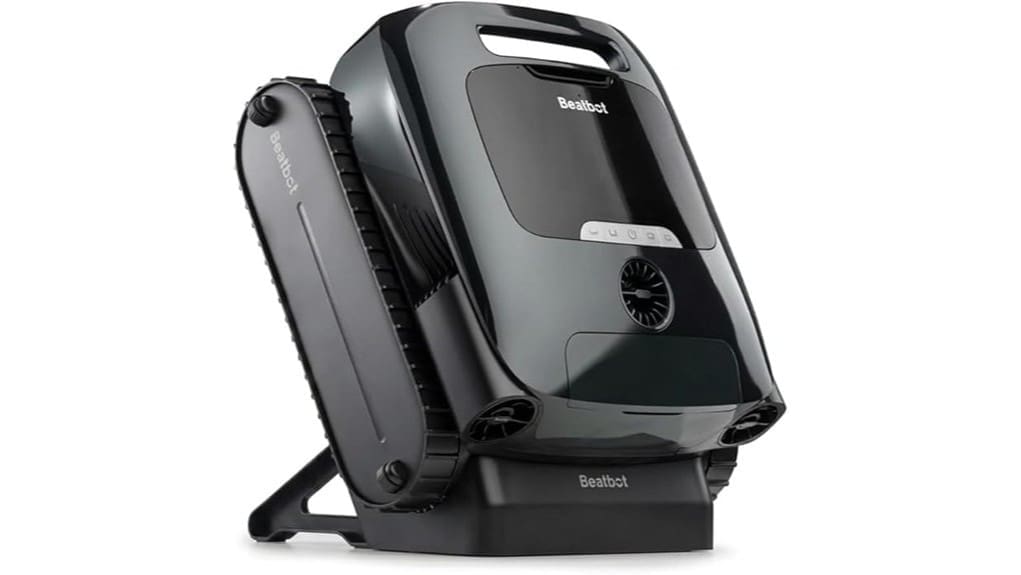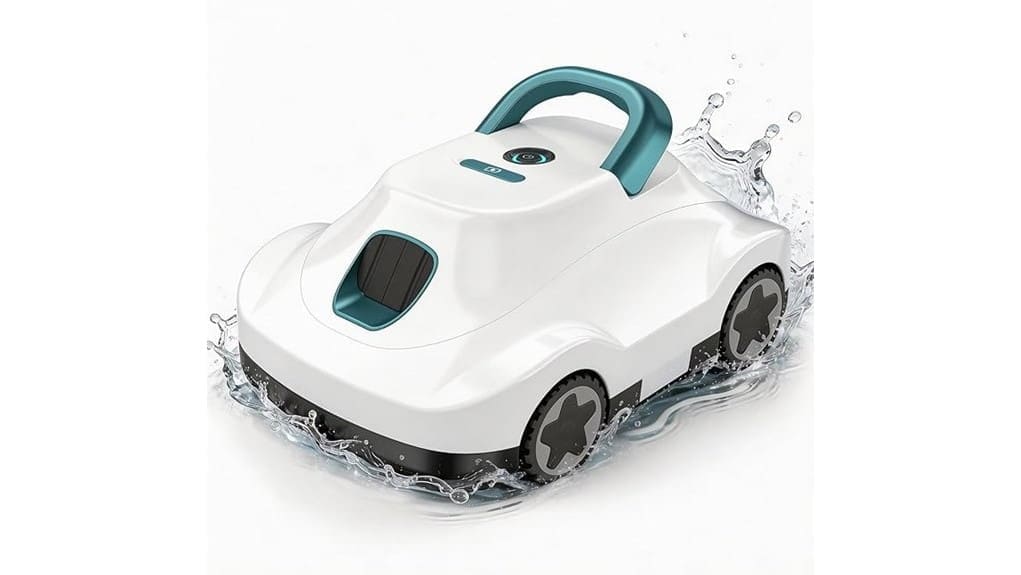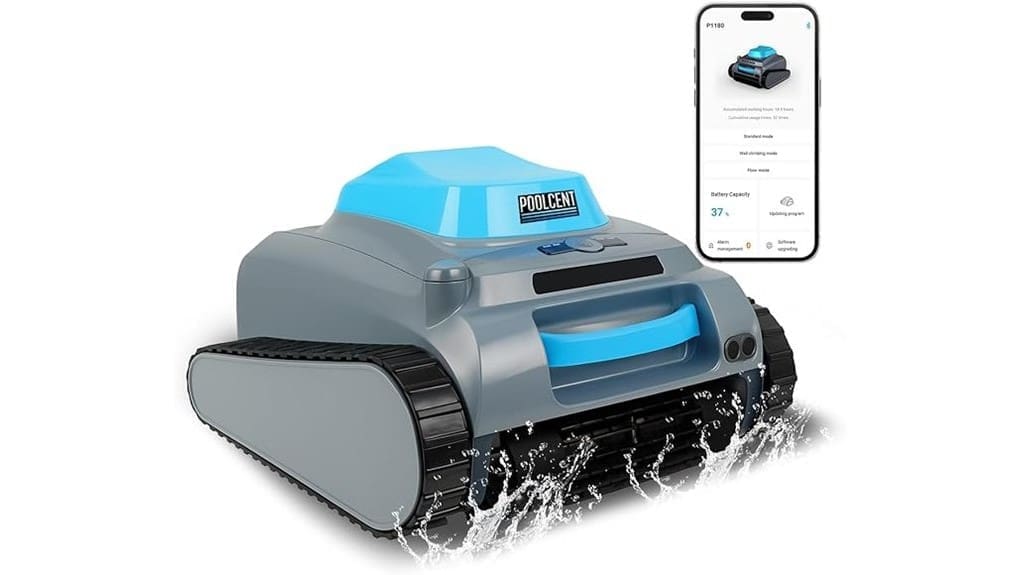
A cordless robotic pool cleaner gives you untethered mobility, wall-climb capability, and three targeted modes for floor, wall, and waterline cleaning. Dual 22.2V/4400mAh batteries center weight for stable climbs and deliver about two hours per cycle under mixed use, while onboard battery management protects cells. Dual-stage filters (70µ + 150µ) and a 4 L bin handle leaves to sand. Bluetooth and wireless firmware updates simplify control and improvements; keep going to see detailed performance and maintenance notes.
Some Key Takeaways
- Cordless design offers untethered mobility and safer operation, ideal for residential pools where convenience outweighs slightly higher pump noise.
- Dual 22.2V/4400mAh batteries (~97.7 Wh each) give up to ~2 hours runtime, influenced by load and wall-climb cycles.
- Sonar mapping and deterministic navigation create efficient, repeatable paths and flag missed zones for secondary passes.
- Dual-layer filtration (70µ + 150µ) with 4 L capacity captures leaves, sand, and fine organic matter while minimizing clogs.
- Routine maintenance includes rinsing exterior, clearing dual filters, inspecting treads/seals, and installing firmware updates for performance.
How a Cordless Robotic Pool Cleaner Works and When It’s the Right Choice
When you deploy a cordless robotic pool cleaner, its onboard battery powers propulsion, high-traction treads, brushes, and the dual filtration pumps so the unit navigates and cleans independently without a tether to the poolside. You position the dual battery cabin centrally to optimize battery placement for balance and center of gravity, which improves wall-climb stability and runtime. You monitor charge state and runtime limits; the 22.2V pack yields up to two hours per cycle. You assess suitability by pool size, debris load, and access; choose cordless where mobility and absence of cord hazards outweigh slightly elevated noise profile from compact pumps and motors. They are ideal for homeowners seeking effortless pool cleaning and more relaxing outdoor living.
Real-World Performance: Cleaning Modes, Wall-Climbing, and Navigation Tested
Although compact, the cleaner delivers distinct, verifiable performance across its three modes—floor, wall, and waterline—so you can expect targeted agitation and debris capture depending on mode selection. You’ll choose mode based on task: floor for bulk debris, wall for biofilm and algae, waterline for scum. Sonar mapping creates an efficient, repeatable path and flags missed zones for secondary passes. Wall-climbing uses high-traction treads to maintain contact while scrubbing; shifts are smooth. Corner suction is effective when the unit reorients into tight junctions. Navigation is deterministic, with firmware updates refining route efficiency without manual intervention. Many homeowners appreciate robotic options for maintaining pristine outdoor pools with minimal effort, especially models designed for residential pools.
Battery Life and Power: What 22.2V / 4400mAh and Dual Batteries Mean for Runtime
Understand the battery specs to set realistic expectations: the 22.2V / 4400mAh lithium pack provides a nominal energy reservoir of about 97.7 Wh per battery, and with dual battery chambers the cleaner can either run two packs in parallel for extended runtime or switch between them depending on the device’s power-management design. You’ll see up to ~2 hours runtime under typical mixed-mode operation; actual duration depends on motor load, wall-climb cycles, and firmware-driven runtime scaling. Robust battery management preserves charge cycles and monitors cell balance. Follow manufacturer guidance for charging and storage to guarantee power safety and consistent performance. For homeowners looking to integrate their cleaning schedule with pool equipment operation, consider how the cleaner’s runtime complements your variable speed pumps and filtration cycles.
Filtration and Debris Handling: Dual Filters, 4 L Capacity, and What They Catch
How well does the cleaner handle different debris sizes? You’ll rely on a dual filter system with double-layer filtration (70µ + 150µ) and a 4 L capacity to manage bulk and fines. Primary coarse mesh focuses on leaf capture and larger detritus, diverting material to the roomy compartment to minimize clogging. Secondary fine layer improves particle retention for sand and fine organic matter, reducing recirculation. Flow rates and impeller design maintain suction without overwhelming filters; you’ll empty less often during typical cycles. Filtering trade-offs favor capacity and staged separation for consistent cleaning efficiency across debris types. Homeowners who use outdoor spaces will appreciate how this design complements essential pool skimmer maintenance routines.
Control, Updates, and Maintenance: Bluetooth, Firmware Updates, and Routine Care
Regularly check the robot’s Bluetooth connection and firmware status to keep navigation efficient and features current. You’ll perform Bluetooth pairing via the app, confirm signal strength, and test remote commands before each run. Firmware maintenance requires installing wireless updates promptly; follow version notes to guarantee algorithm improvements and bug fixes apply to sonar navigation and battery management. For routine care, rinse exterior, clear dual filters, and inspect treads and seals for wear. Dry components before storage, charge per manufacturer guidelines, and log maintenance dates. These procedures preserve performance, extend service life, and minimize swim interruptions. Also consider pairing your maintenance log with digital pool testers to monitor water chemistry alongside cleaner upkeep.
Some Questions Answered
Is This Cleaner Safe for Vinyl and Painted Pool Surfaces?
Yes — you can use it on vinyl and painted surfaces with caution. The cleaner’s high-traction treads and wall-climbing motors minimize slipping, while dual-layer filtration prevents debris abrasion. However, vinyl compatibility depends on tread material and pressure; avoid prolonged scrubbing in one spot to reduce surface abrasion. Use Bluetooth control to monitor paths, enable optimized navigation, and update firmware to guarantee gentle, consistent operation that limits wear on delicate finishes.
How Noisy Is the Unit During Operation?
You’ll hear a low humming during operation; it’s designed to be unobtrusive. Measured decibel levels sit in a quiet range comparable to household appliances, primarily from the high-traction motor and pump. Dual-battery output and treads increase torque but keep noise steady rather than spiking. Bluetooth communication adds negligible sound. Overall, you’ll get consistent, low-frequency noise that’s unlikely to disturb nearby indoor or outdoor activities during typical two-hour runs.
Can It Handle Saltwater or Chlorine-Heavy Pools?
Yes — you can use it in saltwater or chlorine-heavy pools. The unit offers saltwater compatibility and chemical resistance through sealed housings, corrosion-resistant materials, and dual battery cabin protection. You’ll still rinse seals after prolonged exposure and follow manufacturer maintenance intervals to preserve brushes, treads, and filter media. Firmware updates won’t affect chemical durability, but regular inspections will guarantee long-term performance in high-chlorine or saline environments.
What Is the Warranty and Customer Support Process?
You get a standard 24-month warranty duration covering defects and motor or battery failures; wear items and misuse are excluded. For support channels, you’ll use phone, email, and an online portal for diagnostics, troubleshooting, and firmware update assistance. You’ll start with registration, submit a support ticket or call, then follow guided tests. If hardware fault is confirmed, they’ll authorize repair or replacement per warranty terms and shipping instructions.
How Long Does Full Charging Typically Take?
Full charging typically takes about 4–5 hours, giving you the stated battery runtime of up to 2 hours. You’ll plug into the dual charging ports on the unit or dock; the dual battery cabin supports efficient charging and balances cells. Charging time can vary slightly with ambient temperature and battery age, but 4–5 hours is the expected full-charge window for routine operation and peak performance.