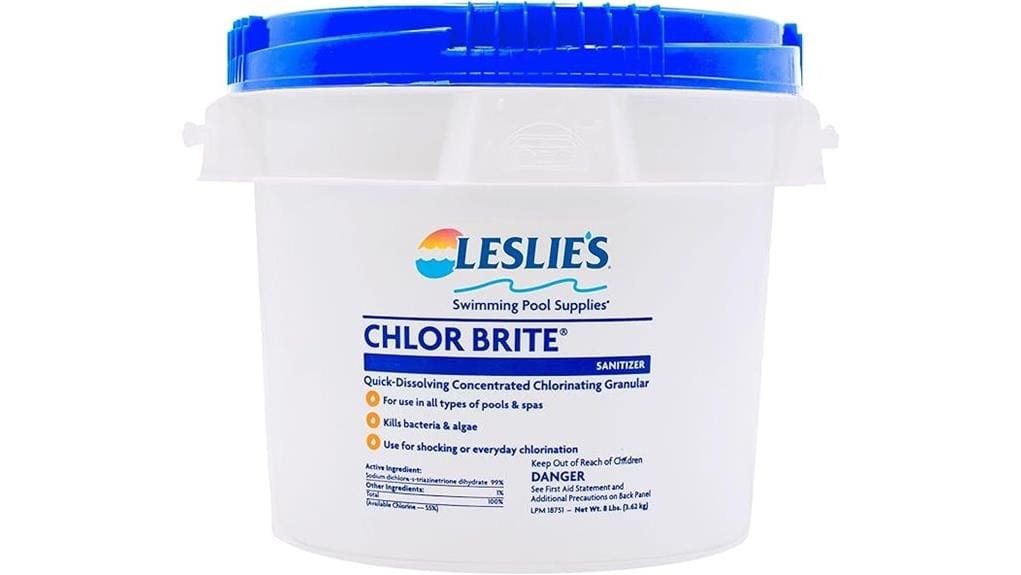
Leslie’s Chlor Brite is a fast-dissolving sodium dichloro granular chlorine with 55% available chlorine and built-in cyanuric acid for UV stabilization, so you get rapid free chlorine and longer residuals. Use 3 oz per 10,000 gallons for routine dosing or 21 oz per 10,000 for shocks, pre-dissolving if desired and running the pump. Wear PPE, monitor free chlorine and CYA to avoid buildup; keep applications low-bather and low-sun for best results, and the rest explains trade-offs and alternatives.
Some Key Takeaways
- Fast-dissolving granular sodium dichloro provides 55% available chlorine for effective routine and shock sanitization.
- Stabilized formulation includes cyanuric acid, improving UV protection but risking long-term CYA buildup.
- Dosing: 3 oz/10,000 gal for routine maintenance, 21 oz/10,000 gal for superchlorination (dissolve in water if desired).
- Compatible with pools, spas, and salt systems, offering predictable chlorine decay for treatment planning.
- Requires PPE during handling, ventilated application, and careful CYA monitoring; packaging is single-use plastic.
Search Intent & Format: Quick Product Review for Buyers (Informational + Commercial Investigation)
Why choose Chlor Brite Sodium Granular Chlorine? You want clear criteria when researching: effectiveness, dosing, handling, and impact on pool aesthetics. This quick review format gives concise data points, comparisons, and practical takeaways so you can decide confidently with peers. You’ll get stability, dissolution rate, and dosing guidelines presented for rapid assessment, plus notes on compatibility and required precautions for chemical storage. The tone is technical and objective; it assumes you value community-tested standards and operational simplicity. Read this section to match product performance to your maintenance routine and aesthetic expectations without unnecessary detail. Many homeowners also consider how products fit into their overall pool care routine, including compatibility with other chlorine formats like chlorine tablets.
What Leslie’s Chlor Brite Sodium Granular Chlorine Is and Who Should Use It
Leslie’s Chlor Brite Sodium Granular Chlorine is a fast-dissolving, stabilized sodium dichloro-s-triazinetrione (sodium dichlor) formulation with 55% available chlorine designed for shock and routine sanitization; it delivers concentrated chlorine quickly while adding cyanuric acid for UV protection. You’ll find it’s a granular, stabilized dichlor product suited for superchlorination and ongoing sanitization of pools and spas. Use it if you’re a pool owner seeking rapid, measurable chlorine boosts or a commercial operator needing reliable, compact dosing for frequent treatments. It’s compatible as a backup for salt systems and works across pool types without leaving residue. It’s an excellent option for homeowners preparing their pools for the season and other outdoor spaces.
Key Specs and Performance at a Glance (Active Ingredient, Available Chlorine, Dissolution, Stabilization)
From the product overview, you can move into the hard specs that determine on‑water performance. You’ll find a 99% sodium dichloro-s-triazinetrione active ingredient and 55% available chlorine, delivering concentrated sanitization. The fast-dissolving granular form yields a high dissolution rate for rapid free chlorine availability; you’ll see quick residuals without extended particulates. Cyanuric acid stabilization is integrated, reducing UV-driven depletion and improving longevity. Stability testing supports predictable decay curves under sunlight exposure, so you can plan treatments confidently. Specs emphasize efficiency and compatibility, giving you measurable parameters to match pool size, treatment frequency, and desired residual control. This makes it a practical choice for homeowners looking to keep their pool sparkling with reliable shock treatment results.
How to Dose and Use It Safely for Routine Maintenance and Shock Treatments
When maintaining sanitizer levels or performing a shock, measure and add Chlor Brite sodium dichlor precisely to avoid over‑stabilization and guarantee effective free chlorine; follow the recommended dosing—3 oz per 10,000 gallons for routine maintenance and 21 oz per 10,000 gallons for superchlorination—dissolving granules in a bucket of water if required and distributing evenly around the pool while the pump is running to promote rapid dispersion. You should test free chlorine and cyanuric acid before and after dosing, schedule application timing for low bather load and no direct sun, wear PPE, keep others informed for pool safety, and record treatments. Homeowners can also use clarifiers to help maintain clear pool water alongside proper sanitizer practices.
Real-World Pros, Cons, and When to Choose This Product Over Alternatives
After you’ve confirmed dosing and tested levels, weigh the practical advantages and limitations of Chlor Brite sodium dichlor for routine and shock use. You’ll get rapid dissolution, stabilized chlorine for UV protection, and concentrated available chlorine that reduces required mass per treatment. It’s compatible with pools, spas, and salt systems as a backup. Expect a brief chemical odor during application; ventilate and avoid breathing dust. Cons: added cyanuric acid can accumulate, and single-use plastic packaging increases packaging waste. Choose Chlor Brite when you need fast, stabilized shocks and precise dosing; consider liquid or calcium hypochlorite alternatives if cyanurate buildup or less plastic is critical. Many homeowners find it useful for routine maintenance of outdoor pools that see frequent recreational use and sunlight exposure, especially when prioritizing stabilized chlorine for UV protection.
Some Questions Answered
Can This Product Damage Pool Equipment or Liners Over Time?
No, used correctly it shouldn’t cause significant corrosion risk or liner degradation. You’ll prevent issues by dosing per guidelines, avoiding repeated high-level superchlorination without neutralization, and maintaining balanced pH and alkalinity. Rapid-dissolving, stabilized dichlor minimizes residues, but sustained high chlorine or low pH can accelerate metal corrosion and stress vinyl liners. You’re included in a community that monitors chemistry and equipment to preserve longevity and safe operation.
How Should I Store Leftover Granules Safely and for How Long?
Store leftover granules in a cool storage area, tightly sealed in their original container or an approved airtight chemical drum to prevent moisture and contamination. Label with date opened to track the expiration timeline; expect effectiveness for about 1–2 years if kept dry and cool. Keep away from heat, fuels, acids, and children; store in a ventilated, dedicated chemical closet. You’ll maintain safety and consistent sanitizer performance.
Is This Safe to Use With Live Plants or Nearby Landscaping?
Yes — you can use it, but take precautions: high chlorine or uneven application risks plant toxicity and root burn. Avoid direct contact with foliage or soil near roots by keeping granules contained and diluting properly before adding to the pool. Rinse spills immediately and maintain recommended dosages to minimize runoff. If you have sensitive plants, create a buffer zone or temporarily cover landscaping to protect them from concentrated chlorine exposure.
How Long After Shocking Can Swimmers Re-Enter the Pool?
You can re-enter once residual chlorine returns to safe levels, typically below 4 ppm; wait time is usually 8–24 hours after superchlorination. Test free chlorine before swimming; for routine shocks you may re-enter sooner if free chlorine is under 4 ppm and cyanuric acid is acceptable. You’ll want to confirm with a test strip or digital tester, ensuring the pool meets local public-health guidelines so everyone feels included and protected.
Can I Mix This With Other Pool Chemicals for Faster Treatment?
No — you shouldn’t mix it directly with other pool chemicals for faster treatment. Maintain chemical compatibility and add products separately, allowing full dissolution and proper circulation between doses. Incompatible mixing can produce hazardous reactions; have emergency neutralization materials and procedures ready. Follow label dosages, test levels before and after treatments, and wait recommended intervals. You belong to a careful pool-care community that prioritizes safety and measured, effective dosing.