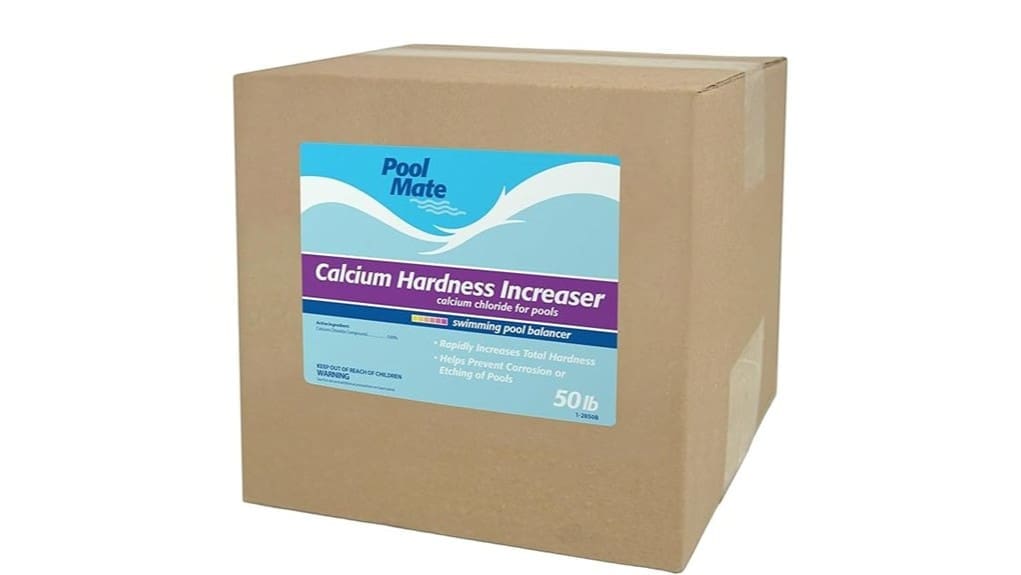
You’ll find Pool Mate’s 50-lb calcium hardness increaser is a concentrated, 100% calcium chloride product that quickly raises hardness when dissolved and added with circulation. Test hardness first, dissolve up to 2 lb per 5-gallon plastic bucket, and add solution slowly around the pool to avoid local etching; follow max addition rates for your volume. It’s cost-effective for large pools but requires careful handling and dry storage for stability — continue for detailed dosing and safety guidance.
Some Key Takeaways
- 50-lb bag contains 100% calcium chloride, offering cost-effective, rapid calcium hardness increases for large pools.
- Dosage guideline: 8 oz raises 10 ppm in 5,000 gallons; convert ounces to pounds for your pool volume.
- Dissolve up to 2 lb per 5-gallon bucket, add slowly with circulation to avoid localized etching or staining.
- Retest after one circulation cycle and again at 24 hours; follow maximum addition rates (e.g., <10 lb per 2 hours in 10,000 gal).
- Handle with gloves, eye protection, and dust mask; store sealed and dry to prevent crystallization and maintain shelf life.
Pool Mate 50‑Lb Calcium Hardness Increaser at a Glance
Overview: Pool Mate’s 50‑pound Calcium Hardness Increaser is a granular, 100% calcium chloride formulation designed to quickly raise total calcium hardness in pools. You’ll use it to correct low hardness, mitigate corrosion, staining, and surface etching. The 50‑lb unit (800 oz) provides industrial dosing capacity; 8 oz raises hardness ~10 ppm per 5,000 gallons. You’ll dissolve product in a plastic bucket, add slowly with circulation running, and adhere to maximum addition rates to avoid overshoot. Its role in water balance is specific and measurable. Store dry; proper storage preserves shelf life and product integrity. Many homeowners find calcium increasers essential for maintaining balanced pool water and protecting pool surfaces.
How to Dose and Add Pool Mate Correctly for Your Pool Size
Now that you know what the Pool Mate 50‑lb calcium hardness increaser is and how it behaves in water, here’s how to calculate and apply the right amount for your pool size. Test current calcium hardness with a reliable kit. Use dosing metric: 8 ounces raises ~10 ppm per 5,000 gallons. Calculate required ounces, convert to pounds. Prepare solution using bucket proportions: dissolve up to 2 lb per ~5‑gallon bucket of pool water. With circulation running, slowly pour solution around the pool perimeter. Observe maximum addition: in 10,000 gallons, don’t add over 10 lb per 2‑hour period. Record addition timing and retest. Keep your pool pH balanced for clearer, safer water by monitoring and correcting pH as needed, since pH influences calcium behavior in the pool and overall water quality, and consult pool pH guidelines for best results.
Real‑World Performance: How Fast and How Effectively It Raises Calcium Hardness
Because Pool Mate is pure calcium chloride and dissolves readily, you’ll see measurable rises in calcium hardness within the circulation cycle after proper dosing and dissolution. You should dissolve recommended amounts in a plastic bucket, add slowly around the perimeter while pump circulation runs, and retest. Expect a rapid response: typical dosing raises hardness predictably (approximately 8 ounces ≈ 10 ppm per 5,000 gallons). Measurement accuracy depends on your test kit and sampling time; test after one circulation cycle and again at 24 hours. For long‑term stability, maintain target ranges with periodic monitoring and incremental top‑ups according to pool volume and results. Maintaining proper stabilizer levels also helps protect chlorine efficacy and overall water balance by preventing rapid chlorine loss.
Safety, Handling, and Pool Surface Compatibility You Must Know
When handling Pool Mate calcium hardness increaser, wear chemical-resistant gloves and eye protection. You’ll also want a dust mask and closed-toe shoes as part of personal protective equipment. Work outdoors or in well-ventilated areas to avoid inhalation of granular dust. Dissolve granules in a plastic bucket per instructions; never mix with other chemicals. Add solution slowly with circulation running to prevent localized high concentrations that can etch or stain plaster, fiberglass, painted, tile, or vinyl surfaces. Store sealed and dry. For spills and leftover product follow local environmental disposal regulations; don’t pour undiluted material to storm drains or soil. Use shock treatment products as part of regular maintenance to keep your pool sparkling and safe.
Pros, Cons, and Who Should Buy the 50‑Lb Bag
Having covered safe handling and surface compatibility, let’s look at practical trade-offs you’ll face with the 50‑lb bag. You’ll benefit from lower unit cost per dose, reduced purchase frequency, and suitability for maintaining recommended calcium hardness across large pools. Drawbacks include heavier handling, limited maximum addition rates, and potential crystallization risk in poor storage. If you plan long term storage, keep the bag sealed and dry to protect resale value and effectiveness. Consider environmental impact and packaging sustainability: the heavy-duty plastic bag is durable but not widely recyclable. Buy this size if you manage large pools or frequent adjustments. Many homeowners who fit pool filter cartridges to maintain water clarity also monitor calcium hardness as part of regular pool maintenance.
Some Questions Answered
Can This Product Be Used in Saltwater Pools With Salt Chlorinators?
Yes—you can use it in saltwater pools with salt chlorinators. It’s saltwater compatibility is acceptable because the product is 100% calcium chloride and raises calcium hardness without adding chlorine or cyanuric acid. However, you should monitor calcium levels carefully and avoid overcorrection; high hardness can accelerate electrode corrosion in chlorinators. Dissolve and add per instructions, test before and after, and follow maximum addition rates to protect equipment and surfaces.
Will It Affect Pool pH or Alkalinity After Dissolving?
No, it won’t markedly change pH or total alkalinity; you’ll mainly alter calcium interaction. You’ll dissolve calcium chloride in a bucket and add slowly, which raises calcium hardness without directly affecting alkalinity or pH. However, warm concentrated solution can transiently lower pH locally; run circulation and retest. Use indicator testing for calcium, pH, and alkalinity before and after dosing to confirm levels and adjust if needed.
Is the Granular Formula Safe for Automatic Feeders or Chlorinators?
No — you shouldn’t feed the granular directly into an automatic feeder or chlorinator. The product’s calcium chloride granules can clog or corrode internal feeder components. For automatic feeder and feeder compatibility, dissolve the recommended amount in a plastic bucket of pool water first, then add the solution slowly to the pool while circulation runs. Test calcium hardness before and monitor after dosing to avoid overdosing and equipment issues.
How Long Should I Wait After Adding Before Swimming?
Wait time: wait at least 2 hours after dosing, longer if you added near the maximum rate. You should make certain complete dissolution to reduce skin sensitivity and avoid localized high concentrations. Because dissolution rate varies with temperature and circulation, confirm granules are fully dissolved and retest calcium hardness before swimming. For swim safety, don’t enter until readings are within recommended ranges and circulation has run sufficiently to homogenize the water.
Does Calcium Chloride Cloud the Water Temporarily?
Yes — you’ll likely see temporary cloudiness after adding calcium chloride. The granular product can cause brief turbidity as undissolved particles disperse; proper dissolution in a plastic bucket and slow perimeter addition while the pump runs minimizes this. Cloudiness clears as particle settling and filtration remove suspended solids; expect improvement within hours, depending on filter efficiency and dosing. Test and adjust only after clarity returns.