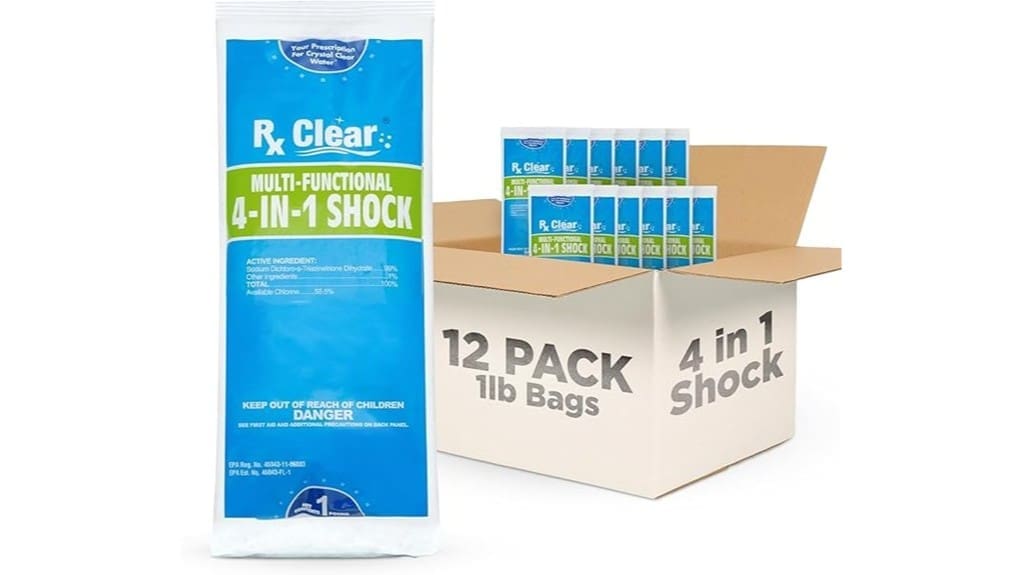
You’ll get a fast‑dissolving, sodium dichloro shock with 55.5% available chlorine that’s dosed predictably at 1 lb per 10,000 gallons. It rapidly reduces algae and oxidizes organics to clear cloudiness and cut chloramine odor, while providing a stable residual for routine maintenance. Handle with gloves, goggles, and avoid acids; pre‑dissolve only if allowed and run the pump after dosing. Keep going to see detailed dosing, safety steps, and performance notes.
Some Key Takeaways
- Contains 55.5% available chlorine (sodium dichloro-s-triazinetrione dihydrate) for fast, predictable oxidation and sanitization.
- Rapidly dissolves and reduces algae and organics, improving water clarity within 24–48 hours at recommended dosing.
- Typical maintenance dose: 1 lb per 10,000 gallons every two weeks, with pump run 6–8 hours after dosing.
- Low odor and reduced chloramine-related irritation compared with some shocks, while providing sustained free chlorine residual.
- Requires PPE when handling, keeps dry away from acids, and may restrict immediate bather reentry for several hours.
Quick Verdict: Is Rx Clear 4‑in‑1 Shock Worth Buying?
While it’s a basic pool oxidizer, Rx Clear 4‑in‑1 Shock delivers reliable, fast-dissolving chlorine (55.5% available) that kills bacteria and algae, breaks down organic contaminants, and helps keep water clear with minimal odor and eye irritation. You’ll find it effective for routine maintenance: dosing 1 lb per 10,000 gallons yields predictable free chlorine recovery and reduced cloudiness. Lab-like performance supports pool aesthetics by maintaining blue clarity without strong odor. User testimonials report straightforward handling and rapid dissolution in both in-ground and above-ground pools. You’ll appreciate its consistent disinfecting strength and simple, scheduled use. It’s a solid choice for homeowners preparing their outdoor spaces for the season, especially when following recommended pool opening chemicals and usage guidelines.
What’s Inside the Bag : Key Ingredients and Chlorine Strength
Because the active ingredient is 99% sodium dichloro-s-triazinetrione dihydrate, you get a concentrated, fast-dissolving source of 55.5% available chlorine that reliably sanitizes and oxidizes contaminants. You’ll find a single-pound bag formulation optimized for predictable dosing and rapid dissolution. Active ingredients are limited to the dichloro compound and inert carriers, minimizing unknowns. Chlorine potency is specified as available chlorine (55.5%), so you can calculate shock dosing precisely (1 lb per 10,000 gallons baseline). The composition supports steady residuals and strong oxidizing capacity without added stabilizers; purity and labeled potency aid consistent field performance. This makes it a convenient option for homeowners looking to keep pools sparkling with straightforward shock treatments.
Real‑World Performance : Killing Algae, Clearing Cloudiness, and Odor Control
When you dose Rx Clear Multi-Functional 4-in-1 Shock at the recommended rate, it delivers a rapid, measurable drop in viable algae counts and a marked improvement in water clarity within 24–48 hours. You’ll observe compromised algae resilience as available chlorine oxidizes cellular structures; counts fall predictably with routine application. Cloudiness recovery follows as organics and particulate matter coagulate and settle or filter out. Odor persistence diminishes because organics that generate chloramines are oxidized, improving smell while maintaining disinfecting strength. Chlorine retention is stable due to the dichloro formulation, providing a sustained residual that supports ongoing control. Homeowners who enjoy their outdoor spaces should combine effective dosing with regular maintenance and use of pool algaecides to keep the water clear and algae-free.
How to Use It Safely and the Right Dosing for Your Pool
Those rapid reductions in algae and improved clarity set the stage for proper handling and dosing of Rx Clear Multi‑Functional 4‑in‑1 Shock to maintain those results safely. You’ll wear personal protective gear—gloves, goggles, and a mask—when handling one‑pound bags. Keep chemicals dry and separate from acids. For routine maintenance, dose 1 lb per 10,000 gallons every two weeks; increase only after testing. Use a pre dissolve procedure only if manufacturer permits: dissolve slowly in a clean bucket of pool‑temperature water, stirring away from patrons, then broadcast solution around pool perimeter. Run pump 6–8 hours and retest chlorine before swimming. Proper filtration and the correct filter powder can help maintain that improved clarity between treatments.
Pros, Cons, and Who This Shock Is Best For
Although compact and concentrated, Rx Clear Multi‑Functional 4‑in‑1 Shock delivers predictable, multi‑purpose performance that suits regular pool maintenance. You’ll get steady available chlorine, fast dissolution, and algae control with recommended dosing of 1 lb per 10,000 gallons. Pros: effective sanitization, reduced cloudiness and chloramine odor, convenient one‑pound bags, measurable cost savings versus liquid alternatives. Cons: contains sodium dichloro—handle with PPE, not ideal for immediate bather reentry for several hours, limited 55.5% available chlorine versus some boosts. Who it’s best for: homeowners or operators seeking routine maintenance efficiency; check user reviews for field longevity and handling anecdotes. Consider pairing this product with eco-friendly pool care practices to reduce environmental impact while maintaining water quality.
Some Questions Answered
Is This Shock Safe for Saltwater Pools With Chlorine Generators?
Yes. You can use it with salt systems, but you should monitor salt cell compatibility and adjust generator settings. The dichlor deliveres stabilized chlorine that dissolves quickly and won’t permanently harm cells, yet repeated heavy dosing can raise cyanuric acid and stress the generator. Lower your generator output briefly after shocking, run filtration, and test chlorine and CYA before restoring normal settings to protect cell lifespan and maintain sanitizer balance.
Will It Bleach or Damage Vinyl Pool Liners?
No, it shouldn’t bleach or damage vinyl pool liners when used as directed; you’ll avoid noticeable color fading or fabric deterioration if you follow dosage and dissolve procedures. High localized concentrations can cause spotting or surface softening, so pre-dissolve granules, dilute before adding, and maintain proper pH and cyanuric acid levels. Rinse chemical spills promptly and test an inconspicuous area before concentrated application to minimize risk.
Can It Be Used in Pools With Plaster or Pebble Finishes?
Yes — you can use it with plaster or pebble finishes if you follow guidelines. You’ll maintain surface compatibility by dosing 1 lb per 10,000 gallons and avoiding concentrated contact. It dissolves fully, reducing localized oxidative stress that can etch surfaces. Test and monitor total chlorine and pH, keep pH 7.2–7.6, and rinse any undissolved residue promptly to guarantee finish preservation and long-term integrity.
How Long After Shocking Can I Swim Again?
You can swim once chlorine levels return to safe limits and the wait time meets activity guidelines. Test free chlorine with a reliable kit; wait until it’s below 5 ppm (ideally 1–3 ppm) and pH is 7.2–7.8. For the Rx Clear shock dose, that typically means waiting 8–24 hours depending on circulation, temperature, and sunlight. Don’t resume activity if chlorine or cyanuric acid exceed recommended values.
Does It Affect Pool pH or Alkalinity Significantly?
No, it won’t cause significant pH drift or deplete alkalinity; you’ll see minimal pH change because the dichloro compound delivers stabilized chlorine that dissolves cleanly. You’ll still monitor alkalinity buffering since total alkalinity provides resistance to any small pH shifts, but routine 1 lb/10,000 gal dosing every two weeks shouldn’t force major adjustments. Test after treatment and correct alkalinity if readings fall outside the 80–120 ppm range.