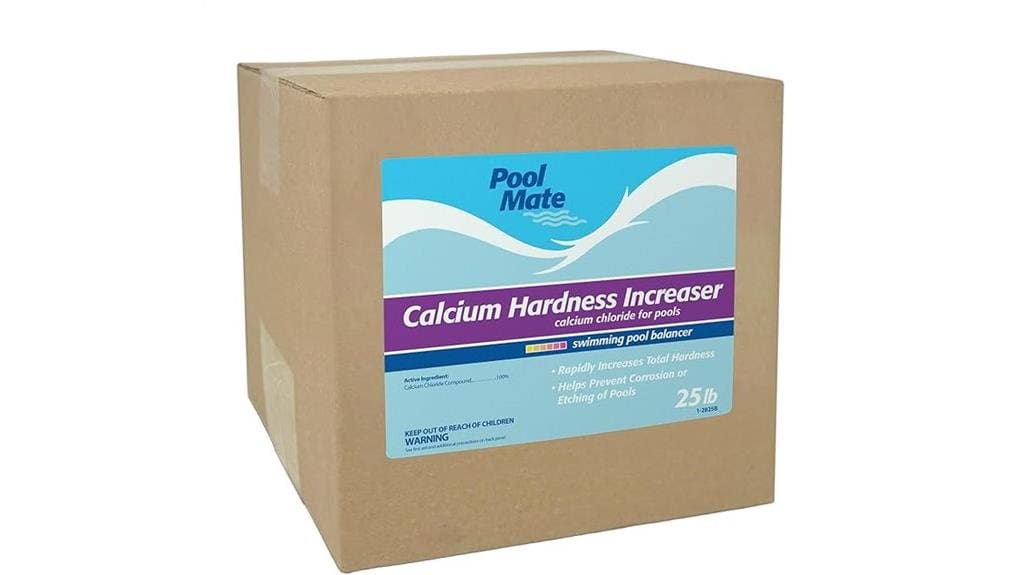
You’ll get a 25‑lb granular calcium chloride that raises hardness predictably (8 oz ≈ +10 ppm per 5,000 gal) and’s formulated to protect plaster, tile, and vinyl. You’ll measure pool volume and current ppm, pre‑dilute up to 2 lb per 5‑gal bucket, and pour slowly with the pump running, staging large additions and honoring per‑period limits. Expect measurable changes within 1–2 hours and retest after circulation; keep alkalinity balanced for best results and more practical guidance follows.
Some Key Takeaways
- 25-pound dry calcium chloride reliably raises hardness; 8 oz adds ~10 ppm per 5,000 gallons for predictable dosing.
- Formulated to protect plaster, tile, and vinyl from corrosion, staining, and etching when used as directed.
- Requires safety gear and pre-dilution (≤2 lb per ~5-gallon bucket) and slow perimeter pouring with pump running.
- Respect staged dosing limits (e.g., ≤10 lb per 2 hours for 10,000 gallons) and retest after full circulation.
- Measurable hardness increase within 1–2 hours; retest again at 12–24 hours and maintain alkalinity for stability.
Why Choose Pool Mate 25-Pound Calcium Hardness Increaser for Your Pool
Choose Pool Mate 25‑Pound Calcium Hardness Increaser when you need a fast, reliable way to raise and stabilize your pool’s calcium hardness; it’s 100% calcium chloride in a dry granular form that delivers predictable dosing (8 oz ≈ +10 ppm per 5,000 gallons) and is formulated to protect surfaces from corrosion, staining, and etching. You’ll get measurable durability benefits for plaster, tile, and vinyl surfaces by maintaining recommended hardness ranges. The 25‑pound unit offers easy storage in a compact container, clear dosing guidance, and practical handling—so you’ll feel confident, supported, and technically equipped to maintain pool integrity. It’s ideal for homeowners who enjoy their outdoor spaces and want to keep pool water balanced.
How to Calculate the Right Dose for Your Pool Size and Target PPM
Start by determining your pool’s volume and current calcium hardness so you know exactly how much to add to reach the target ppm. Convert your desired ppm increase using the dose guidance: 8 ounces raises ~10 ppm per 5,000 gallons. Use gallons calculation: for your pool, scale proportionally (e.g., 10,000 gallons needs double). Perform ppm conversion to ounces: desired ppm increase × (8 oz / 10 ppm) × (your gallons / 5,000). Respect maximum addition rates (no more than 10 pounds per 2 hours for 10,000 gallons) and retest after full circulation to confirm target. Proper dosing helps protect pool surfaces and equipment by maintaining balanced calcium hardness.
Safe Mixing and Application: Step‑by‑Step With Dilution and Circulation Tips
Now that you’ve calculated the exact dose for your pool, prepare for safe mixing and application by pre-diluting the granular calcium chloride and planning staged additions. Don safety equipment—gloves, goggles, and a dust mask—before handling dry granules. Fill a plastic bucket with pool water, add up to 2 pounds per ~5-gallon bucket, and stir until dissolved. With the pump running, slowly pour the solution around the pool perimeter, avoiding concentrated spots. Honor the per‑period dose limits (for example, max 10 pounds per 2 hours in 10,000 gal). Monitor alkalinity interaction by testing alkalinity and calcium after each stage. For homeowners maintaining outdoor pools, following proper shock treatment procedures helps keep water clear and safe.
Performance Expectations: How Fast It Works and How Often to Retest
Although calcium chloride works quickly once dissolved and circulated, you’ll typically see the full increase in measured calcium hardness within 1–2 hours after adding the staged doses and allowing the pump to run; larger additions or poor circulation can extend this to several hours. Expect a rapid response if you pre-dilute and pour around the perimeter with good flow. Retest timing: check hardness after 1–2 hours, then again after the 12–24 hour stabilization period to confirm uniform distribution. For shared caretakers, establish a long term monitoring cadence—weekly for variable pools, monthly for stable systems—to maintain targets and catch drift. Keep your pool alkalinity balanced by testing regularly and adjusting as needed to support overall water health and calcium stability pool alkalinity.
Pros, Cons, and Who This 25‑lb Product Is Best Suited For
Because it’s pure calcium chloride in a convenient 25‑lb bag, this product gives you a fast, predictable way to raise pool hardness with minimal guessing—dissolve and dose per the provided rates, run the pump, and you’ll typically see target changes within a few hours. Pros: precise formulation, rapid action, clear dosing guidance, easy storage, and strong cost effectiveness for routine maintenance. Cons: corrosive if mishandled, requires pre‑dilution and staged dosing for large volumes, and can raise chloride levels long term. Best suited for committed DIYers, pool professionals, and facility managers who value predictable chemistry control and community‑minded care. This product is a practical option for homeowners focused on maintaining clean pool water with properly functioning filtration systems pool filter cartridges.
Some Questions Answered
Does Calcium Chloride Affect Pool Water Temperature?
Yes — adding calcium chloride can raise water temperature slightly because its dissolution is exothermic. You’ll notice modest heat transfer to the pool as the crystals dissolve and crystal formation releases heat; the effect’s small in large volumes, but measurable in small fills or concentrated doses. You should pre-dilute in a bucket, pour slowly while circulating, and retest hardness to avoid localized heating or uneven crystal formation that could stress surfaces or equipment.
Is This Product Safe for Use With Saltwater Systems?
Yes — you can use it with saltwater systems, but be cautious: calcium chloride is saltwater compatible and raises calcium hardness effectively. You’ll want to dilute and dose per guidelines to avoid local high concentrations that can increase electrode corrosion risk in salt chlorinator cells. Test hardness before and after, maintain recommended ranges, and inspect electrodes periodically. You’ll fit right in with pool pros who monitor chemistry and protect equipment.
Can It Be Used to Raise Hardness in Hot Tubs or Spas?
Yes — you can use it for hot tub compatibility, but you’ll need to adjust spa dosage carefully. You’ll pre-dilute granular calcium chloride in a plastic bucket (max 2 lbs per ~5 gal), add slowly with circulation on, and retest calcium hardness. For small spa volumes, calculate ppm change (8 oz ≈ +10 ppm per 5,000 gal) and never exceed safe single-dose limits to avoid scaling or equipment damage.
Are There Storage Recommendations to Prevent Caking or Moisture Damage?
Yes — you should Keep dry and use Cool storage to prevent caking or moisture damage. Store the sealed bag in a cool, dry area away from humidity and direct sunlight, ideally off the floor on a pallet. Don’t store near acids or heat sources. If opened, reseal in an airtight container with desiccant and label it. You’ll maintain granule integrity and guarantee consistent dosing for your group’s pool care.
Does It Impact Pool pH or Require pH Adjustment After Use?
It won’t noticeably change pH, but you should check it — calcium chloride mildly affects alkalinity and can reduce buffering capacity in low-alkalinity pools. You’ll want to test pH and total alkalinity after dosing, especially if your alkalinity is borderline. If pH shifts or buffering capacity drops, adjust alkalinity first (baking soda) to restore buffer, then correct pH if needed so everyone’s pool stays stable and welcomed.