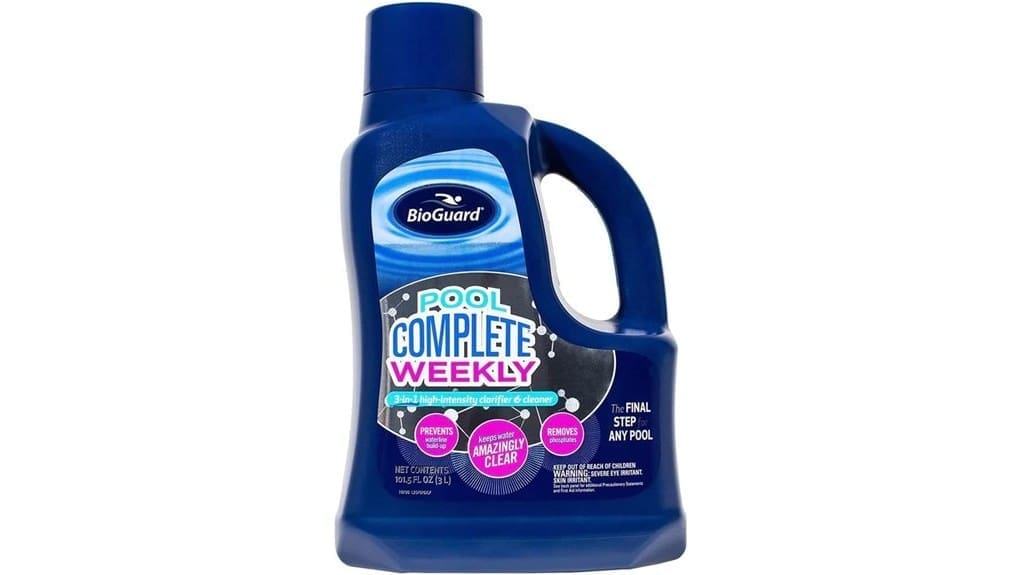
You’ll find BioGuard Pool Complete Weekly 3L is a concentrated, low‑effort 3‑in‑1 treatment that combines enzymes, a clarifier, and phosphate control to improve clarity and cut organic buildup with one capful per week. You’ll dose it into the skimmer or return, run the pump 6–8 hours, and expect flocculation and clearer water within days while enzymes reduce waterline scum and organic reattachment. Keep going to see detailed usage, limits, and buying notes.
Some Key Takeaways
- 3-in-1 concentrated formula (clarifier, enzyme pack, phosphate remover) simplifies weekly pool maintenance with one capful per week.
- Enzymes and polymers reduce organics, waterline scum, and turn submicron particles into filterable flocs within days.
- Recommended for residential pools up to ~25,000 L; not ideal for large or commercial systems.
- Works best when pump runs 6–8 hours after dosing and is compatible with mineral systems, though some oxidizers can reduce efficacy.
- 3L bottle offers mid-range pricing and potential lifecycle savings versus buying separate products.
Quick Verdict: Is BioGuard Pool Complete Weekly 3L Worth Buying?
If you want a low-effort, technical solution for weekly pool maintenance, BioGuard Pool Complete Weekly 3L delivers: its 3-in-1 formula (clarifier, enzyme pack, phosphate remover) works continuously to sharpen clarity, cut organic load, and limit waterline buildup with a single capful per week. You’ll get measurable clarity gains and reduced maintenance labor; dosing is simple and predictable. Evaluate long term cost against standalone products—this consolidates three functions, reducing purchase complexity and likely lowering cumulative spend. Consider environmental impact: concentrated dosing lowers chemical volume dispensed, but verify biodegradability and local disposal rules before routine use. This product is especially convenient for homeowners who enjoy their outdoor spaces and want straightforward pool care with minimal shopping for separate treatments, so consider how it fits into your weekly maintenance routine.
How the 3‑in‑1 Formula Works: Enzymes, Clarifier, and Phosphate Removal
Because the three active components target different stages of contamination, BioGuard Pool Complete Weekly delivers complementary actions: enzymes digest organic films and oils that foul filters and create scum, clarifiers coagulate submicron particles into filterable aggregates, and the phosphate remover chemically sequesters or precipitates dissolved phosphates so your filter and sanitizer can control nutrient-driven algae growth. You’ll see enzyme mechanisms reducing surfactants and lipids into smaller, soluble molecules that won’t reattach to surfaces. Clarifier polymers bridge nanoscale colloids into micron-scale flocs for mechanical capture. Phosphate dynamics shift dissolved orthophosphate into bound forms or insoluble precipitates, lowering nutrient availability for algal proliferation. This product is a convenient option for homeowners looking to enhance their outdoor pool maintenance with mineral system–friendly chemistry and simplified dosing.
Weekly Use and Real‑World Performance: Dosing, Clarity Results, and Waterline Control
Stick to one capful per week and Pool Complete Weekly works quietly in the background, dosing enzymes, clarifier polymers, and phosphate sequestrants to maintain filterable particulates, break down organic films, and lower dissolved phosphate levels that fuel algae. You’ll follow weekly maintenance routines: measure capful into skimmer or return, run pump six to eight hours, and monitor residual clarity. In real-world use you’ll see measurable visual improvement within days as fine particulates agglomerate and phosphate load decreases. Waterline residue is inhibited over successive doses; enzymes reduce organic scum. Maintain consistent dosing for reliable clarity and reduced algae risk. Designed for homeowners who enjoy their outdoor spaces, it complements regular shock treatments to keep pools sparkling with minimal fuss and consistent weekly care, making it an ideal part of a pool maintenance routine.
Who Should (and Shouldn’t) Choose This 3L Bottle: Pool Size, Problems, and Compatibility
Having established how weekly dosing preserves clarity and controls waterline buildup, next consider whether the 3L bottle suits your pool’s size, typical problems, and chemical regimen. You should choose this 3L when your pool falls within suitable capacities—typically small residential tanks up to ~25,000 L—where one capful weekly delivers consistent enzyme, clarifier, and phosphate dosing. Opt for it if you face persistent waterline scum, high phosphate loads, or want background filtration support. Don’t pick it for very large pools, commercial systems, or if your current sanitizer program lacks chemical compatibility; incompatible oxidizers or shock schedules can reduce efficacy. Many homeowners pair flocculants with weekly maintenance to keep clearer pool water and enjoy their outdoor spaces.
Price, Availability, and Warranty: Where to Buy and How It Compares to Alternatives
If you shop online or at pool specialty retailers, you’ll usually find the BioGuard Pool Complete Weekly 3L priced competitively with mid-range enzyme/clarifier combos, and availability tends to be good through major e-commerce platforms, local pool stores, and BioGuard dealers. You’ll evaluate pricing options by comparing unit cost per liter and promotional bundles. Use retailer comparisons to check authenticity, shipping costs, and delivery windows. Verify return policies and manufacturer warranty coverage before purchase; third-party sellers may limit returns. Compared to DIY enzyme blends and single-function clarifiers, BioGuard’s integrated formula often yields lower lifecycle cost and simplified maintenance. Many homeowners who enjoy their outdoor spaces also prioritize easy-to-maintain filtration and often choose products that reduce routine work, such as filter cartridges.
Some Questions Answered
Does It Affect Saltwater Chlorinator Performance?
No — it won’t markedly impact your saltwater chlorinator performance. The formulation is chlorinator compatibility-friendly and doesn’t introduce heavy metals or harsh minerals that accelerate electrode scaling. Enzymes, clarifiers, and phosphate removal work upstream, reducing organic load and phosphate-driven algae that can indirectly lessen electrode fouling. You’ll still monitor cell condition and maintain routine cleaning, but regular dosing shouldn’t increase electrode scaling or impair chlorinator output.
Is It Safe for Vinyl and Fiberglass Pool Surfaces?
Yes; you can use it on vinyl and fiberglass surfaces. You’ll preserve vinyl compatibility and surface integrity when you follow dosing and dilution instructions. The high‑intensity enzymes and clarifiers act chemically on organics and particulates, not on liner polymers or gelcoat, so routine weekly dosing won’t degrade materials. Avoid overdosing or concentrated contact with painted or unprotected finishes, and rinse spills promptly to maintain peak surface integrity.
Can It Be Used With Algaecides and Shock Treatments?
Yes — you can use it with algaecides and shock treatments. Compatible products should be added per label instructions; don’t mix chemicals directly. Observe treatment timing: add shock or algaecide, wait recommended circulation and stabilization time, then dose the weekly product. You’ll maintain filtration efficiency and phosphate control without interference if you stagger applications and follow manufacturer compatibility and safety guidelines.
Does It Have Any Fragrance or Strong Chemical Odor?
You shouldn’t notice a strong fragrance; the product has a minimal scent profile focused on functional chemistry rather than perfuming. You’ll detect a faint chemical odor briefly during dosing, but odor longevity is short as the enzymes and clarifiers dilute rapidly in pool water. You’ll still follow normal ventilation and dosing precautions. Overall, the formulation prioritizes efficacy over scent and won’t leave persistent or noticeable fragrance in routine use.
Is the Bottle Childproof or Leak‑Resistant for Storage?
No, the bottle doesn’t advertise a childproof cap, so you shouldn’t assume child-resistance; store it out of reach. The container is designed for leak prevention during normal handling, with a screw‑top and sturdy plastic to minimize drips, but it’s not claimed as fully leak‑proof under pressure or if tipped repeatedly. For safe storage, you should keep it upright, secure the screw cap tightly, and place it in a locked cabinet away from children.