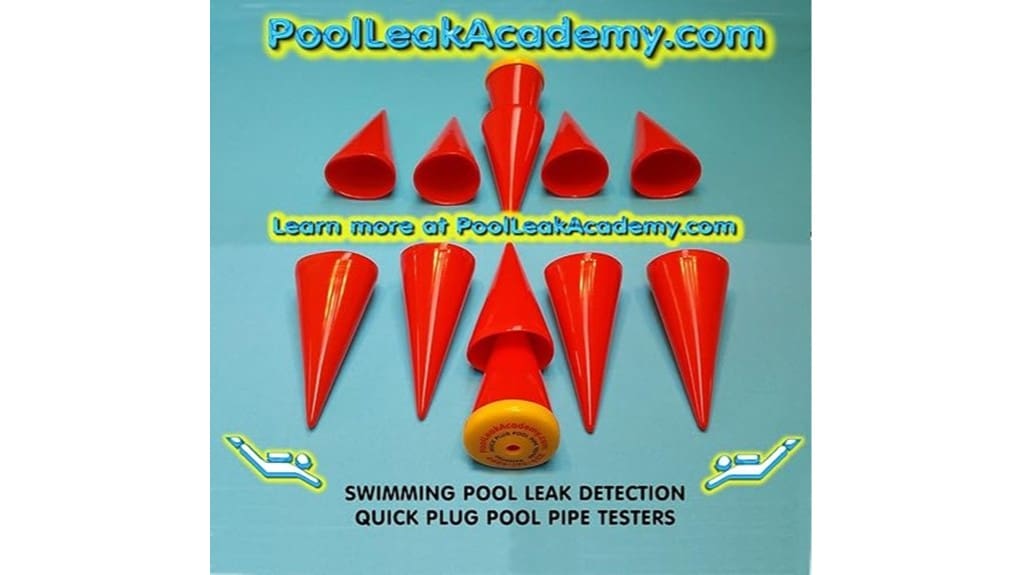
You’ll like Quick Plugs if you need a fast, repeatable way to isolate returns for dye tests: six stackable cones convert multiple jets into a single 9 mm test hole, fit sockets up to 2″, and seat quickly for focused leak diagnosis. They’re great for confirming pipe fractures or socket leaks with minimal setup, but they can fail on large openings, degraded cones, or strong convection. Keep spares and proper technique—keep going to see full use, limits, and alternatives.
Some Key Takeaways
- Quick Plugs are a six-piece stackable cone set that reduce multiple return openings to a single 9 mm test hole for controlled dye tests.
- They fit sockets up to 2″, stack or trim for proper depth, and seat quickly to concentrate flow toward suspected leaks.
- Best used with pump off for dye pull-in tests; restart briefly to verify seal and manage surface water during observation.
- Limitations include large openings, strong convection, temperature effects, and degraded cones causing false or misleading results.
- Good low-cost DIY tool for isolating return leaks, but not universal—budget for spares, alternatives, or professional diagnostics when needed.
What the Quick Plugs Are and Why Pool Pros Use Them
Think of Quick Plugs as small, stackable cone plugs that let you shrink multiple jet openings down to a single 9 mm test hole so you can run a controlled dye test. You’ll use the six-piece set to temporarily cap multiple returns, concentrating flow so dye moves predictably toward suspected leaks. Pool pros rely on these for consistent testing techniques that reduce false readings from convection and wind. They fit up to 2″ sockets, stack neatly, and integrate into pros workflows and field methods, letting you isolate lines quickly and perform repeatable, practical dye tests with minimal setup time. These tools help homeowners keep skimmers and other pool fittings operating smoothly by making maintenance and leak detection more efficient and reliable, especially for routine skimmer maintenance.
Which Pool Plumbing Problems These 9 Mm Dye Testing Cones Solve
With the Quick Plugs already helping you reduce multiple returns to a single 9 mm test hole, you can target specific plumbing faults more reliably: leaking return lines, cracked fittings, broken bonded pipes, and compromised bottom drains often show predictable dye movement when flow is concentrated. You’ll use them to isolate return leaks and confirm pipe fractures where dye is drawn into a breach with the pump off. They clarify whether seepage originates at joints, sockets, or deeper underground runs. While not a universal fix, Quick Plugs simplify diagnostics for up to 2″ sockets, speeding accurate leak identification. They’re an ideal tool for homeowners maintaining outdoor pool plumbing and enjoying their property’s outdoor spaces.
How to Use Quick Plugs Step-by-Step for Accurate Dye Testing
Before you begin, gather the pool pump key tools and inspect each return: Quick Plugs fit sockets up to 2″, so select the correct cone, clean the socket lip, and stack or trim cones if needed to get a snug temporary seal; this preparation cuts testing time and reduces false positives from poor seals. Prepare equipment: shut pump off, note flow direction, and clear debris. For plug insertion, compress the cone and seat it firmly in the return or drain socket so only the 9 mm test hole remains exposed. Restart pump briefly to verify seal, then perform dye testing with steady observation. Keep your pool area dry by using cover pumps and proper drain management to prevent equipment damage and slipping hazards, and consider a cover pump when water accumulates.
Real-World Performance: Limits, Common Failures, and How to Avoid Them
Although Quick Plugs simplify dye testing, they have real-world limits you need to know to avoid false readings and wasted time. You’ll see failures when returns, large openings, or strong convection mask dye flow; use the 9 mm hole and isolate lines as much as possible. Temperature effects alter water density and dye behavior—test when pool and ambient temperatures are stable. Inspect cones for cracks, UV wear, or material degradation before each use; a compromised seal gives misleading results. Keep spares from the set of 6, seat plugs firmly, and rerun tests if conditions or seals change to confirm findings. For routine pool maintenance, consider integrating automatic pool vacuums into your schedule to keep water clarity and make visual leak checks easier.
Should You Buy THE Pool Leak Academy Quick Plugs? Fit, Value, and Alternatives
Given the limits and wear points covered above, here’s how to decide if THE Pool Leak Academy Quick Plugs make sense for you. You’ll get six compact cones that fit up to 2″ sockets, simplify multiple jets to a single 9 mm test hole, and help counter convection during dye tests. For occasional DIY diagnostics they’re a low-effort buy; check cost comparison against generic rubber plugs and pricey commercial kits. Read user reviews for real-world notes on fit, repeated-use wear, and performance in returns or complex systems. If you need guaranteed solutions for all layouts, budget for professional diagnostics or alternative sealing methods. Consider also the common homeowner need for pool assembly hardware when planning additional tools or replacements.
Some Questions Answered
Can Quick Plugs Damage PVC or Older Pipe Materials?
Yes — quick plugs can damage PVC or older pipe materials if misused. You’ll need to check material compatibility and avoid over-tightening or forcing cones into brittle sockets. Short-term testing is usually safe, but repeated use or excessive pressure can cause cracks, stress fractures, or accelerate long term degradation in aged plastics. Inspect fittings before and after, use gentle insertion, and avoid plugs on visibly deteriorated or flexible pipes.
Are These Cones Reusable After Chemical Exposure?
Yes — you can usually reuse them after chemical exposure, but inspect them first. Check for chemical resistance against pool sanitizers (chlorine, bromine) and acids; look for cracking, swelling, or hardening. Follow reuse protocols: rinse thoroughly with fresh water, neutralize residues if needed, dry completely, and test fit before relying on them. If material shows degradation or loss of sealing ability, discard and replace to avoid false test results.
Do They Work in Saltwater or Chlorinated Pools?
Yes — they work in saltwater and chlorinated pools. You’ll get Saltwater compatibility and Chlorine resistance for short-term dye testing; the Quick Plugs’ material tolerates typical pool chemistry during inspections. Rinse and dry after use to reduce chemical exposure and prolong life. Avoid leaving them installed long-term in highly concentrated solutions. They’re best for temporary tests; extreme conditions or prolonged exposure can still degrade the plugs over time.
What Size Adapters Are Compatible Besides 2 Sockets?
Besides 2″ sockets, you’re primarily limited to fittings that accept the 9 mm test hole format; adapter sizes depend on local plumbing adapters and cuff fittings. For socket compatibility, you’ll typically use reducers or slip adapters to convert smaller PVC or spa pipe diameters (1½”, 1¼”) into a 2″ socket fit. You’ll need appropriately sized rubber or PVC adapters and hose couplings to guarantee a snug, leak-free temporary seal for dye testing.
Are Replacement Cones Sold Individually or Only in Sets?
They’re sold only in sets; you won’t find replacement cones individually listed. Replacement availability is limited to the set of six Quick Plugs, so individual pricing isn’t offered by the manufacturer. If you need single cones, you’ll have to buy a full set or check third-party sellers who might resell single units. Contact THE Pool Leak Academy or retailers to confirm stock or possible aftermarket individual options.