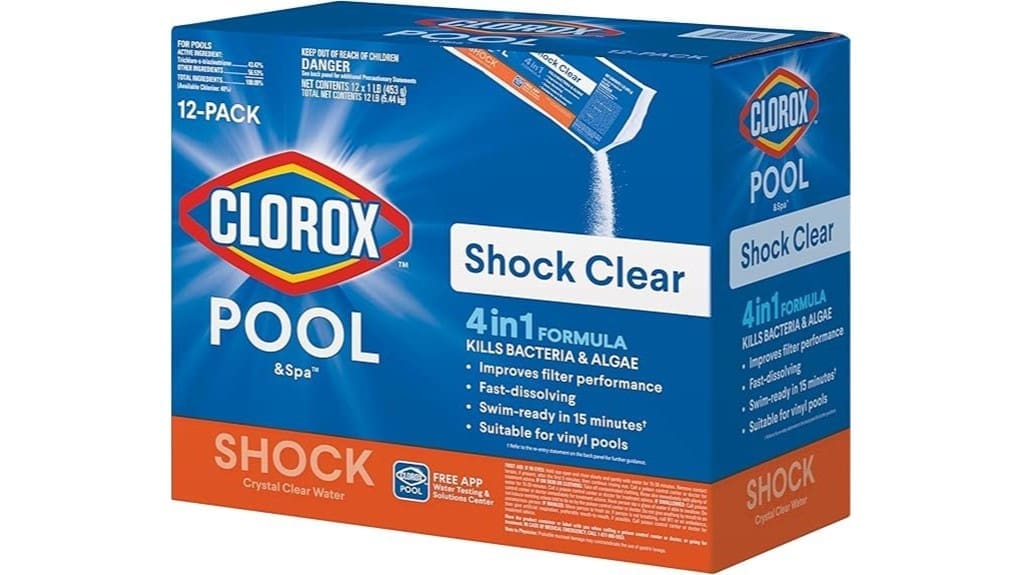
You’ll get fast, reliable shock treatment with Clorox® Pool&Spa™ Shock Clear: a 4‑in‑1 granular formula that oxidizes organics, reduces bacteria, fragments particles for improved filtering, and leaves water swim‑ready in about 15 minutes when levels are correct. Dose 1 lb per 12,000 gallons, broadcast with the pump or pre‑dissolve for small pools, and avoid concentrated contact with liners. It minimizes stabilizer buildup versus dichlor—keep reading for detailed comparisons, dosing tips, and troubleshooting.
Some Key Takeaways
- Fast-acting 4-in-1 granular shock oxidizes contaminants and makes water swim-ready in about 15 minutes when levels are correct.
- Dose 1 lb per 12,000 gallons, broadcast with pump running or pre-dissolve for small pools for predictable results.
- Effective bactericidal action and particle fragmentation improve clarity and reduce strain on filters.
- Safer long-term than dichlor for CYA buildup; non-chlorine oxidation minimizes stabilizer accumulation.
- Weekly shock after heavy use or rain, with protective gear and re-test after 4–8 hours for follow-up dosing.
Quick Verdict: Is Clorox® Pool&Spa™ Shock Clear Worth Buying?
In short, Clorox® Pool&Spa™ Shock Clear delivers fast, reliable results: its 4-in-1 granular formula kills bacteria and algae, clears cloudy water, destroys contaminants, and boosts filter performance, with swim-ready water in about 15 minutes. You’ll find it worth buying if you prioritize rapid action, broad surface compatibility, and predictable dosing (1 lb per 12,000 gallons). Assess cost via a price comparison against bulk shock products; per-ounce pricing and 12-pack availability often justify the premium for convenience. Packaging durability is solid for retail handling, though store-to-home protection benefits from secondary containment during transport. For homeowners who enjoy outdoor spaces, proper shock treatment tips help maintain sparkling pool water and extend equipment life.
How the 4‑in‑1 Formula Performs: Clarity, Bacteria Kill, Contaminant Removal, and Filter Help
When you need fast, measurable improvement in water quality, the 4‑in‑1 Shock Clear formula delivers: its oxidizing granules quickly break down organic contaminants, oxidize nitrogenous wastes that cause cloudiness, and provide a strong bactericidal effect while helping the filter collect finer particulates. You’ll see clarity benchmarks met faster than with basic oxidizers: turbidity drops and visual clarity returns within the swim‑ready window. Lab‑grade oxidants drive contaminant breakdown and measurable bacterial reduction, reducing colony counts on contact. Simultaneously, particle fragmentation improves filter efficiency, so your circulation system traps smaller debris and maintains stable water quality between treatments. This makes it an excellent complement to regular use of filter powder to maintain long-term clarity and reduce strain on your filtration system.
How to Use Shock Clear Safely and Effectively (Dosing, Surfaces, and Timing)
For safe, effective use of Shock Clear, follow precise dosing, surface compatibility, and timing guidelines to avoid damage and get swim‑ready water quickly. You’ll dose 1 lb per 12,000 gallons; broadcast granules evenly with pump running, or pre-dissolve for small pools. It’s safe on vinyl, plaster, fiberglass, and tile—avoid concentrated contact with liners. Shock weekly and after heavy use, heat spikes, or rain; swim-ready in about 15 minutes when levels are correct. Wear protective gear, store per chemical storage guidance, and keep containers sealed. Observe pool safety and child precautions: restrict access until levels normalize. Many homeowners rely on trusted retailers for the right opening supplies, including pool opening chemicals and related products.
How It Compares to Other Pool Shock Options (Bleach, Dichlor, Potassium Peroxymonosulfate)
Although each shock type can clear contaminants, you’ll choose based on speed, stabilizer impact, and byproduct profile: Clorox Pool&Spa Shock Clear (potassium monopersulfate–based) dissolves fast, makes water swim-ready in about 15 minutes, and improves filter performance without adding chlorine stabilizer; household bleach (sodium hypochlorite) is inexpensive and raises free chlorine quickly but lacks brevity in stabilization and can alter pH; dichlor (sodium dichloro-s-triazinetrione) supplies combined chlorine and cyanuric acid, making it useful for routine chlorination but unsuitable if you want to avoid CYA buildup; and pure potassium peroxymonosulfate (non-chlorine shock) oxidizes organics without leaving residual chlorine, giving rapid clearing with minimal chlorine rise.
You’ll weigh chlorine alternatives by response time, residuals, handling, and environmental impact; Shock Clear balances speed and minimal stabilizer addition, reducing CYA accumulation while limiting long-term chlorine loading.
Natural enzyme products can also complement shocks by breaking down organic matter and helping maintain overall pool health, particularly for homeowners who enjoy their outdoor spaces and prefer natural pool care.
Common Problems and Fixes: Cloudiness, Algae, and When to Re‑Test or Re‑Shock
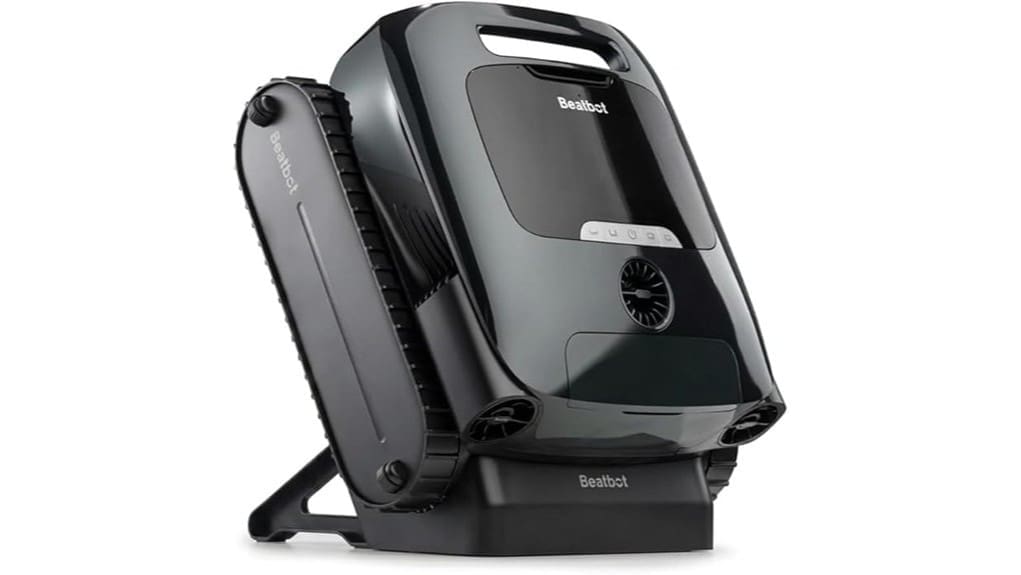
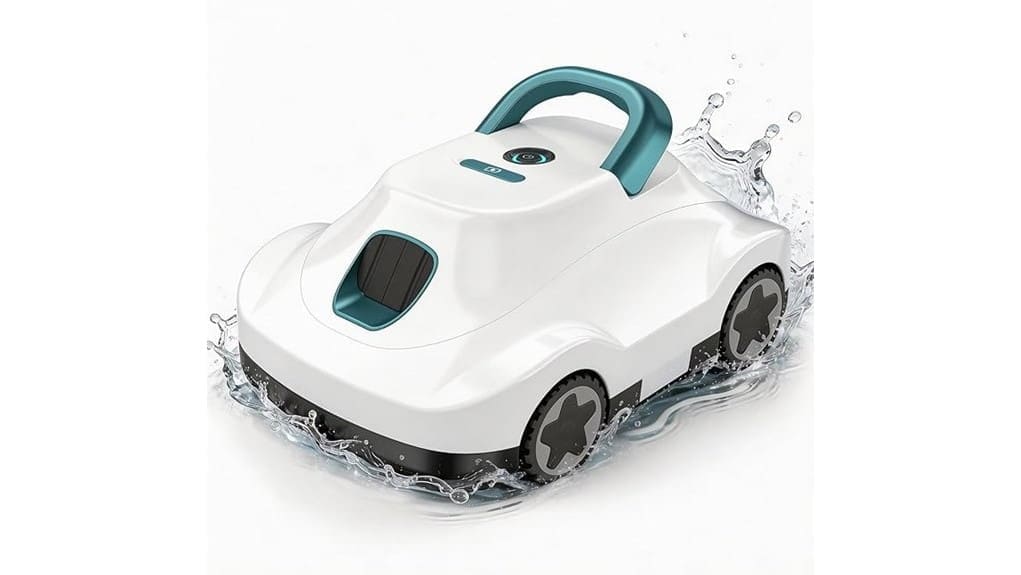
If your pool turns cloudy or shows algae growth, act quickly to diagnose cause and apply targeted treatment to avoid larger water-quality issues. First, perform thorough pool testing to check free chlorine, combined chlorine, pH, stabilizer, and alkalinity. Cloudiness often signals filtration, circulation, or water balance issues; backwash/clean filter and adjust pH/alkalinity. For visible algae, brush surfaces, vacuum, then apply Clorox® Pool&Spa™ Shock Clear per dosage; fast-dissolving formula kills algae and bacteria and clears water. Re-test after 4–8 hours; re-shock if free chlorine remains below recommended levels or combined chlorine is elevated. Consider pairing shock treatment with automatic pool vacuums to maintain clean water and reduce manual maintenance.
Some Questions Answered
Is Shock Clear Safe for Hot Tubs or Spas?
Yes — you can use Shock Clear in spas and hot tubs with caution. You’ll follow lower dosing, avoid adding while people are present, and guarantee complete dissolution before reuse to protect surfaces and equipment. For hot tubcompatibility, verify sanitizer and pH levels first; adjust per spamaintenance routines and manufacturer guidance. Use the Clorox Pool app or customer support for precise, volume-based dosing and to prevent corrosion or irritation.
Can Shock Clear Be Used With Saltwater Chlorinators?
Yes — you can use Shock Clear with saltwater chlorinators, but monitor salt cell compatibility and charging cycles. You’ll dose per label (1 lb per 12,000 gallons), avoid adding directly to the cell, and run the pump to disperse granules. Frequent shock may accelerate electrode scaling; inspect and clean cells per manufacturer guidance. Use the Clorox Pool App or your chlorinator manual to adjust maintenance intervals and charging cycles accordingly.
Does It Affect Pool pH Long-Term?
No, it won’t dramatically change pool pH long-term if you follow dosing and maintenance. You’ll see short-term pH dips or rises after application, but proper monitoring of pool alkalinity and buffer capacity prevents lasting shifts. You should test and adjust alkalinity first, then shock per instructions. Regular shocking, balanced alkalinity, and using the Clorox Pool App for dosage recommendations keep your buffer capacity stable and pH within target ranges over time.
How Should I Store Leftover Granules Safely?
Store airtight, cool, and dry to preserve potency and prevent moisture-triggered reactions. Keep leftover granules in their original sealed container or a compatible HDPE container with a tight-fitting lid; label it clearly. Keep away from children and pets; store on a high shelf or locked cabinet. Avoid heat sources, direct sunlight, and incompatible chemicals (acids, organics). Use appropriate PPE when handling and dispose of per local hazardous-waste guidelines.
Are There Pet or Wildlife Risks After Application?
Yes — you should prevent pet exposure and avoid wildlife impact after application. Keep pets and animals away until chlorine levels return to safe swim-ready levels (typically about 15 minutes for this fast-dissolving formulation, but verify with a test). Rinse any pet that contacted treated water and secure leftover granules in a sealed container. Use the Clorox Pool App or test kit to confirm safe levels before allowing animals near the pool.