You’ll get high‑strength (≈90% available chlorine) trichloro tablets in a slow‑dissolving, UV‑stabilized matrix that controls release and limits volatile loss. Individually wrapped 3‑inch tablets are dust‑reduced for safer handling and work predictably in properly sized skimmers, floaters, or feeders, though they lower pH and aren’t ideal for very small pools or frequent shocking. Store sealed buckets away from acids and organics, use PPE, and monitor combined chlorine; keep going to see detailed handling and purchasing guidance.
Some Key Takeaways
- High-strength trichloro tablets (≈90% available chlorine) provide long-lasting, stabilized chlorination for inground and large above-ground pools.
- Slow-dissolving, UV-protected matrix yields consistent, predictable dissolution and steady free-chlorine residuals.
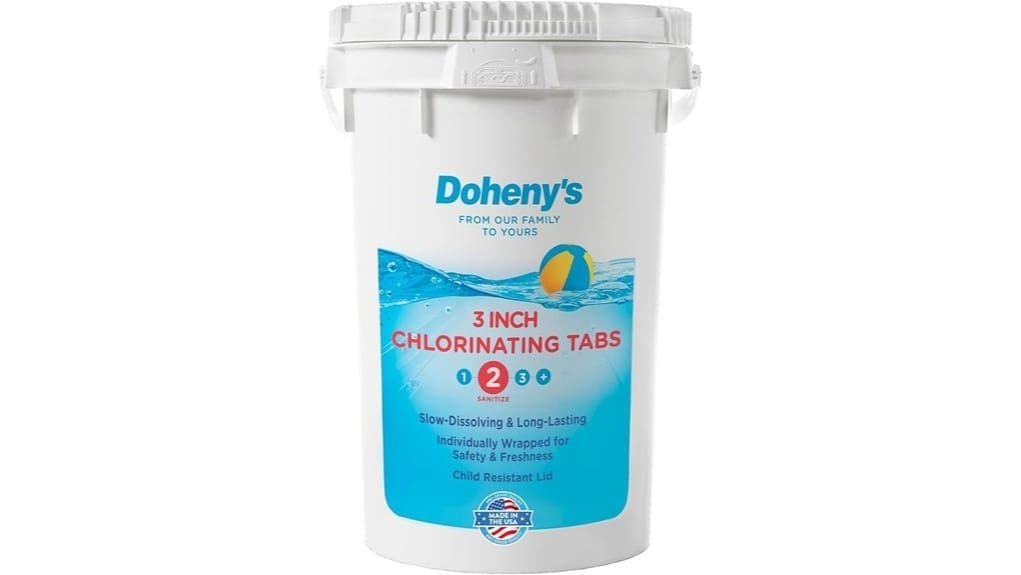
- Individually wrapped 3-inch tablets in a dust-reducing 50 lb bucket minimize handling exposure and simplify storage.
- Low per-tablet cost for bulk 50 lb buckets (≈800 tablets) makes them economical for commercial or high-use pools.
- Downsides: lowers pool pH, adds stabilizer (isocyanuric acid), and is less suitable for small pools or frequent shock cycles.
What Doheny’s 3-Inch Chlorine Tablets Contain and How They Work
Contain trichloro-s-triazinetrione (99% pure) as the active ingredient, Doheny’s 3-inch stabilized tablets deliver roughly 90% available chlorine in a slow-dissolving, UV‑protected matrix. You’ll rely on precise tablet composition—binders, fillers, and stabilizer chemistry—to control dissolution and protect isocyanuric acid levels that shield chlorine from photodegradation. Each tablet’s stabilized formulation reduces volatile chlorine loss while providing consistent free chlorine release for sanitation. You’ll deploy tablets via skimmer, floater, or feeder; the individually wrapped, dust-reducing packaging minimizes handling exposure. The technical profile emphasizes long-term dose stability and predictable residuals for routine pool chlorination. These tablets are marketed toward homeowners who enjoy maintaining their outdoor pool spaces and prefer convenient, reliable sanitation with stabilized chlorine.
Real-World Performance: Dissolution Rate, Stabilization, and Sanitation
When you test Doheny’s 3‑inch tablets in typical pool conditions, they deliver a consistently slow, predictable dissolution that sustains free‑chlorine residuals without large concentration spikes. You’ll observe low dissolution variability across temperature ranges and typical flow rates; tablets maintain structural integrity long enough for steady dosing. The stabilized trichloro formulation resists UV degradation, so you keep target chlorine residuals with fewer top‑ups. In skimmers, floaters, or feeders you’ll get uniform sanitant release when equipment is properly sized. Monitor combined chlorine and adjust feed rate based on measured residuals to prevent under‑ or over‑chlorination. These tablets are a convenient option for homeowners who want to keep their pool sparkling with predictable, low‑maintenance chlorination.
Safe Handling, Storage, and Recommended Application Methods
As part of routine pool maintenance, handle and store Doheny’s 3‑inch stabilized chlorine tablets with strict adherence to safety protocols to prevent accidental exposure, moisture ingress, and chemical reactions. You’ll store the sealed 50 lb bucket upright in a cool, dry, well‑ventilated area away from organics, acids, and combustible materials. Use gloves, goggles, and a respirator as required; label this as personal protective equipment in your protocol. For dosing, favor a calibrated feeder or floater over direct hand placement to minimize contact and dust. Maintain posted emergency procedures, including spill containment, eyewash access, and prompt decontamination steps. Consider storing chemicals in a purpose-built, lockable chemical storage container designed for outdoor use and ventilation.
Pros, Cons, and Who Should Choose These 3-Inch Tablets
If you need consistent, long‑lasting chlorination for an inground or large above‑ground pool, Doheny’s 3‑inch stabilized tablets deliver high available chlorine (90%) and slow dissolution to maintain sanitizer residuals with fewer feedings. Pros: high‑strength, UV‑stabilized chemistry reduces loss; slow release lowers dosing frequency; packaging minimizes dust and contact; compatible with skimmers, floaters, feeders. Cons: trichloro formulation lowers pH; requires careful handling and storage; not ideal for small pools or frequent shock cycles. Who should choose: pool owners managing sizable residential pools and commercial operators running pools or spas needing reliable, low‑maintenance chlorination. These tablets are a common choice for homeowners stocking essential pool opening chemicals and supplies, so consider adding them to your pool opening checklist.
Price, Packaging, and Where to Buy (Value Comparison)
Although price varies by retailer and bulk availability, Doheny’s 50 lb bucket (800 individually wrapped 3‑inch tablets) typically delivers one of the lowest per‑tablet and per‑pound costs in the stabilized chlorine category, making it a cost‑effective choice for large or regularly serviced pools. You’ll perform a price comparison across suppliers—manufacturer direct, Amazon (ASIN B0050K3624), and pool‑supply distributors—to quantify unit cost, shipping, and return terms. Buying options include single 50 lb buckets or multi‑bucket bulk purchases; look for vendor discounts, seasonal promotions, and fulfillment method differences. Packaging (childproof bucket, individual wraps) reduces handling loss and liability. Consider also how maintaining proper calcium hardness can protect pool surfaces and equipment when using stabilized chlorine products.
Some Questions Answered
Are These Tablets Safe for Vinyl and Fiberglass Pool Liners?
Yes — you can use them, but you’ll need to manage concentration and placement to protect liners. These stabilized 3-inch tablets are vinyl safe when dissolved appropriately; avoid direct prolonged tablet contact with vinyl or fiberglass surfaces to guarantee liner protection. Use a floater, feeder, or inline chlorinator to distribute chlorine evenly, monitor free chlorine and pH, and follow dosing guidelines to prevent bleaching, etching, or premature liner degradation.
Can I Use Them in Hot Tubs or Spas?
No — you shouldn’t use these 3-inch stabilized chlorine tablets in hot tubs or spas. Hot tub chemistry requires fast‑dissolving, lower‑stabilizer products and precise control; spa compatibility demands smaller doses and pump feeders or liquid chlorine/bromine. Large, slow‑dissolving trichloro tablets can over‑stabilize, raise cyanuric acid, and cause chloramine buildup and equipment issues. Use spa‑specific sanitizer and follow manufacturer dosing and test water frequently.
Do They Affect Pool pH or Require Alkalinity Adjustment?
Yes — you’ll see a slight pH decline and may need alkalinity adjustment. Trichloro tablets release acidic byproducts that lower pH while maintaining chlorine residuals; monitor free chlorine and pH daily. Stabilizer interaction preserves FC but doesn’t prevent acidification, so raise total alkalinity when pH drifts below 7.4. Use a feeder or floater to moderate dosing, and adjust alkalinity incrementally to stabilize pH without overshooting.
Are They Compatible With Saltwater/Chlorine Generator Systems?
No — they’re not recommended for saltwater systems; using stabilized trichlor tablets will cause saltwater compatibility issues and can lead to generator interference. You should avoid adding stabilized chlorine to pools with chlorine generators because cyanuric acid buildup reduces electrolysis efficiency and may foul cell plates. Instead, use unstabilized liquid chlorine or calcium hypochlorite per manufacturer guidance, monitor CYA and salt levels, and follow your generator’s maintenance schedule.
What Is the Expected Shelf Life Unopened and After Opening?
Unopened, you can expect about 3–5 years if storage temperature is cool and stable and packaging integrity is maintained. Once opened, expect 1–2 years of effective strength if you reseal the original bucket, minimize moisture exposure, and keep tablets dry. You’ll preserve potency best by storing at consistent moderate temperatures, away from heat or humidity. Compromised packaging integrity or temperature excursions will accelerate loss of available chlorine and effectiveness.